ВУЗ: Не указан
Категория: Не указан
Дисциплина: Не указана
Добавлен: 08.11.2023
Просмотров: 530
Скачиваний: 2
-
What is a treatment? -
How does a treatment relate to a patient’s diagnosis? -
What kinds of treatment do you know?
III. Read and translate the following word combinations paying attention to the word formation:
diagnosis - diagnostic - diagnostician, to treat – treated - treatment, to complicate – complicated – complication,severe course - severity, to prevent - preventive – prevention, to cure – the cure - curative, to manage – manager - management, dose – dosage, vein – venous– intravenous, to prescribe – prescribed -prescription, pharmacy – pharmacist, chemistry - biochemistry - chemical - chemist’s IV. Read and translate the following word combinations to design the specific combination of signs, symptoms, and test results, to compare and contrast several possible explanations, all complicationspossible and those found in the given patient, on the basis of number and severity of symptoms, tests to monitor the condition and the progress of the treatment, the management and care of a patient, to combat disease or disorder, to be based on the potential outcomes of treatment, indications and contraindications of each treatment approach, to sell both prescription drugs and a wide range of non-prescription medicines and other products, to be dispensed by a pharmacist without needing a doctor's prescription, to have labels in the form of colorful stickers, medication bottle or package, to have information about side effects and potential interactions.GrammarV. Read and translate the sentences into Russian paying your attention to the sequence of tenses:1. A clinician considered that there had been a number of diagnostic methods and techniques before. 2. The doctor knew what was wrong when the patient was entering the doctor’s office. 3. Dr. Patrick Smith informed his patient that taking the medications correctly would reduce the risk of complications. 4. The research performed in the United States showed that medication errors had happen too often being the cause of 1.3 million injuries each year. 5. One determined that diagnosis was the process of finding out the cause of a health problem. 6. The physician considered that diagnosis would be made on the basis of medical signs and patient-reported symptoms. 7. The professor reported that his team had used immunotherapy to treat allergies. 8. Long ago people knew that drugs could be dangerous. 9. He was not sure that appropriate information would be obtained from recommended textbooks and lecture notes. 10. He reported that a long-term medication treatment had required a central venous catheter. 11. The research showed that high fat intake had reduced the response of bronchodilators, which people with asthma used to treat symptoms of that condition. 12. Just because a drug interaction could occur it didn’t mean that it would occur in every instance.VI. Put the verbs in the brackets in the appropriate tense (follow the rule of Sequence of Tenses)1. The nurse practitioner noticed that the vein (be) severely damaged before the injection. 2. It was known that in the United States a pump infusion (be) the most common method used. 3. The patient was told that he (follow) this treatment to reduce side effects in future. 4. The surgeon said that clots (block) the important blood vessels long before the tissue damage could be seen. 5. My mother understood that this information (not tell) her everything she needed to know. 6. The registered nurse informed the patient that some medications (have) to be given by an intravenous injection next day. 7. The physician stated that she (be) at a very high risk of complications taking these drugs at one and the same time after surgery. 8. Everybody knew that vaccines (can) be injected, inhaled or swallowed. 9. There was an opinion that continuing treatment (not be) in the person's best interests.VII. Translate the sentences into English:1. Было известно, что многие препараты действуют гораздо быстрее при введении в кровоток. 2.Физиотерапевт говорил, что занятия физиотерапией восстановят те мышцы, которые было повреждены во время тяжёлых физических нагрузок. 3. Исследование показало, что половина случаев заболевания гриппом в США была обусловлена отсутствием профилактических мер. 4. Врач ответил, что стандартный катетер для внутривенного введения будет находится в вене в течение нескольких дней. 5. Было обнаружено, что подбор дозировки некоторых препаратов проводился методом проб и ошибок. 6. Он был уверен, что врач знает какие препараты принимает его мать.
ReadingVIII. Read and say if these facts are true or false
-
A term ‘diagnosis’ has derived through French from Greek. -
Diagnostic criteria indicate the specific combination of signs, symptoms, and test results. -
Etiology is the actual cause of disease. -
Pathogenesis is the symptom of disease. -
Prophylactic care is not a treatment. -
Antibiotics can be given through both intravenous and intramuscular injection. -
Community pharmacy sells both prescription drugs and a wide range of non-prescription medicines and other products such as cosmetics. -
Over-the-counter drugs are available in pharmacies and supermarkets without special restrictions. -
Inhaler is a form of injection. -
Warning label has information about drug side effects and potential interactions.
or drugstore in North America. In hospitals, prescriptions are dispensed by the pharmacy (the department where the drugs are prepared).
Drugs are classified in various ways. One of the key divisions is by level of control by governments, which distinguishes over-the-counter medications which are available in pharmacies and supermarkets without special restrictions; behind-the-counter medicines, which are dispensed by a pharmacist without needing a doctor's prescription, and prescription medicines which must be prescribed by a licensed medical professional, usually a physician.
Preparations can be as follows: liquid (also called a ‘mixture’, ‘solution’ or ‘syrup’), tablet, pill, capsule, topical medicine (cream, lotion or ointment in tubs, bottles or tubes), suppository, drops, inhaler, injection and other.
The patient should always read all drug labels and patient drug information received from the healthcare provider. The prescription may have warning labels in the form of colorful stickers located directly on medication bottle or package having information about side effects and potential interactions. 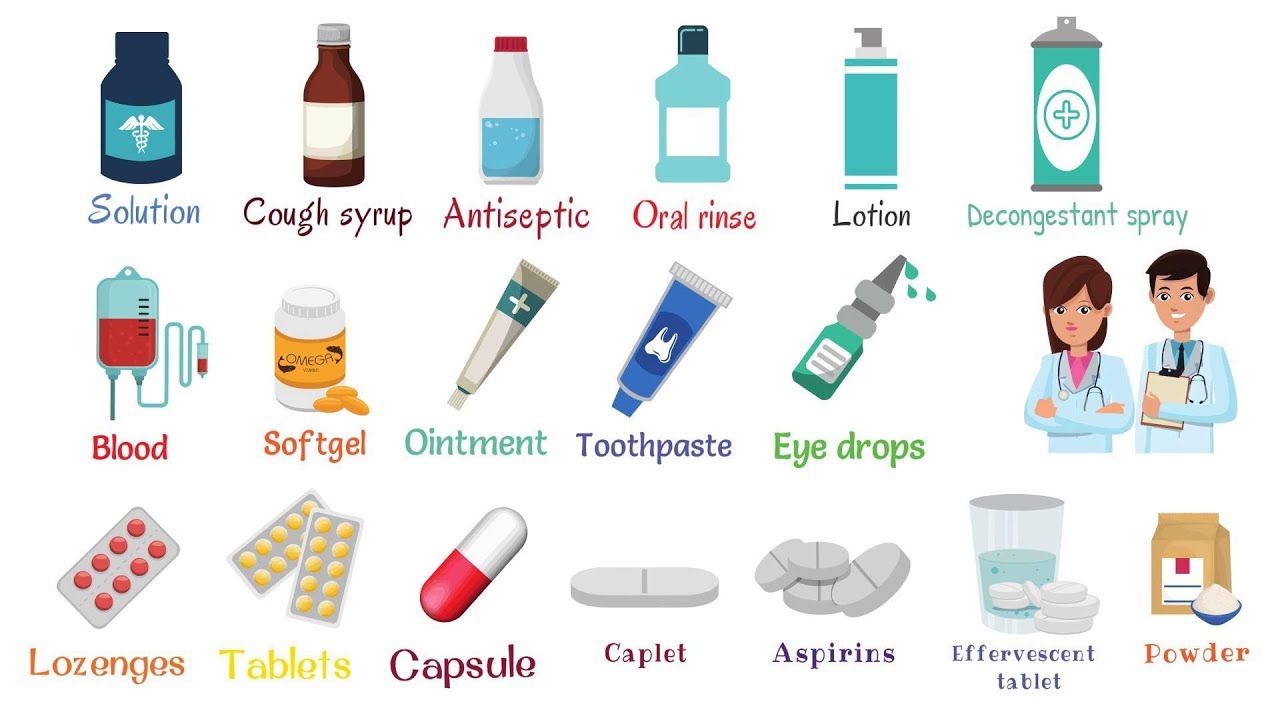
X. Choose the right variant:
Diagnosis & Treatment Quiz
1. Medical diagnosisis the process of
-
determining which etiology or pathogenesis explains a patient’s symptoms and signs. -
determining which disease or condition explains a patient’s symptoms and signs. -
determining which criteria or procedure explains a patient’s symptoms and signs.
-
the specific tools that the clinicians use to widen the diagnostic possibilities. -
the specific tools that the patients use to narrow the diagnostic possibilities. -
the specific tools that the clinicians use to narrow the diagnostic possibilities.
-
a person who diagnoses. -
a person who draws the patient’s blood. -
a person who refers the patient to the inpatient department.
-
the actual main symptom of disease. -
the actual progress of disease. -
the actual cause of disease.
-
the cause of disease. -
the mechanism of disease. -
the prognosis of disease.
-
the management and care of a patient to combat symptoms or signs. -
the management and care of a patient to combat a nurse or doctor. -
the management and care of a patient to combat disease or disorder.
-
the process by which a patient takes a medicine. -
the process by which a patient buys a medicine. -
the process by which a patient prescribes a medicine.
-
the outpatient department where the drugs are prepared. -
the inpatient department where the drugs are prepared. -
the inpatient department where the drugs are sold.
-
available only in pharmacies without special restrictions. -
available only in supermarkets without special restrictions. -
available in pharmacies and supermarkets without special restrictions.
-
dispensed by a doctor without needing a pharmacist 's prescription. -
dispensed by a doctor without needing a nurse's prescription. -
dispensed by a pharmacist without needing a doctor's prescription.
-
prescribed by a licensed medical professional. -
prescribed by a non-licensed medical professional. -
prescribed by a licensed medical administrator.
-
the information about major effects and potential interactions. -
the information about side effects and food interactions. -
the information about side effects and potential interactions.
XI. Make a word combination, match the words: diagnostic effectdifferential pharmacytreatment shoppalliative labelcommunity medicinechemist’s diagnosisover-the-counter planprescription caredrug criteriaside medicationXII. Match the terms (1-7) with the correct definition (a-g):1. progression 2. prognosis 3. complication 4. medication 5. prescription 6. drugstore 7. label
-
a secondary disease or condition aggravating an already existing one -
an instruction written by a medical practitioner that authorizes a patient to be issued with a medicine or treatment -
a small piece of paper attached to the bottle or package and giving the information about the medecine -
an opinion, based on medical experience, of the likely course of a medical condition -
a drug or another form of medicine that is used to treat or prevent disease -
a pharmacy that sells also toiletries and other articles -
the progress of developing gradually towards a more advanced state
-
Treatment plan\Medical diagnosis is a major component of a doctor's visit. -
The information required for diagnosis is typically collected from personal data\a history and physical examination of the patient. -
Diagnostic procedures\administrations are the specific tools that the clinicians use to narrow the diagnostic possibilities. -
A person who diagnoses is called a logician\diagnostician. -
Etiology and history taking\pathogenesis are closely related. -
A provider proposes a treatment plan after the differential\final diagnosis has been made. -
Prescribing the medications a doctor gives out a prescription\an administration. -
In hospitals, prescriptions are dispensed by the drugstore\pharmacy. -
The patient should always read all drug labels and patient drug information received from the healthcare provider\case manager. -
Prescription labels\Warning labels in the form of colorful stickers located directly on medication bottle or package have information about side effects and potential interactions.
-
How many months were spent to build the most technologically advanced hospital pharmacy? -
How much was spent to build the most technologically advanced hospital pharmacy? -
How do doctor’s orders come in? -
Why does the nurse scan the medication at the patient bed side?
XVI. Watch the Video ‘Medical treatment for refugee children in Canada’ and answer the questions:
https://www.youtube.com/watch?v=2nstPud1Ww4-
Where does the doctor consult her young patients and why? -
What symptoms do the children present? -
Who helps in communicating between the doctor and the young patients? -
Where has the pediatrician worked in challenging environment before? -
What may cause an infectious outbreak in the hotel?