ВУЗ: Не указан
Категория: Не указан
Дисциплина: Не указана
Добавлен: 08.04.2020
Просмотров: 705
Скачиваний: 3
Problem solving is the occupation which switches on the task generalizing the given section with detailed analysis of the decision and the multialternative task for the supervision of obtained skills. In the task with the detailed decision the step analysis of the task is carried out in an interactive mode. A student is given the possibility to fulfil each following step independently. It is the attempt unsuccessful the help material and right answer is gated out on the screen. Then the following step is made. The tasks contain 15-20 steps.
The multialternative task is for the supervision of skills of the decision. It allows to generate not less than 10 conditions of the one-type tasks for the individual decision on one educational situation. Each task contains one generalizing hint, which is gated out on the screen after the first unsuccessful attempt.
Being the means of the development of the programs of training installed a PC «Универсал» is not suitable for creation of software products providing the publication and performances in the Internet. That is an essential disadvantage, as the processes of integration of derivation as a whole and tutors in particular with Internet occur to all rising rates.
2.1.8 T h e p r o g r a m L i n k W a y i s a p o w e r m u l t i m e d i a h y p e r- t e x t s y s t e m. It has the advanced built - in «Script» language. The flexibility of the hypertext allows the teacher to personalize learning process, and also to make by its visual and interesting at moderate expenses for development of learning courses.
The fundamental components «Linkway»: objects, «Linkway» utility, graphics, textual, character editor ««Linkway» and «Script» language.
The disadvantage of the given tool sheath is standard of the interface for the majority of hypertext documents of a multimedia learning manual, received as a result of development, and rather high requirements to hardware.
2.1.9 P r o g r a m « У Р О К » i s U n I v e r s a l E d I t o r o f L e a r n i n g C o u r s e s a T o o l c o m p l e x. It is intended for creation of systems of computer-based learning. The system represents «УРОК» a program complex providing creation of computer learning and inspecting courses in various data domains, realization of the tests and check jobs. «УРОК» can also be used for creation of presentation, demonstration complexes and projects. The conducting version of the development support system «УРОК - 6.00». The version « УРОК - 6.00» is entered into operation in 2001. System is functionally divided into the following parts: a system of the Writer, System Trained, Editor of the Scripts, Editor of Dynamic Models, Graphics Editor. The program complex gives ample opportunities of connection of various dynamic modules and usages of modern multimedia tools. Thus for minimum time it is achieved enough high level of training of the students of educational institutions and centres. Besides the program complex allows to carry out the supervision behind training and effective handle of the educational process. There is a number of other functions and possibilities for wider usage of the given complex at development of new software products. With the help of the program complex «УРОК 6.00» the computer programs are made for realization of the doctrines with the usage of automated work stations and simulation analysis of various situations for a substantiation of acceptance of the correct decision are established at execution of the defined tasks. The fundamental advantage of a system «УРОК» before similar systems consists in the comprehensive approach to the decision of a problem of automation of training. The unity between two various processes - development of course and organization of training is provided in «УРОК» at a level of its structure. The important advantage of «УРОК» is its openness, flexibility and possibility of import various given, graphics and textual. In «УРОК» there is a possibility of connection and start-up of tutors created in other tool environments. There is a possibility of shaping of an integrated rating of knowledge in view of results obtained trained in programs, being external in relation to «УРОК».
Disadvantage of the system «УРОК» is the usage of the limited in-house operational lifers of the given editor, narrow directivity of a tutor and limitation of operation with trained by means of Internet - technologies.
2.1.10 S o f t w a r e p r o d u c t «H y p e r M e t h o d 3.5 » i s t h e d e s i g- n e r o f m u l t i m e d i a a p p l i c a t i o n s. It is aimed for fast and effective creation of information systems, presentation disks, electronic tutorials, quick references, of the encyclopaedias and any other multimedia of applications.
About thousand organizations from more than 20 cities of Russia, from close countries and other ones have already selected this packet for the operation. For today it is the unique domestic software product represented in the market of development tools by a multimedia of applications.
Further we shall consider components of a system «HyperMethod 3.5».
The development of a network of the Internet opens new perspectives of remote derivation, at which the possibilities peculiar to training are provided to the pupil and the tool packet «eLearning Office 3000» is intended, first of all, for the teachers of maximum and average educational institutions, and also for the technicians occupied with problems of remote training. It distinguishes the friendly interface and maximum automation of operations. «eLearning Office 3000» includes three program components: «eAuthor», «ePublisher», «eBoard». «eAuthor» is designer for creation of remote multimedia educational courses with the lectures and the terminological dictionary, with systems of testing and search. The program is a high level authoring means based on technologies «Web-CD». «ePublisher» is a designer of the electronic manuals. «eBoard» - component for support of the interactive lectures through the Internet. The program allows transmitting the map from the Internet - chamber, video-tape recorder, screen of the screen monitor and other devices capable to conduct transmission. «eLearning Office 3000» is not the first program development for organization of remote training.
The remote education becomes a unique real possibility to study in an individual mode, irrespective of a place and time, and to get education continuously and on an individual trajectory according to high principles of open education. The remote education is called to realize the rights of the man to continue education and obtaining of the information
The software product «HyperMethod 3.5» is an instrument for creation of complex multimedia products, which is so simple in handle, as far as it is effective in operation. The packet does not require special skills of programming and has the intuitively understandable Russian interface. Besides the packet allows working practically with any formats of files:
- ASCII formats - «HTML», «RTF», «TXT», «PDF»;
- Graphics formats - «GIF», «JPG», «BMP», «WMF», «EMF»;
- Voice formats - «WAV», «MIDI», «MP3»;
«HyperMethod 3.5» solves any tasks in development of multimedia applications:
- The operates with any information volumes, encyclopaedias and directories;
- Establishes structures of any complexity containing of tens thousand of hyperlinks;
- Allows establishing individual design, representation disks;
- Is easily integrated with data bases and about the Internet;
- Uses power retrieval mechanisms, quick references and archives.
The used metaphor of a text editor allows rather easily to master operation of a packet. Due to the built - in programming language it is possible to establish and feedback system - with check of knowledge of the user.
The given packet gives possibility for design of appearance of the developed program, nevertheless, for shaping a program code of the learning multimedia software package it is necessary to program using the built - in programming language, that requires additional intellectual expenses. The application of the in-house programming language as superimposes limiting on the developed software package.
2.2 Classification of the programming languages
At present there are thousand, if not tens and hundred thousand languages, dialects and their implementations. Moreover, new languages are daily born or dialects existing of the languages appear [2].
Almost any language is possible to examine as the improved version of any other language. It is sometimes very difficult draw a breakpoint link, where one language comes to an end and another starts. Take, for example, «LISP», which started as the separate language and has resulted in the total in the whole set of languages. Its dialects such as «Scheme» or «Common Lisp» have the large differences. Its variants such as «Kyoto Common Lisp» or «Allegro CL» and are identical, but can have some features, which make them incompatible.
The implementations are established for start-up on the concrete computer with a concrete operating system and can have additional properties. Some sequential invisible variations in implementation can result in small variations in the language.
Not always the name of the language can unambiguously identify it. Sometimes a language can undergo significant variations in the language without the change of the name. Sometimes only the name varies, and language remains same «IAL» in «ALGOL», and then in «ALGOL 58». And it happens, that one name is used for several different languages.
Usually it is difficult it happens to distinguish, that belongs to the characteristic of the language, and to its environment. For example, «SML» is described in some stages, at first the syntax of a nucleus, and then its expansions, that technically defines two various languages. The descriptions of some languages can omit such important features, as is the file inlet/lead-out as is not supposed use them without the standard library, in a case of C, for example, or without the environment of development as a whole, or because it makes the command language of any operating system or commercial product.

At the same time some languages are inherently extended as «Fort», and for them there is such plenty of such expansions as for «TeX», for example, that each such expansion is possible to consider as the separate language.
It often happens that a known manufacturer brings in expansions to the core language in the implementation, for example, «Turbo Pascal» or «Delphi» in implementations «of the Borland» corporation strongly differs from the out-of-date standard «ANSI». The same tendency it is especially visible in various implementations of «BASIC» or «Prolog». The implementations of «Basic» of one corporation can often strongly differ from each other, for example «Microsoft» has the following list of different from each other variants to a greater or lesser extent «Basic»: «Visual Basic», «Visual Basic for Applications», «Access Basic», «WordBasic», «TestBasic», «Basic PDS». Even the different implementations of such language as C can strongly differ from each other, so for example it is possible to consider «Turbo C» and «Microsoft C» as separate languages.
During the classification of languages we can select the following types of languages:
The
programming languages
The
description languages of documents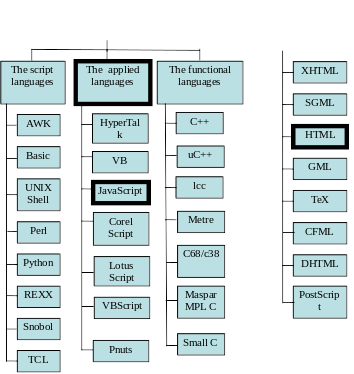
Figure 2 - Classification of the programming languages
2.2.1 S c r i p t l a n g u a g e s h a v e a r i s e n i n 1 9 6 0 s. Then there was an acute need for languages providing a program manager, differently speaking for, command languages of the tasks.
Belong to the commands, they are the Numerous command interpreters «CLI», so-called languages of batch processing and languages for construction of system command sheaths, vivid example - «sh», «csh» and their variations for «UNIX». As a rule, such languages are oriented not to interactive, and to the batch mode of processing, when the involvement of a man at the stage of execution is shown as zero and all works in continuous stream. These languages could not directly cooperate with an appropriate operating system, but also were supplied with a means of parsing of the programs and transformation of the data. With their help it was possible to establish various program filters used, in particular, in the pipeline of a system «UNIX». «Awk» is one of the known languages of such type for the first time appeared in «AT&T UNIX Version 7», and now is becoming a part of the standard «POSIX Command Language and Utilities». It is possible to attribute the mechanism of regular expressions, to key features of the language, which has found subsequently wide application in the environment universal script of languages, without which the analysis of the text is not so effective.
Languages of this class were oriented also to processing of system events, generating the text and high level access to data bases. Here it is necessary to mark the «RPG» language. This time it before is successfully applied to creation of the reports from corporate DB operating mainly on mainframes «RPG/400» for computers «IBM AS/400 «.
Today «Rexx» is used most actively from languages of this class, it is created in research laboratories «IBM». On a kit it differs a little, from universal script of languages, however it is fulfilled as the classical block-structured procedural language and is intended mainly for integration and expansion of a multifunction of applications.
2.2.2 A p p l i e d s c r i p t l a n g u a g e s a p p e a r e d i n 1 9 8 0 s, i n e p o c h o f a p p e a r a n c e o f i n d u s t r i a l P C s. Then there appeared a necessity of the tasks of interactive dialogue with an operating system, and also data access of spreadsheets and data bases. A distinctive feature of script languages of the given class is the orientation to a client part of the software.
The table 1 - Applied script languages
|
The name |
Year of appearance |
The developer of the language |
Organization, where the language was created |
|
HyperTalk |
1986 |
- |
Apple Computer |
|
Visual Basic |
1990 |
- |
Microsoft |
|
JavaScript |
1994 |
- |
Netscape Communications, Microsoft |
|
CorelScript |
1995 |
- |
Corel |
|
LotusScript |
1995 |
- |
Lotus Development |
|
VBScript |
1995 |
- |
Microsoft |
|
Pnuts |
2001 |
Toyokazu Tomatsu |
Sun Microsystems |
Usage of object model in languages of the given class becomes already a norm, instead of exception. They still cannot be named as full languages of object-oriented programming; however they appreciably try to use convenience of the object approach.
Among applied script languages there is a variety for office programming, as «VBA» mostly selects «Visual Basic», including. «Visual Basic» is that most «boundary» language, which concerns to script, than to traditional faster. It influenced in many respects such class of languages, as applied script languages. Moreover, operation with the user's interface and embedding of program components «VBX», «OCX», «ActiveX» of steel hardly probable not by a visiting card of the given language. It is necessary to note, that in a course of evolution «VBA» has swallowed other specific languages, in particular «Word Basic» and «Excel Macro Language», having undertaken their tasks. Under its influence such languages, as «VBScript», special dialect of the language Visual Basic, oriented on creation of OLE-components and on operation were created within the framework of browsers and «LotusScript», some kind of analog of languages «VBA» and «CorelScript», intended for problem solving of automation of office in frameworks «Lotus Notes».
«JavaScript» stands especially in this number, becoming the standard in Internet - programming at implementation of a client part. Its prototype was the «LiveScript» language, being a part of the server «LiveWire» product of the «Netscape» company and originally built - in «Netscape Navigator 2.0». After appearance of the «Java» language of corporation «Sun Microsystems» it began to play a role of a self-sufficient deckhouse above this language, and its name was replaced by «JavaScript». Dialects of this language is «Jscript» of corporation Microsoft and «ECMAScript».
«JavaScript» can be used at shaping of the program code of the tests input and outgoing control of the multimedia manual created on the basis of Internets - technologies.
We shall mention the experimental «Pnuts» language from the beginners in the given class of languages, which fundamental idea is to give of the scripts the most complete access to «Java API» within the framework. It can be used for the most different tasks, but, first of all for operation with the component software.
2.2.3 L a n g u a g e s o f s e c t o r i n g, o r t a g g e d l a n g u a g e s, s t a n d a l i t t l e a t s o m e d i s t a n c e f r o m a t r u n k l i n e o f d e v e l o p m e n t o f s c r i p t l a n g u a g e s. The systems of macro processing, every possible macroprocessors, so popular in 1960s 1970s are closest for them. Their main distinctive feature - embedding of a special code as isolated «commands» - tags is direct in the normal texts. Such languages, as «Postscript» and «RTF» which are more often perceived simply as the special format of representation of documents. The tags are to use for the most different purposes: for separation of structure of the information from its contents, for embedding commands of formatting and even for the job of dynamic behaviour of interactive objects, built - in in the document.
The table 2 - Languages of sectoring
|
The name |
Year of appearance |
The developer of the language |
Organization, where the language was created |
|
GML |
1969 |
Charles Goldfarb |
IBM |
|
TeX |
1979 |
Donald Knut |
Stanford University |
|
SGML |
1986 |
- |
ISO |
|
HTML |
1991 |
Tim Bernersly |
CERN |
|
CFML (Cold Fusion) |
1995 |
- |
Allaire |
|
DHTML |
1996 |
- |
Microsoft, Netscape Communications |
|
XML |
1997 |
- |
W3C |
|
XHTML |
2001 |
- |
W3C |
The idea of separation of structure of the information from the contents has arisen long ago. The first realized decision became start-up of the project «GenCode». In September, 1967 William Tannicliff, the chairman of Committee under the composite decisions of association «Graphic Communications Association», has offered to draw a precise border between the contents and format of representation of the information. The chief of «GCA» Norman Sharpf receives the decision to begin implementation of the appropriate project «GenCode».
Under the influence «GenCode» in 1969 the American scientist Charles Goldfarb has headed operation of research group in «IBM», which purpose was the study of principles of the integrated information systems in the field of the legislation. A fruit of efforts of this collective, where also Edward Mosher and Raymond Lorry entered, became «GML» - generalized language of sectoring. It is the power language of sectoring «ISO 8879». «Sgmls» is «SGML» the analyzer, descendant «ARCSGML» of the analyzer written Charles Goldfarb. Puts out idle time, easy, line, «ASCII» representation «SGML» of structure «Element Structure Information Set». Is used for applications with control structures as «SGML». «SGML» is an important step in a direction of junction to separation of the information from its representation. Many decisions of this group have found application in various publishing systems of «IBM». On the base of «GML» and ideas of the system «Scribe», developed by Brian Raid, the International organization of the standardization of «ISO» has developed a meta-language «SGML», standard «ISO-8879:1986».
The most significant achievements are in the field of languages of sectoring of steel «TeX», ««HTML» and ««XML». The language has anticipated «TeX», developed in 1979 by Donald Knout, for three years «Postscript», created John Wornok in «Adobe» company which is intended for the exact description of the external form of documents with composition of arbitrary complexity. Unlike the low level of «Postscript», the language orients to «TeX» on operation of the users not having skills of programming. To be applied this language began most widely in the scientific environment, where the highest requirements to quality of construction of the formulas of complex structure are needed.
The «HTML» language, with which appearance concept «hypertext» became simple and ordinary, was established on the base of «SGML» by maximum simplification of its structure and properties. There is no meaning to describe it in detail: it is the fundamental language of representation of the information in the Internet - environment. For this reason the given programming language can be applied for creation of the multimedia project, as it enables to publish the given project by means of the Internet.
The meta-language «XML», created mostly by John Bosak, the chief of a workgroup «SGML ERB», also was grounded on «SGML», but for him it is a characteristic of more careful ratio to ideas of the grandparents, and he absolutely fulfils an other role, rather than «HTML». It is some kind of the language of transportation and intermediate data storage at the exchange by them between the diverse and distributed systems. On its base it is possible to spend many complex conversions of documents and textual information, and the main, thing is to store the given relational-outlines, including tunings and programming of components. It is truly the truth, does not prevent to use it and not absolutely on designation - for the job speakers of behaviour of every possible objects. In 2001 the audit «HTML» has appeared which has received the name of «XHTML», where the requirements «XML» were taken into account.
«Postscript» as the implementation of «Ghostscript» is the available «Postscript» as the interpreter with the possibility of review for many systems and many fonts. It is used under operating systems: «Unix», «MS DOS».
«CFML» and «DHTML» are the languages of sectoring directly intended for dynamic creation of Internets - pages and access to a DB. They are both expansions of «HTML», but «CFML» is only a commercial language of the «Allaire» company, not having other implementation, and «DHTML», arisen from «Dynamic HTML», is the result of the numerous compromises and competition of «Netscape» and of «Microsoft», which were summed up by a consortium of «W3C». The same «ASP» is as a matter of fact, the script on «VBScript», which is done on a server.
2.2.4 N a t u r e o f s c r i p t l a n g u a g e s. What is the script of a language? Let's use some positions formulated «fathers - founders» of the given direction.
Dichotomy Usterhaut is the principle of classification of languages offered by John Usterhaut, a writer of the «Тсl» language. According to his approach the high level of languages is divided into languages of system programming and into script. The last, ones are, called also as languages, or poorly typed, or in general without typical. They have no means for representation of complex data structures and are normally interpreted. The scripts, as a rule, cooperate with other program, frequently as a pasting, or with a menu function given by the interpreter.
Larry Wall, the writer of the language «Perl», professes some other approach. As he said, script languages should form «free from ethics artistic conditions». «The Script, - is underlined by him, is that you transmit to the actor, and the program is that is transmitted to auditorium».
If to continue the thought of Wall, it is possible to make a simple analogy between creation of the Internets - programs, theatrical performance and shooting of a movie.
The script - performance. The script at theatre is «interpreted» by the actors. As a result the auditorium sees the performance.
The script - movie. In the cinema the script is «compiled» in a taking material, which a film editor composes in film. As a result the spectator audience sees a movie.
The script - program. The script in Web-programming automatically, by interpreting/compilations turns to the program. As a rule the user sees the result of operation of the program.
The analogy is close to such branch, as the industry of entertainments, first of all it concerns the games, multimedia applications and authoring programs. Script languages are always rather actively used in computer games and applications of a multimedia, in particular, it concerns languages «SCUMM», «INF», «COG». The truth, generally they remain closed, being know-how. For strategic games, action-games and even of simulators the scripts are practically irreplaceable, as they allow shifting questions of programming of the scenes, strategies and scenes on shoulders of the designers. The application of script languages, though also specific implementation in the field of computer games, where reliability, memory size and rate of execution of a code are extremely important, is the best certificate of their potential efficiency.
As Robert Hubner, marks the conducting programmer of the company «LucasArts Entertainment», the in-house script language allows to establish the separate environment around your service computer. It protects a virtual machine fulfilling complex and often a varying game code, from «real» computers controlling game service computer. As the system of the scripts is much more floppy, rather than collection of the fixed effects, your service computer can fulfil more interesting functions, which originally were not planned.