ВУЗ: Не указан
Категория: Не указан
Дисциплина: Не указана
Добавлен: 17.08.2020
Просмотров: 995
Скачиваний: 3
beach – пляж
sample – образец
to offer – предлагать
a cable car – вагон канатной дороги, фуникулёра
exciting – волнующий
shark – акула
diving – нырять с аквалангом
experience – опыт
cheap – дешевый
jewelry – ювелирные украшения
cage – клетка
incredible – невероятный
satellite television – спутниковое телевидение
internet connection – подключение к интернету
advice – совет
to compare – сравнивать
price – цена
II. Imagine some friends are coming to visit your town or city. They only have time to see three things. What three things should they see? Make a list.
III. Read the extract from a guide book for Cape Town.
Cape Town
Cape Town is one of South Africa's most beautiful cities. Cape Town is famous for its beaches, mountains and wine. There are lots of things to do and see during your visit. We have collected here a small sample of the best Cape Town has to offer.
1. The most exciting thing to do
Cape Town sits next to the beautiful Table Mountain. Table Mountain is 1,086 metres high and is the most famous mountain in South Africa. If you visit Cape Town, you must take a cable car up to the top of the mountain. (1) ___.You can also go walking around the top of the mountain.
2. The most frightening activity
The ocean near Cape Town is famous for sharks. On special adventure tours you can go diving with a great white shark (2) ___.This is an experience that you will never forget!
3. The best shopping
For many reasons the Victoria and Albert Waterfront is the best and most popular shopping centre in the city. You can find cheap jewellery, good books and quality clothes at the shopping centre. If you want African paintings and souvenirs, go shopping at the Green Point Market on Sundays. (3) ___. There are hundreds of little shops at the market, and some are cheaper than others.
4. The most expensive place to stay
The Cape Grace is a five-star hotel next to the sea in Cape Town. At Cape Grace you can go swimming in the pool, relax in the spa or read in the library. (4) ___. The hotel bar has more than 420 different kinds of whisky!
5. The most historical place
If you want to go sightseeing, you must go to Robben Island. Robben Island was one of South Africa's worst prisons during apartheid. (5) ___. Nelson Mandela, former president of South Africa, spent 27 years in prison on Robben Island.
6. The wildest night out
Cape Town is home to the biggest nightclub in South Africa, the Dockside. (6) ___. The giant building has a dance floor for 5,000 people.
IV. Put the sentences a-f back in the gaps 1-6 of the article.
a. A special cage protects you from the most dangerous animal in the world.
b. The 360° views are incredible.
с. It is now a national memorial and museum.
d. This is the best place to go dancing and have a good time.
e. The 122 rooms have beautiful furniture, satellite television, internet connection and lots of space,
f. Some advice: you should always compare prices before you buy.
V. Work in pairs. Imagine you have a free trip to Cape Town but you can only see three things. Which of the places would you like to visit most? Decide which three places are the best to go to.
VI. Match column A to column В to make sentences about things you can do in Cape Town.
А
1. You can go walking
2. You can go sightseeing
3. You can go diving
4. You can go dancing
5. You can go shopping for souvenirs
6. You can go swimming
B
a. at the Dockside nightclub.
b. on Robben Island.
с. at the Green Point Market on Sundays.
d. with sharks in Gansbaai.
e. at some of the beaches around Cape Town.
f. on the top of Table Mountain.
VII. Anny and Nick are visiting Cape Town. Complete the sentences and put the adjectives in brackets into the superlative form. Where are they in each conversation?
1. – What about this souvenir for my brother?
– I don't know. It's__souvenir in the shop! (expensive)
2. – Look at this place! I think it's the ___ club in town, (big)
– It's also very expensive, and I don't like dancing. Let's go to a different place.
3. – Why don't you want to go?
– Because it's_thing in the guide book! It's also ___. (crazy, dangerous)
4. – The guidebook says this is ___ part of Cape Town.
– Wow. You can see everything from up here, (high)
5. – Who is Nelson Mandela?
– He's ___ person in modern South African history! (important)
VIII. Make questions with the phrases below about your native city. Use the superlative form of the adjectives. Make two more questions of your own.
Pattern: What's the best place to go shopping for clothes?
1. good place to go shopping for clothes?
2. interesting monument?
3. dangerous part of the city?
4. nice park?
5. bad time of year to visit the city?
6. important festivals in the city?
Directions
I. Words and word-combinations to be remembered:
over - над
along – вдоль
across – через
up – вверх
down - вниз
into – внутрь
out of – из
round - вокруг
onto – на что-либо
through – сквозь
from ... to – из…в
bridge – мост
hedge – кустарник
straight – прямо
turning – поворот
crossroad – перекресток
traffic lights – светофор
|
We use prepositions of movement to show the direction in which somebody or something is moving. These include: over, along, across, up, down, into, out of, round, onto, through and from ... to... . Note: When we talk about a means of transport, we use the preposition by. e.g. by car / bus / train / taxi / plane / boat BUT: on foot |
II. Fill in the gaps with up, into, through, round, onto, from...to, over or down.
1. The dog is jumping ... the table.
2. The postman has just gone ... the corner
3. How far is it ... your house ... the post office?
4. The train is going ... the tunnel.
5. The plane is flying ... the village.
6. Look! That man has climbed ...the ladder.
7. Tears are running..............his face.
8. Come.............the house and get warm.
III. Look at the pictures and speak about Robert`s driving lesson. Put a preposition from the box into each gap.
|
along down into out of over past through under up |
Robert's driving lesson
Robert drove ___the garage, ___the road, and ___ the bridge.
Then he drove ___ the pub, ___ the hill, and ___the hill.
Next he drove ___the river, ___ the hedge, and ___the lake!
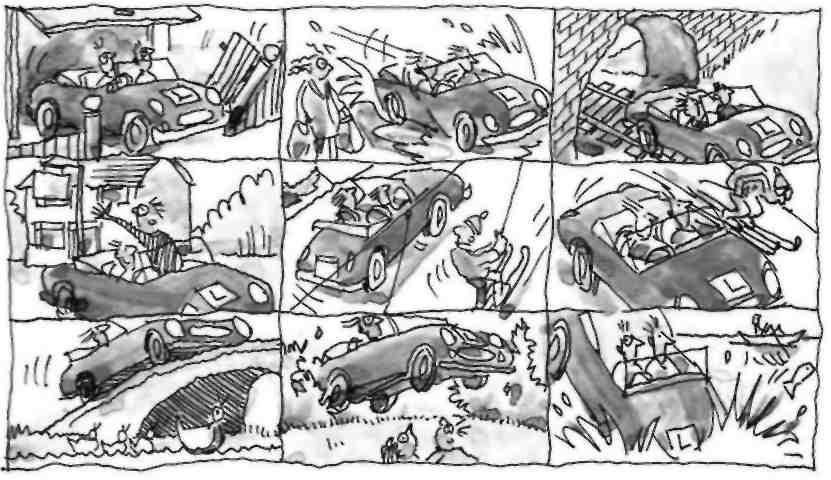
IV. Underline the correct word(s).
1. You must go up/across/into the bridge to get to school.
2. Put the cake into/out of/through the oven.
3. The motorbike is going down/onto/through the tunnel.
4. The children ran onto/out of/over the classrooms when the bell rang.
5. I go to school on/by/onto foot.
6. The pop singer is ready to sing. He is coming through/over/onto the stage.
7. The child is running through/over/across the road.
8. The cat has jumped down/onto/across the car.
9. You must always take off your shoes when you come into/ down/ round the house,
10. He goes to work by/on/into bus every day.
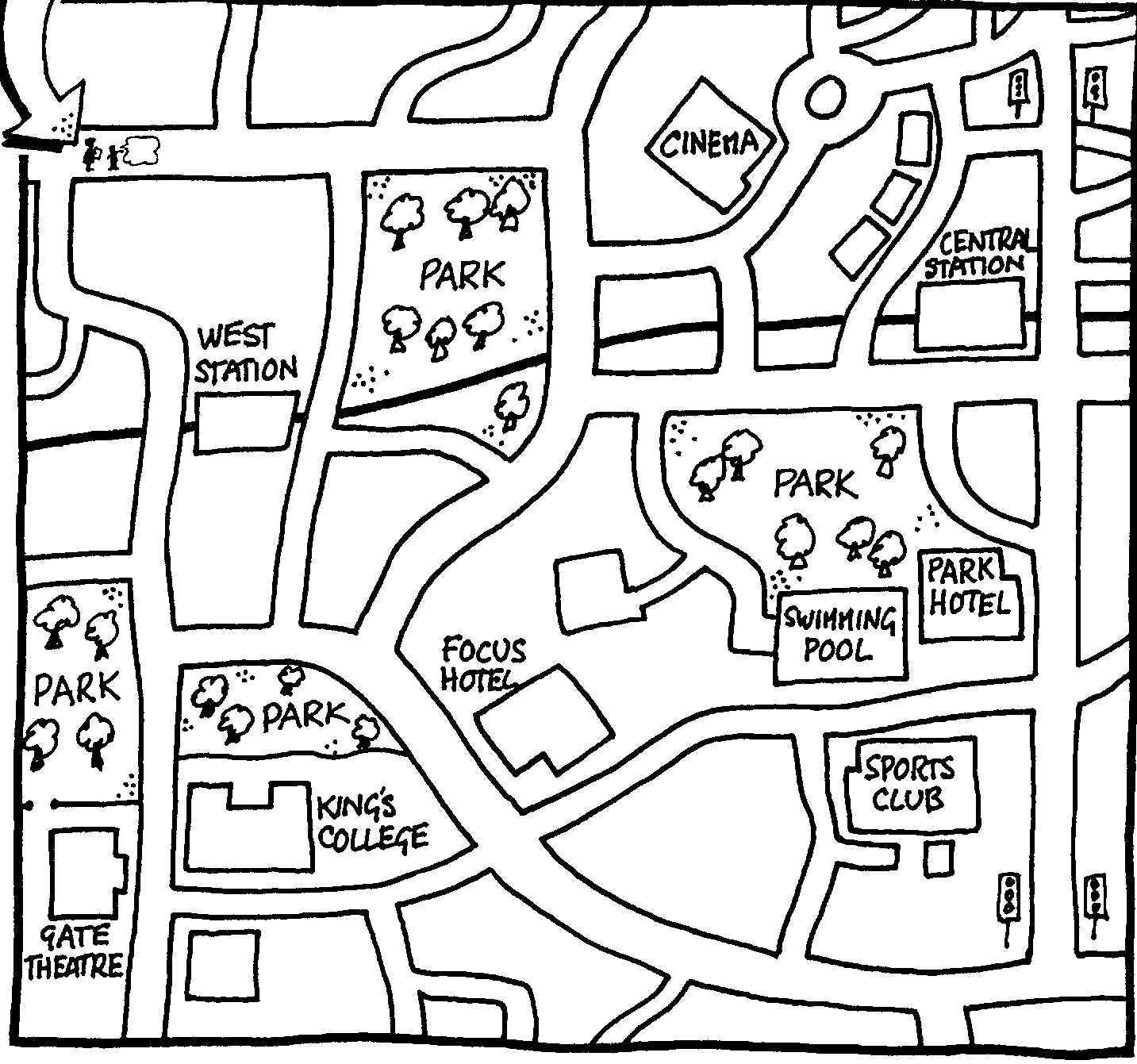
V. Follow the directions on the map and write down the name of the place. Try to guess where the woman wants to go.
Walk straight on the end of the road. Then turn right. Take the second turning on the left. Go down the road till you come to a crossroad. Turn right. Then turn right again at the traffic lights. Go down the road until you come to a park. Then turn left. Keep straight on for about two hundred metres and it`s on your right.
Transport
I. Words and word-combinations to be remembered:
subway/ underground – метро
hot air balloon – воздушный шар
fast – быстрый
slow – медленный
ride a bicycle – ездить на велосипеде
wait for – ждать
get on a train – садиться на поезд
get off a train – сходить с поезда
crowd – толпа
magnetic Levitation train - поезд на магнитной подвеске
city traffic - движение городского транспорта
queue – очередь
II. Put these types of transport in order from fast to slow.
a boat a train a tram an underground train
an airplane a ship a scooter a motorbike
a taxi a bicycle a ferry a hot air balloon
III. Read the text. Can you guess which numbers go in the gaps?
|
1,000,000 (one million) 100,000,000 (one hundred million) 5 8 740 500,000 (five hundred thousand) 77,000,000 9,000,000 59 3 |
Transport facts!
1. People in most countries drive on the right - but people drive on the left in (a) ___ countries, including Japan, India, Australia and Britain.
2. In the USA (b) ___ people in every thousand drive car. In Japan, it's 640 and in Germanу it`s 570. More than (c) ___ people in the world ride a bicycle!
3. In Tokyo people never wait for more than (d) ___ minutes for an underground train. The only problem is it's often difficult to get on or off a train because they're sо crowded!
(c) ___ people fly to Hartsfield Airport in Atlanta, USA every year! (That's about one hundred end fifty people every minute!)
4. In Chinа, the 30 km journey from Shanghai city centre to Pudeng Airport takes only f) ___ minutes on the new Magnetic Levitation (Маg Lev) train.
5. Most people in Moscow go to work by underground. The Moscow Metro has 165 stations and about (g) ___ passengers every day. The stations in the city centre are very beautiful.
6. Every day more than (h) ___ people travel into the centre of London. About 20% drive, 77% take the train or the bus, and only (i) ___ % walk to work!
7. In Italy, a country of 57 million people. 8 million people have scooters. In Rome, (j) ___ people ride scooters so they can travel fast in the city traffic.
IV. Look back at we text and choose the correct words to go together.

1. drive/ ride a car
2. drive/ ride a bicycle
3. wait/ wait for a train
4. get on/ in a train
5. get off/ out a train
6. fly in/ to Atlanta
7. go with/ by underground
8. take/ go a train, or a bus
9. walk to/ in work
V. Which sentences are true for your country? Correct the false ones.
a) Most people drive small cars.
b) People always wait in a queue to get on a bus.
c) People often fly from one city to another
d) Not many people walk to the shops.
e) A lot of people ride bicycles to work.
f) Traffic is a problem all day.
g) The buses are very crowded.
h) Taxis drive very slowly.
SHOPPING
I. Words and word-combinations to be remembered:
shop – магазин
self-service shop – магазин самообслуживания
shop-assistant – продавец
shop window – витрина
do shopping – делать покупки
department store – универсальный магазин
supermarket – большой магазин самообслуживания
grocery – бакалея
greengrocery – овощной магазин
bakery – булочная
butchery – мясная лавка
to sell – продавать
to be on sale – быть в продаже
to buy – покупать
to pay – платить
clothes – одежда
foot-wear – обувь
shoes – ботинки, туфли
toy – игрушка
china – фарфоровая посуда
appliance – прибор, приспособление
underwear – нижнее белье
linen – белье
fabrics – ткани
camera – фотоаппарат
dress – платье
costume – костюм (женский)
blouse – блузка
skirt – юбка
raincoat – плащ
coat – пальто
to suit – быть к лицу
to try on – примерять
fitting-room – примерочная
to fit – подходить (по размеру)
to wear – носить
suit – костюм (муж.)
trousers – брюки
sweater – свитер
cardigan – шерстяной джемпер
knit-wear – трикотаж
pullover – пуловер
jacket – жакет
perfumery – парфюмерия
face cream – крем для липа
powder – пудра
lipstick – губная помада
lotion – лосьон,
shampoo – шампунь
products – продукты питания
butter – масло
sausage – колбаса
fish – рыба
meat – мясо
poultry – птица
sugar – сахар
macaroni – макаронные изделия
bread – хлеб
cereals – крупы
roll – булочка
biscuits – печенье
milk – молоко
cream – сметана
cheese – сыр
basket – корзина
customer – покупатель
serve – обслуживать
counter – прилавок
cashier – кассир
cash-desk – касса
purchase – покупка
change – сдача
price – цена
II. Read, translate and retell the text:
Shopping
When we want to buy something we go to a shop. There are many kinds of shops in every town or city, but most of them have a food supermarket, a department store, men’s and women's clothing stores, a grocery, a bakery and a butchery.
I like to do shopping at big department stores and supermarkets. They sell various goods under one roof and this is very convenient.
A department store, for example, true to its name, is composed of many departments: ready-made clothes, fabrics, shoes, sports goods, toys, china and glass, electric appliances, cosmetics, linen, curtains, cameras, records, etc. You can buy everything you like there. There are also escalators in big stores which take customers to different floors.
The things for sale are on the counters so that they can be easily seen. In women's clothing department you can find dresses, costumes, blouses, skirts, coats, beautiful underwear and many other things.
In the men's clothing department you can choose suits, trousers, overcoats, ties, etc. In the knitwear department one can buy sweaters, cardigans, short-sleeved and long-sleeved pullovers, woollen jackets. In the perfumery they sell face cream and powder, lipstick, lotions and shampoos.
In a food supermarket we can also buy many different things at once: sausages, fish, sugar, macaroni, flour, cereals, tea. At the butcher's there is a wide choice of meat and poultry. At the bakery you buy brown and white bread, rolls, biscuits.
Another shop we frequently go to is the greengrocery which is stocked by cabbage, potatoes, onions, cucumbers, carrots, beetroots, green peas and what not. Everything is sold here ready-weighed and packed. If you call round at a dairy you are sure to buy milk, cream, cheese, butter and many other products.
The method of shopping may vary. It may be a self-service shop where the customer goes from counter to counter selecting and putting into a basket what he wishes to buy. Then he takes the basket to the check-out counter, where the prices of the purchases are added up. If it is not a self-service shop, and most small shops are not, the shop-assistant helps the customer in finding what he wants. You pay money to the cashier and he gives you back the change.
III. Complete the following sentences:
1. When you want to buy something ..: 2. There are different kinds of shops in our city: ... 3. A department store is divided-into-several departments:... 4. In the men's clothing department you can find... 5. In the women's clothing department you can choose ... 6. After you have chosen the thing you ... 7. If you need a jacket or a pullover you can go to... 8. Shoes are sold at... 9. In a supermarket you can buy ... to. The greengrocery is stocked by ... 11. At a dairy you can buy ...
III. Read, translate and reproduce the dialogues:
Dialogue 1:
Ass: Can I help you?
Cust: No, it's alright. Thanks, I'm just looking.
Ass: Have a look around then. May be you would like something in our shop.
Cust: (in some minutes) I like this navy-blue jacket very much. Can I try it on?
Ass: Certainly. The fitting room is in the right-hand comer.
Cust: Oh, it suits me very well, doesn't it?
Ass: That's a really nice jacket. Pure wool, a modern fashion.
Cust: How much is it?
Ass: $ 55. English clothes are really of good value. They are so well-made.
Cust: All right. I can afford the price.
Dialogue 2:
Ass: Can I help you?
Cust: Yes please. I would like to have something from this shopping list.
Ass: Oh, your shopping list is very big. We stock only three items you ask for: butter, milk and cheese.
Cust: Two packets of butter, a pound of cheese and three bottles of milk, please.
Ass: Here they are. Pay by cheque at the cash desk.
Cust: Excuse me, do you happen to know where I could find some ham, minced meat and beef sausages?
Ass: They are all sold at the butcher's.
Cust: And I wonder if you stock any cigarettes here?
Ass: I'm afraid we don't You should try the shop next door for the cigarettes.
Dialogue 3:
Cust: Hello. I'm looking for a pullover. Can you show me one?
Ass: Certainly, madam. What kind of pullover do you want?
Cust: A woolen one. Medium size.
Ass: How about this one? It's very attractive.
Cust: Yes, but it's too thick.
Ass: How about this yellow one?
Cust: Oh, it's quite nice but it's too short and I don't like the colour.
Ass: What colour do you want?
Cust: I think blue or brown will do.
Ass: Well, we have some pullovers of that colour. Here they are, which one do you like best?
Cust: Can I try this brown one?
Ass: Of course, madam... Oh, it fits you perfectly. It's exactly your size.
Cust: Yes, but I don't think it suits me. Can I try that blue one? It matches the colour of my eyes.
Ass: Which one? The dark blue or the light blue?
Cust: Light blue suits me better. But you see it's too long. Can I try another one?
Ass: May be this one is what you need. The price is 25 pounds.
Cust: Good heavens! That's a lot of money.
Ass: Nowadays that's cheap, madam.
Cust: No, it's too expensive for me. I'll look for something less expensive.
Ass: Unfortunately, we can't offer you exactly what you want. The colour, size, material, price are all wrong. Try another shop, please.
Cust: Good-bye, then.
Ass: That's right. But you'd better go to a big supermarket next time. You'll find everything there.
Cust: Thank you very much. It was very kind of you to explain me all that. I'm a foreigner here and I'm not accustomed to your service and prices yet.
VI. Ask your friend:
– любит ли он ходить в магазины;
– как часто он делает дорогие покупки;
– сколько стоит телевизор и холодильник;
– что он покупает в подарок ко дню рождения друга;
– обращается ли он за помощью к продавцу;
– какую одежду он предпочитает: спортивную или элегантную;
– какие товары он покупает к началу учебного года;
– какие магазины находятся рядом с его домом;
– нравится ли ему профессия продавца.
VII. Act out the situations using the following words and word combinations:
a) a self-service shop, a shop window, to display goods, a shop-assistant, to serve the customer, a basket, a counter, a cashier, to cost, to give back the change;
6) a blouse, to fit, to suit, a fitting room, to try on, tight, loose, of the latest fashion and style, to be out of fashion;
в) a book shop, to look for, be on sale, to be sold out, to recommend, a newspaper stall, to be lucky.
PART II
Travelling
I. Words and word combinations to be remembered
to go through the customs – пройти таможенный досмотр
a customs duty – таможенная пошлина
to smuggle smth. into the country – провести что-либо контрабандой
have you (got) anything to declare? – У вас есть что-то. для предъявления таможне?
valuables – ценности
a check-in counter – стойка регистрации
to have one’s luggage weighed – должны взвесить свой багаж
to label – навесить бирку, наклеить ярлык
to board a plane (ship) – сесть на самолет (пароход)
boarding pass – посадочный талон
an immigration form – иммиграционный бланк
a security check – проверка безопасности
to take measures against hijacking – принять меры против угона самолёта
to reach the port of destination – добраться до места назначения
with a delay – с опозданием
departure lounge – зал ожидания
jet-lag – разница во времени при перелете в разные часовые пояса
block letters – печатные буквы
to pay extra – платить дополнительно
nationality – гражданство, подданство
duty free shop – беспошлинный магазин
at the invitation of – по приглашению
GOING ABROAD
II. Read, translate and reproduce the text
The rules for passengers who are going abroad are similar in most countries, but sometimes there might be a slight difference in formalities.
If, for instance, you are supposed to begin with going through the customs, you'd better fill in the customs declaration before you talk to the customs officer. An experienced customs officer usually "smells" a smuggler, but he may ask any passenger routine questions, for instance, "Have you got anything to declare?" or "Any spirits, tobacco, presents?" The usual answers would be, "Yes, I've got some valuables, but I've put them all down in the declaration", or "I've got two blocks of cigarettes for my own use" or something of that kind.
Then you go to the check-in counter where your ticket is looked at, your things are weighed and labeled, a claim-check for each piece of luggage is inserted in the ticket and you are given a boarding pass, which has a seat number on it. Of course, if your luggage weighs more than 2Okgs. you have to pay extra. The next formality is filling in the immigration form and going through passport control. The form has to be filled in in block letters. You write your name, nationality, permanent address and the purpose of your trip. In most countries there is also a security check when your carry-on luggage is inspected. This is an anti-hijacking measure, and anything that might be dangerous or disturbing to other passengers must be handed to one of the crew and only returned to the owner after the plane has reached its destination.
After fulfilling all these formalities you go to the departure lounge where you can have a snack, read a paper, buy something in the duty-free shop and wait for the announcement to board the plane.
Some of these formalities are repeated when you arrive at your destination. The customs declaration and the immigration form are often filled in on board the plane. At the airport you may be met by a specially trained dog who will make sure that you are not carrying drugs, and the immigration officer might want to know at whose invitation you are coming and whether you have a return ticket.
III. Exercises
1. Give the English equivalents
«Возможна небольшая разница в прохождении формальностей», «прохождение таможни», «заполнить таможенную декларацию», «у вас имеется что-либо для предъявления таможне?», «я записал их в декларацию», «для личного пользования», «что-нибудь в таком роде», «стойка регистрации», «талон для получения багажа вкладывается в билет», «вам выдают посадочный талон», « вы должны оплатить отдельно», «бланк надо заполнять печатными буквами», «гражданство», «постоянный адрес», «цель поездки», «проверка безопасности», «противоугонные меры», «должно быть сдано одному из членов экипажа и возвращено владельцу после того, как самолет достигнет места назначения», «ждать объявления о посадке на самолет», «когда вы прибудете на место назначения», «вы не везете наркотики», «есть еще одно неудобство, к которому вы должны приготовиться», «разница между привычным вам временем и новым», «сначала будете не очень хорошо себя чувствовать», «не беспокойтесь, вы быстро к нему привыкнете».
2. Translate into English
Оборот had better + инфинитив без частицы to.
e.g. It's going to rain. You’d better take an umbrella
1. Вам бы лучше заполнить таможенную декларацию, прежде чем беседовать с таможенником.
2. После того как ваши вещи взвешены и на них навешен ярлык, вам выдается посадочный талон.
3. Иммиграционный бланк нужно заполнить печатными буквами.
4. Если ваш багаж весит более двадцати килограмм вам придется платить дополнительно.
5. После прохождения всех формальностей вы идете в зал вы идёте в зал ожидания и ждёте объявления о посадке на самолет.
6. Есть ещё одно неудобство, к которому вы должны приготовиться, путешествуя на самолёте.
7. Вам не понадобится много времени, чтобы привыкнуть к разнице во времени при перелете в разные часовые пояса.
3. Answer the questions
1. Have you ever travelled long distances by plane?
2. When was it?
3. Where did you go?
4. How long did the journey take?
5. Did you enjoy your trip?
6. Was it a business trip or a pleasure trip?
7. Have you ever had to go through the customs?
8. What are you supposed to write in the immigration form?
9. Why does it have to be filled in in block letters?
10. Do you like to live in hotels?
I. Words and word combinations to be remembered:
to overcome – преодолеть
in the twinkle of an eyeв – мгновение ока
to travel on business – путешествовать по делу
to travel for pleasure – путешествовать для удовольствия
to begin with – прежде всего, начнет с того, что
the ruins of ancient towns – развалины древних городов
for a change of scene – для смены обстановки
different ways of life – разные стили жизни
to look at shop windows – рассматривать витрины магазинов
a city dweller – городской житель
to laze in the sun – нежиться на солнце
advantages – преимущества
disadvantages – недостатки
enjoyable – приносящий радость
means of travelling – способы
путешествовать
a 4-deck liner – четырехпалубный лайнер
a drawback – недостаток
seasickness – морская болезнь
to reserve tickets – резервировать, бронировать билеты
hiking – пеший туризм
to climb a mountain – взбираться на гору
to feel oneself a part of nature – чувствовать частью природы
a tent – палатка
a holiday-maker – отдыхающий, отпускник
to take pictures of smth – делать снимки
to be reminded by the photos – вспоминать, глядя на фотографии
in advance – заранее
overnight train – ночной поезд
fast train – скорый поезд
a berth – полка (в вагоне),
спальное место
a sleeper – спальный вагон
to be due to arrive – должен прибывать по расписанию
II. Read, translate and retell the text:
Travelling
The scientific and technological progress of the 20th century has allowed people to overcome time and distance in the twinkle of an eye. Now modern life is impossible without travelling. Millions of people travel every day either on business or for pleasure. To begin with most of us travel every day to our schools, offices and factories. From time to time we have to go to another city or country on business. Then after a year’s work people get a holiday and they don’t like to spend it at home.
Many people all over the world spend their holidays travelling. They travel to see other countries and continents, modern cities and the ruins of ancient towns. They travel to enjoy picturesque places, or just for a change of scene. It is always interesting to discover new things, different ways of life, to meet different people, to try different food, to listen to different musical rhythms.
Those who live in the country like to go to a big city and spend their time visiting museums and art galleries, looking at shop windows and dining at exotic restaurants. City dwellers usually like a quiet holiday by the sea or in the mountains with nothing to do but walk and bath and laze in the sun.
People can travel by plane, by train, by boat or by car.
Of course, travelling by plane is the fastest and the most convenient way, but it is the most expensive too. Travelling by train is slower than by plane but it has its advantages. You can see much more interesting places of the country you are travelling through. Modern trains have very comfortable seats. There are also sleeping cars and dining cars that make even the longest journey enjoyable. Speed, comfort and safety are the main advantages of trains and planes. That is why many people prefer them to all other means.
Travelling by boat is popular mostly for pleasure trips. On board of river ships you can visit different places of interest within your own country. On board of large cruise ships people can get across oceans and visit other countries. Ships stop for a day or two in different ports and people go on the shore for excursions. Crossing the ocean is a magnificent voyage with enormous waves before you and a 4-deck liner under you. The only drawback is seasickness. So before starting on a voyage you should find out whether you suffer from it or not.
Many people prefer travelling by car. This way of travelling is very convenient. You needn’t reserve tickets, needn’t carry heavy suitcases and you can stop wherever you wish and spend at any place as much time as you like.
The cheapest and one of the most popular ways of travelling is hiking. It is always a great experience for a lover of nature. Walking through the wood or along the river, having a rest on the shore of forest lake, climbing a mountain you feel yourself a part of nature. You can place yourself in a tent and enjoy fresh air and the sun all day long.
Most travellers have a camera with them and take pictures of everything that interest them. Later they will be reminded by the photos of the happy time they have had.
All means of travelling have their advantages and disadvantages. People choose one according to their plans and destination. When travelling we see and learn a lot of things that we can never see or learn at home.
IV. Answer the questions:
1. Are you fond of travelling?
2. What do people travel for?
3. How do people living in the country spend their holidays?
4. What do city dwellers usually like to do on the holidays?
5. Why do people choose different means of travelling?
6. Why do some people choose planes for travelling?
7. Do you like to travel by train? Why?
8. What are advantages of travelling by train?
9. What are advantages of travelling by plane?
10. Would you like to go on a big ocean cruise? Why?
11. Why can it be convenient to travel by car?
12. If you could spend a hiking holiday wherever you like, what place would you choose?
V. Ask your friend:
1. Какой вид путешествия он предпочитает
2. Где можно купить билеты
3. Ездил ли он в морской круиз
4. Хочет ли он попробовать пищу другой страны
5. Страдает ли он от морской болезни
6. Любит он путешествовать по делу или ради удовольствия
7. Почему многие люди предпочитают пеший туризм
8. Хочет ли он съездить в другую страну
9. Куда бы он хотел поехать в отпуск, если бы он жил за городом покупает он билет в один конец или туда и обратно, когда едет куда-нибудь в отпуск
IV. Words and word combinations to be remembered