ВУЗ: Не указан
Категория: Не указан
Дисциплина: Не указана
Добавлен: 07.08.2020
Просмотров: 1208
Скачиваний: 5
Module Title: Ecology and stable development |
|||||||||
|
module code (if used) Еко 1106 |
student workload Total = 45 h |
Credits (ECTS) 2 |
semester1, 2. Sem. |
frequency 1 semester |
duration semester – 15 weeks |
||||
|
1 |
Types of courses General educational compulsory |
contact hours 11 hours |
independent study SIW 34 hours |
class size 45 students |
|||||
|
5 |
Prerequisites for participation Participation in teaching process and discussions of pragma- professional tasks. During the semester 15 weeks requires fluent language skills(sp. group) written, oral, conversational |
||||||||
|
2 |
Learning outcomes Assimilation of the content of the course. Students should be aware of
acquire skills - using gained knowledge about laws of interaction of living organisms with enviroment in practical activity for preserving stable development; - analysis of natural and antropogenic ecological processes and possibilities of their regulation; - analysis of ecological situations; - usage of gained knowledge for the solution of ecological tasks; -rational usage of natural resourses, which is a basis of stable development. |
||||||||
|
3 |
Subject aims To form ecological thinking, acquire habits of ecological approach to solve industrial tasks, work out ecological culture of behavior, and to dicloze the role of ecological factors in stable development. – are of paramount importance for specialists with higher education. |
||||||||
|
4 |
Teaching methods Lectures, seminars(conversations, discussions, round-table, project work); innovation methods: interactive white board, multimedia project.(oral, written form, test ) |
||||||||
|
6 |
Assessment methods Parameters of assessment according to credit technology ( per cent, letter equivalent, scores) |
||||||||
|
8 |
This module is used in the following degree programmes as well The subject is used in programmes and projects for the assessment of state of environment. |
||||||||
|
10 |
Responsibility for module Teacher is responsible for the content of the subject according to his education and speciality (diploma, master’s degree,candidate, PhD ) |
||||||||
|
11 |
Other information Essential reading list:
|
||||||||
|
Module Title: Introduction to linguistics |
|||||
|
Code of VY/IL 1209 |
Total quantity of hours - 45 |
1 credit |
2 semester |
Frequency |
Duration |
|
1 |
1 course |
Hours of meeting |
SIW – 11 hours |
Quantity of students 45 |
|
|
2 |
The pre-props (stipulation) of “Introduction of linguistics” course are the language subjects of secondary school program, and post-props (stipulation) are all subjects which regard in the general and single linguistics. |
||||
|
3 |
The result of the course:
|
||||
|
4 |
The aim and object of the course:
|
||||
|
5 |
Teaching methods: projects, case-folders, lectures
|
||||
|
6 |
Used materials:
|
||||
|
Module Title: Basic Russian Language |
|||||||||
|
Module code K (R) Ya - 1103 |
Student workload (hours) |
Credits 6 credits |
Semester 1 , 2 |
Frequency In the winter and in the summer |
Duration 30 weeks |
||||
|
1 |
Types of courses . Practical lessons |
Contact hours 90 hours |
Independent study 90 hours |
Class size 15 students |
|||||
|
5 |
Prerequisites: This course is taught to translation students after the disciplines, such as Russian language which was studied at school, Professional Russian Language. |
||||||||
|
2 |
Learning outcomes Students should be able to held business communication concerning their speciality and be able to create business documents. |
||||||||
|
3 |
Subject aims To check the students knowledge with the help of test due to the types of speech. |
||||||||
|
4 |
Teaching methods Interactive method, technology of communication, projection and case, role play. |
||||||||
|
6 |
Assessment methods To check the knowledge with the help of test. |
||||||||
|
8 |
The module is taught in the specialty 050207 – Translation studies |
||||||||
|
10 |
Name of module convenor: Kudiarbekova M.K. |
||||||||
|
11 |
Essential bibliography: |
||||||||
|
Module Title Note Taking Techniques |
||||
|
Credits (ECTS) 2 |
Semester 2 |
|
||
|
Types of courses
|
Contact hours 30 hours |
|
||
|
Prerequisites for participation Students must have successfully completed modules: The Practice of Written Translation, The Practice of Literary Translation, The Theory of Translation. Co-requisites: Practice of Informative Translation, Practice of Interpretation. Post-requisites: The course will help the students to acquire the techniques of all types of interpretation: simultaneous, consecutive, conference and interview translation. . |
||||
|
Learning outcomes This course is designed to provide the students with the skills of using the universal note-taking techniques which make the interpreter’s work much easier in the actual situation of rendering the long fragments of sounding texts. As the result of accomplishing the course the students are to know:
Professional skills: The students should be able:
|
||||
|
Subject aims The aim of the course is to familiarize the students with the system of conventional signs and symbols used during the consecutive interpretation, and also to form the skills of quick encoding of the information and decoding it and an adequate translation. -Tasks: - to teach the students’ to use the universal symbols and signs of interpreter’s note-taking, - to form the students’ skills of using the individual system of contracting the words; - to form the students’ skills of quick encoding and decoding information and interpreting it according to the notes. |
||||
|
Teaching methods Lectures, practice, listening Each lesson will be conducted as interactive group discussions, based on theoretical review, case studies and practical tasks. Students are expected to express their understanding of theoretical assumptions in connection with their practical activities; they will be encouraged to use all symbols and other methods of note taking techniques. |
||||
|
Assessment methods Assessment of students’ progress: the maximum scoring marks 100, minimum – 55. Student contact time Attendance – 20% Home Task – 40% Class activity – 40% Total: 100% Independent learning Appropriate translation – 50% Using note taking – 50% Total: 100% Module translation Skill to code the received text-25p. Skill to use note taking-25p. Speed of reproduction-25p. Adequacy of reproduction-25p. Total: 100% Final control is conducted in the form of: Consecutive translation of high informative, complicated text with duration up to 5 minutes on different themes and with use of the skills of full knowledge of translation note technique Mark criteria of final control: Skill to code the received text-30p. Skill to use UPS-20p. Speed of reproduction-20p. Adequacy of reproduction-30p. Total – 100 marks. |
||||
|
This module is not used in other degree programmes. |
||||
|
Competences Competences to be developed within the module: -special professional competences. Students will be able:
|
||||
|
Responsibility for module: Bekbulatov T.R., MA in Translation Studies |
||||
|
Other information -Short content of the discipline: 1. The methods of shortening of literal notes - cutting down the endings - Arabian approach 2. The method of coding the information with the help of the symbols - literal symbols 3. Associative symbols 4. The methods of coding of modality 5. The methods of coding of the derivative signs 6. The methods of noting the digital precision information 7. The methods of noting the asserted constructions 8. The methods of noting of the cause-and-effect relations 9. The methods of noting the sentences with indication of an aim 10. The methods of noting the sentences with comparison |
||||
INFORMATION FOR RELATED ASSIGNMENTS
GUIDELINES FOR WRITING AN ACADEMIC ESSAY
Essays, in the required word length, should have a title page providing the title of the essay, the student’s name and/or candidate number (as specified in the module specification), programme, module, lecturer’s name, date of submission. It is highly recommended to have a separate page as a table of content, listing the headings of the chapters and sub-chapters and the respective page numbers. If necessary, a page providing abbreviations, survey of tables, figures, or similar, should follow.
 Clarify
the meaning of a given essay topic or field of research. Relate it to
your lecture notes and what you have read during the teaching period.
An essay question always contains a question you need to answer, or a
thesis you are expected to discuss. It is essential that you focus
your essay accordingly. This will help you structure your material
and to decide on what is relevant or irrelevant for your work. Seek
help if you are in any doubt about remit of the topic.
Clarify
the meaning of a given essay topic or field of research. Relate it to
your lecture notes and what you have read during the teaching period.
An essay question always contains a question you need to answer, or a
thesis you are expected to discuss. It is essential that you focus
your essay accordingly. This will help you structure your material
and to decide on what is relevant or irrelevant for your work. Seek
help if you are in any doubt about remit of the topic.
The structure of the essay should reflect a logical arrangement, and it should be an argumentative essay. Structure your essay clearly: introduction, main section(s), conclusion, and bibliography (mention only books and other sources that you have actually quoted in your essay). The essay should start with a clear outline of its aim and an overview of its structure. The introduction should also indicate why your topic is of interest and relevance, what the essay attempts to achieve, and what you have established to be the main conflicting views (if any). The body of the text (i.e. the main sections) should reflect a critical engagement with existing literature. It should unfold the main line(s) of your argument as backed up by relevant quotations. Quotes from the literature need to be contextualised and commented on. Do not leave quotations uncommented and make the relevance of the quotation for your argument clear. Where necessary and/or appropriate, examples should be provided. The conclusion should not be a mere summary of the body of the text, but should be devoted to discussing the consequences of the topic/question/hypothesis etc. studied. If explicitly required, an abstract is to precede the essay (after the title page).
Style:
Avoid using the first person singular (“I think that…, in my opinion…” etc). Do not use commonplaces or state the obvious. Avoid paraphrasing the material you have read; your job is to interpret it critically. What you argue in your essay has to be supported by evidence (e.g. data in your corpus and/or quotes from primary or secondary sources. The exact location of quotes needs to be referenced properly.
Format:
Use word-processing software. Handwritten essays are not acceptable. Take advantage of the spell-checking facilities. Use the software facilities for automatic numbering of pages and footnotes (if any). Use Arabic numerals (1, 2, 3, etc) rather than roman numerals (I, II, III, etc) or symbols (*). Seek help from IT support personnel if unsure about software facilities.
All quotes must be indicated by quotation marks. Make sure you understand the crucial difference between plagiarism (disciplinary offence) and quoting (the very characteristic of an academic essay)!! The essay must be typed double spaced throughout on one side of A4 paper, with wide margins. Use at least a 12-point font. Titles and section headings should be clear and brief. Lengthy quotations (over 40 words) should be displayed, indented, in the text. Tables and figures (if used) should have short descriptive titles.
Notes should only be used for additional information or explanations. They should be indicated by superscript numbers in the text and appear as footnotes on the respective page. References cited in the text should read as follows:
• direct citation: Nord (1997: 55)
• reference to publication: Nord (1997), Nord (1991, 1997), Hatim and Mason (1997)
• Use ‘et al.’ for more than two authors
• The letters a, b, c, etc. should be used for different works by the same author in the same year.
All text references should be listed alphabetically (by author or editor) at the end under the heading References. For each title, the following information is to be provided: author, year of publication, title, where published, town of publication, publisher, page numbers. For journals, the volume, the issue, and the page numbers need to be provided.
GUIDELINES FOR THE PROJECT WORK
The basis of the project method constitutes development of informative, creative skills, and also students’ ability to construct individually their knowledge, ability to orient in the informative area, development of critical thinking.
The method of projects always orients on independent work of students – individual, pair and group works, which students make during certain period of time. This approach harmonically combines in cooperating with the method of studying.
The method of projects always assumes the decision of some problem providing on the one hand use of various methods with another - integration of knowledge, abilities from different areas of a science, techniques, technology, creative areas.
Improvement of cognitive skills at students, ability to form individually their knowledge, ability to orient in the informative area, improvement of critical thinking all lay on method of projects. Results of fulfilled projects should be so-called “tangible”, i.e. if it is a theoretical problem it will need concrete decision; if it is a practical one it will need concrete result ready for an implementation.
T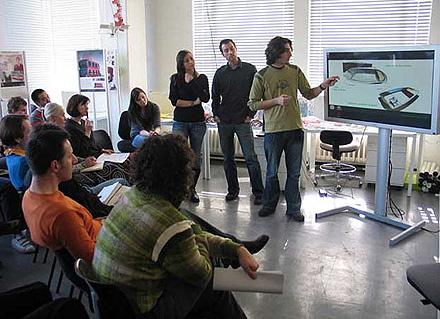 he
work on method of projects assumes not only presence and realization
of such problem but also the process of its openings, decisions, that
include accurate planning of actions, presence of decision’s
intention and hypothesis, accurate distribution( if it means group
work) of roles, i.e. tasks for every participant under the assumption
of close cooperation. The method of project making is used only in
that case when in studying process appears any research, creative
challenge for which dissolving needs interconnected knowledge from
various fields, also the using of research techniques.
he
work on method of projects assumes not only presence and realization
of such problem but also the process of its openings, decisions, that
include accurate planning of actions, presence of decision’s
intention and hypothesis, accurate distribution( if it means group
work) of roles, i.e. tasks for every participant under the assumption
of close cooperation. The method of project making is used only in
that case when in studying process appears any research, creative
challenge for which dissolving needs interconnected knowledge from
various fields, also the using of research techniques.
For the method of project making increasingly substantive the question of practical, theoretical and significance of expanding purviews of supposed results.
Work on the project is carefully planned and discussed by students under the supervising by the teacher. Thus it is carried out a detailed planning of a substantial part of the project with the indication of stage-by-stage results and terms of "public" results representation, i.e. other students of group, or for example the external user of the Internet which is not having the direct attitude to process of training
Research methods of teaching lie in the basis of educational projects. All students’ activity is focused on the following stages:
-
Decision of the problem and followed research tasks;
-
Advancement of hypothesis of solution them;
-
Discussion of research methods;
-
Conducting of assemblage data;
-
Analysis of received data;
-
Mounting of ultimate results;
-
Summarizing, correction, conclusions (use during joint research of a method of "brain storm", "a round table", statistical methods, creative reports, viewings and other).
The procedure of project presentation includes:
-
The title
-
The list of participants and their roles
-
Script
-
PowerPoint papers
-
Version on CD
GUIDELINES ON COLLOQUIUM AND ROUND TABLE DISCUSSIONS
Colloquium
Colloquium - from Latin, conversation, from colloqu , to talk together : com-, com- + loqu , to speak; see tolkw- in Indo-European roots
Colloquium is an informal meeting for the exchange of views.
Colloquium is an academic seminar on a broad field of study, usually led by an instructor at each meeting.
Colloquium is an academic meeting or seminar usually led by an instructor and on a different topic at each meeting.
Research colloquium is a colloquium at which the results of (scientific) research are reported.
Papers with the results of analysis have to be sent to the instructor by e-mail. The procedure of passing the colloquium is a discussion with the instructor on the indicated dates.
Round table discussions
Method of “Round table” is the main form of organization of exchange of opinions. The teacher's role has a new objective: to teach how to search for this information, be critical of and interact with it, and use it for the holistic development of each person. New technologies, and specifically, telematics are very useful tools, because they allow contact and exchange of knowledge among people through collaborative work. This is also an excellent information source.
This new type of work is a first step to be able to eradicate prejudices: those attitudes which take differences not as implying people's right to their own identity (cultural diversity), but as the justification for another kind of right which creates servitude.
3