ВУЗ: Не указан
Категория: Не указан
Дисциплина: Не указана
Добавлен: 10.04.2021
Просмотров: 1736
Скачиваний: 3

12
Which technique would you use to find:
1.
a telephone number in a telephone directory?
2.
the name of a village in the index of an atlas?
3.
an article in a magazine which was interesting and worth reading?
4.
the score of your favourite team in a list of football results?
5.
a book you are interested in from a page of book reviews?
8b Skimming: Skim the text “Lifelong Learning” and answer the questions.
1.
Where could the text come from?
2.
What is 'lifelong learning'?
3.
Do you think that the text will be interesting?
8c Scanning: Now scan the text “Lifelong Learning” and find the following:
three quotes about lifelong learning and teaching;
the percentage of adults in Britain following adult education in 2000 and
2004;
a reason why lifelong education is increasing in Europe.
LIFELONG LEARNING
Lifelong learning is the concept that it's never too soon or too late for learning, a
way of thinking that many different organizations now believe in. Albert Einstein,
the famous scientist, summed up this way of thinking when he said, 'Learning is
not a product of schooling, but the lifelong attempt to acquire it.'
Lifelong learning provides adults with learning opportunities at all ages and in
various contexts: at work, at home and through leisure activities, not just through
formal channels such as school and higher education. In recent years, participation
in adult education has increased in most European countries. In Britain, for
example, 44 percent of adults participated in adult education programs in 2004,
compared with 40 percent in the year 2000.
Lifelong education is a form of teaching often carried out through distance
learning or e-learning, continuing education, home schooling or correspondence
courses. It includes postgraduate programs for those who want to improve their
qualifications, bring their skills up to date or retrain for a new line of work. Internal
corporate training has similar goals.
One of the reasons why lifelong education has become important is the
acceleration in the progress of science and technology. Despite the increased
length of primary, secondary and higher education, the knowledge and skills
gained there are usually not sufficient for a professional career over three or four
decades. As an American educator has said, 'Learning prepares us for change.'
More importantly, lifelong learning is about an attitude - that you can and should
be open to new ideas, decisions, skills or behavior. Lifelong learning does not
accept the saying 'You can't teach an old dog new tricks.'
8d Work with a partner to discuss the following.

13
1.
What opportunities are there for lifelong education in your country?
2.
What are the advantages and disadvantages of distance learning?
3.
What do you think the saying 'you can't teach an old dog new tricks' means?
Do you agree?
WATCH AND STUDY ABROAD 1
a Look up these words and word combinations in the dictionary:
to shop around for; consortium; alumni; a fair; coordinator
b Make up your sentences with these words.
c Watch the video and get to know what USAC is W1(2 min)
d After watching speak about how the information from this video clip can
be of interest to you.
UNIT 2
Higher Education in Russia and Abroad
In this unit you will:
Read
about higher education in Britain, United States and Russia; The
Univers ity of C hicago;
College and University Degrees in the USA
Talk
about higher educational systems in different countries
Test
your knowledge about basics of higher education
Practice
summarizing, presenting, comparing, interviewing
Listen
to the staff members of US University
Write
theses to give an oral presentation, an article, an advertisement, an
Application
1.LEAD-IN
1a Read the following quotations. Say which sayings sound optimistic.
Comment on the idea of one of the saying.
The modern world belongs to the half-
educated, a rather difficult class, because they do
not realize how little they know.
~William R. Inge
The foundation of every state is the
education of its youth. ~
Diogenes Laertius
I think education is power. I think that being able to communicate with people

14
is power. One of my main goals on the planet is to encourage people to empower
themselves. ~
Oprah Winfrey
Live as if you were to die tomorrow. Learn as if you were to live forever.
~
Mahatma Gandhi
1b Read the sayings again paying attention to the names of their authors. What
do you know about them (and their education)? What countries are they from?
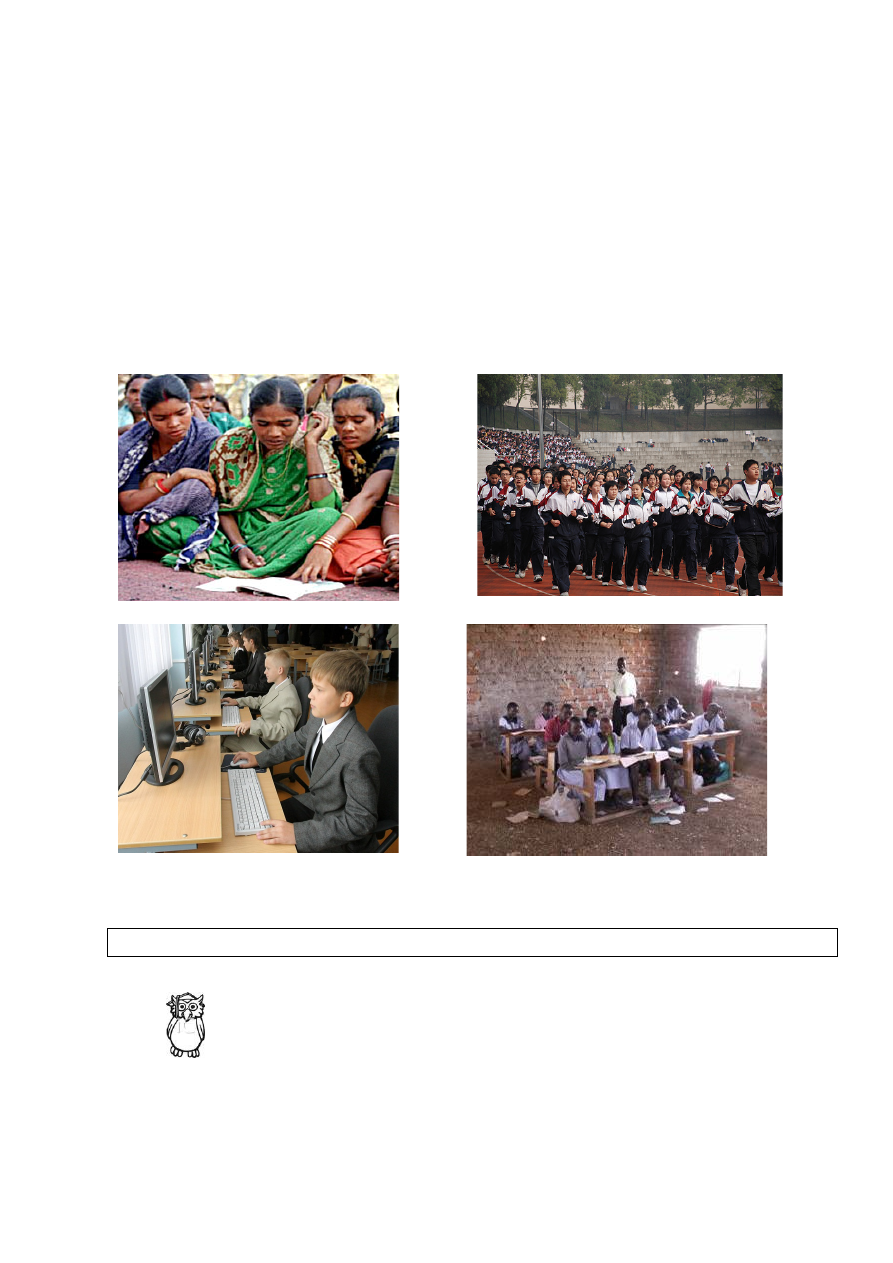
1c Look at the pictures and try to guess in what countries these pictures were
taken? Describe the pictures in 3 – 4 sentences.
What do you know about different approaches and systems of education in
different countries?
2.READING,WATCHING AND SPEAKING
2aRead the text and take down notes summarizing each paragraph.
HIGHER EDUCATION IN GREAT BRITAIN
The quality of a country's future life, commercially industrially and
intellectually, depends on the quality of its education system. The state in the UK
provides a full range of higher education.

15
Having completed a compulsory education,16 year-olds take the school-leaving
General Certificate of Secondary Education (GCSE)exams -in a range of subjects.
After that they may start work, remain at school or go to college
of f
urther
education. Other students prefer to pursue work-based training such as General
National Vocational Qualifications (GNVQs),which provide skills and knowledge
some in vocational areas such as business, engineering, etc. Having completed
GCSEs most students usually specialize in three to four subjects leading to General
Certificate of Education(GCE) A Levels. Others can take higher grade GNVQs.
Many students then move towards higher education training at universities,
colleges and institutes offering studies at degree level and higher. Pupils going on
to higher education or professional training usually take "A" level examinations in
two or three subjects. Universities accept students mainly on the basis of their "A"
level results, although they may interview them as well. In 1971 the Open
University was started, where these formal qualifications are not necessary. Nearly
a quarter of all adult part-time students follow its degree courses on radio and
television.
The most common degree courses usually take three years of full-time study to
complete, although a number of subjects take longer, including medicine,
architecture and foreign languages (where courses include a year abroad). They
lead in most cases to the Bachelor of Arts (BA), Bachelor of Science (BSc),
Bachelor of Education (BEd), Bachelor of Engineering (BEng) and Bachelor of
Laws (LLB). Master degrees for those undertaking, further study include the
Master of Arts (MA), Master of Science (MSc), Master of Business Administration
(MBA) and Master of Laws (LLM). Then there are research-based postgraduate
courses leading to the Master of Philosophy (MPhil) and Doctor of Philosophy
(PhD/DPhil). The last two are awarded for research in arts or sciences.
Degrees are awarded either by the institution itself, or by the Council for National
Academic Awards, particularly in vocational areas. Students of law, architecture
and some other professions can take qualifications awarded by their own
professional bodies instead of degrees.
At present, students who have been accepted by universities or other
institutions of higher education receive a grant from their local authority, which
covers the cost of the course, and may cover living expenses. Parents with higher
incomes are expected to make a contribution. Until 1990 the grant did not have to
be paid back, but now a system of loans has been introduced.
There are forty-seven universities in Britain and thirty former polytechnics
(now also universities), plus 350 colleges and institutes of higher education (some
of which train teachers). The most famous British universities are, of course,
Oxford and Cambridge called “Oxbridge” and famous for their academic ex-
cellence.
2b Find the English equivalents for:
Качество системы образования; закончить обязательное образование; сдавать
выпускные экзамены; экзамен на сертификат об общем среднем образовании;

16
колледж дальнейшего образования; осуществлять профессиональную
подготовку; курс, ведущий к получению сертификата общей национальной
профессиональной квалификации; обеспечить получение навыков и знаний в
профессиональных областях; специализироваться в ч-л; перейти к высшему
образованию; предлагать программы, ведущие к получению степеней;
выпускной экзамен продвинутого уровня; принимать студентов; на основе;
провести собеседование; открытый университет; формальные результаты;
студент заочник / вечерник; проходить курс, ведущий к получению степени;
занимать три года; бакалавр искусств / наук / образования / инженерных наук
/ юриспруденции; степень магистра; курсы, ведущие к получению научной
степени; присуждать степень; национальный совет по присуждению ученых
степеней;
область
профессионального
обучения;
сдавать
экзамены;
профессиональный орган / совет; получать стипендию; местный орган
власти; покрывать расходы; стоимость проживания; возместить расходы;
возвращать деньги; ввести систему займов; бывший политехнический
институт; ВУЗ; быть известным; великолепное качество обучения.
2c Answer the questions:
1.
What is necessary to get higher education?
2.
What types of higher educational establishments are there in the UK?
3.
What courses of study are offered by higher education establishments?
4.
What is the procedure of awarding degrees?
5.
What are the conditions of receiving grants?
6.
What are the Oxbridge universities famous for?
2d Translate into English:
1.
В университеты принимают студентов в соответствии с результатами
сдачи ими экзаменов продвинутого уровня.
2.
В открытом университете не нужны формальные результаты; курс
обучения предполагает получение степени.
3.
В открытом университете учатся взрослые студенты-вечерники и
заочники.
4.
Вузы
Великобритании
подразделяются
на
следующие
типы:
университеты (в том числе бывшие политехнические институты),
колледжи и институты.
5.
Обучение на дневном отделении обычно длится три года и более.
6.
Обучение студентов обычно приводит к получению степени бакалавра
гуманитарных или естественных наук.
7.
Степень
магистра
присуждается
за
исследования
в
области
гуманитарных или естественных наук.
8.
Исследовательские курсы, подводящие к получению степеней выше
бакалавра, могут привести к степеням магистра философии или
доктора философии.