ВУЗ: Не указан
Категория: Не указан
Дисциплина: Не указана
Добавлен: 13.10.2020
Просмотров: 1644
Скачиваний: 1
GLOBAL REPOR
T ON
TRAFFICKING IN PERSONS
2014
82
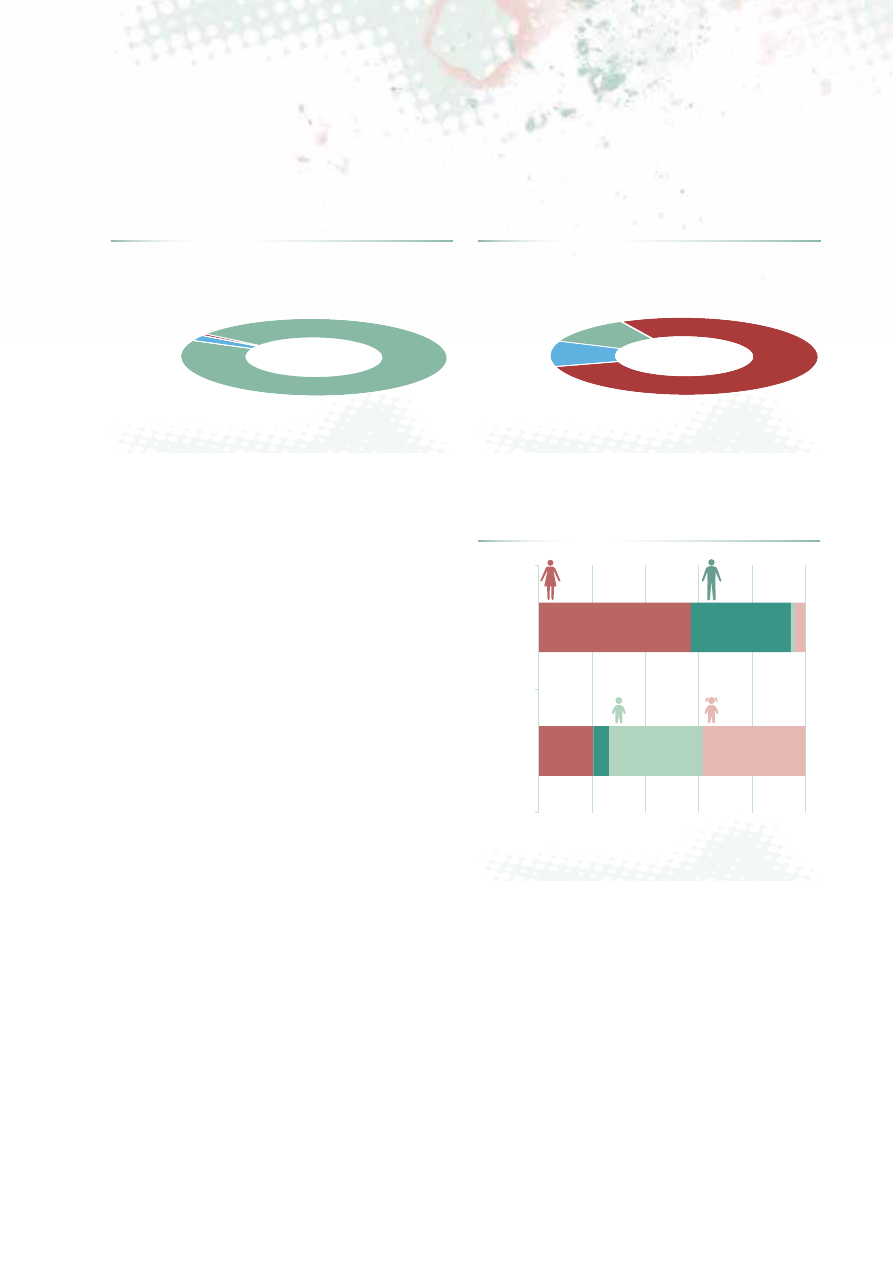
from other countries in the subregion, and less than 1 per
cent are foreigners from outside the region.
The subregion of North Africa and the Middle East
reports the highest share of foreign involvement in traf-
ficking in persons. Some 80 per cent of the persons con-
victed of trafficking in persons here are citizens of countries
in other regions, mainly Asians. Just 11 per cent of the
persons convicted in this subregion come from the coun-
try where they were convicted; a share that is largely made
up of North Africans, rather than Middle Easterners.
This breakdown reflects the fact that the Middle East is
mainly a destination of trafficking from Asia. This area
experiences relatively limited intraregional trafficking,
while limited domestic trafficking is detected.
Looking at the countries where citizens of countries in
Africa and the Middle East have been convicted of traf-
ficking in persons, there seems to be a relation with the
cross-border trafficking flows of victims from this region.
In Europe and Central Asia, some 9 per cent of the per-
sons convicted are from Africa and the Middle East (6 per
cent from Sub-Saharan Africa and 3 per cent from North
Africa and the Middle East). Moreover, West African traf-
fickers were detected in other parts of Africa, the Middle
East and Europe. A limited number of Middle Eastern
traffickers were detected in Europe and the Middle East
Profile of the victims
The two subregions also differ greatly in terms of the pro-
files of the detected victims. Sub-Saharan Africa reports
the highest share of child trafficking in the world, and
girls and boys are more or less equally detected. Traffick-
ing in adults mainly targets women, as adult men comprise
only 6 per cent of the total number of victims detected in
Sub-Saharan Africa.
In North Africa and the Middle East, on the other hand,
almost all detected victims (95 per cent) are adults. This
is the largest share of adult victims of any region or sub-
region. While most of the adults are women, at 55 per
cent of the total, the share of males is large in a global
perspective. Among the 5 per cent of victims who are
children, more girls are detected than boys.
Almost one in five of the victims detected in Africa and
the Middle East are trafficked for purposes other than
FIG. 61:
Citizenships of offenders convicted
in Sub-Saharan Africa (by region),
2010-2012
Source: UNODC elaboration on national data.
FIG. 62:
Citizenships of offenders convicted
in North Africa and the Middle East,
2010-2012
Source: UNODC elaboration on national data.
FOREIGNERS -
WITHIN THE
SUBREGION
2%
FOREIGNERS -
OTHER REGIONS
1%
NATIONALS
97%
FOREIGNERS -
WITHIN THE
SUBREGION
11%
11%
NATIONALS
FOREIGNERS -
OTHER REGIONS
78%
FIG. 63:
Age and gender breakdown of
victims detected in Africa and the
Middle East, by subregion,
2010-2012
Source: UNODC elaboration on national data.
0%
20%
40%
60%
80%
100%
Sub-Saharan
Africa
North Africa
and the
Middle East
57%
37,5%
1,5%
4%
35%
38,5%
6%
20,5%
Regional overviews
II
83
East
Africa
2%
Western and Central
Europe
10%
The Middle
East
100%
Sciences Po - Atelier de cartographie, 2014
West
Africa
14%
Western and Central
Europe
100%
North America,
Central America
and the Caribbean
Flows of less than 1%
of detected victims
at destination
Sciences Po - Atelier de cartographie, 2014
sexual exploitation or forced labour. A major role is played
by child soldiers in Sub-Saharan Africa, which particularly
affects Central African conflict and post-conflict
countries.
Trafficking flows
In terms of flows, domestic trafficking is the main type of
trafficking in Sub-Saharan Africa. This type of trafficking
accounts for more than three quarters of the total number
of detected victims in this subregion, which is a very large
proportion. Cross-border trafficking flows are normally
of short range. Most West African victims are detected in
West Africa, most Southern Africans in Southern African
countries and so forth. Countries in Sub-Saharan Africa
also detect a limited number of victims from other regions,
especially East Asia, but these victims comprise a small
share of the total number of detected victims.
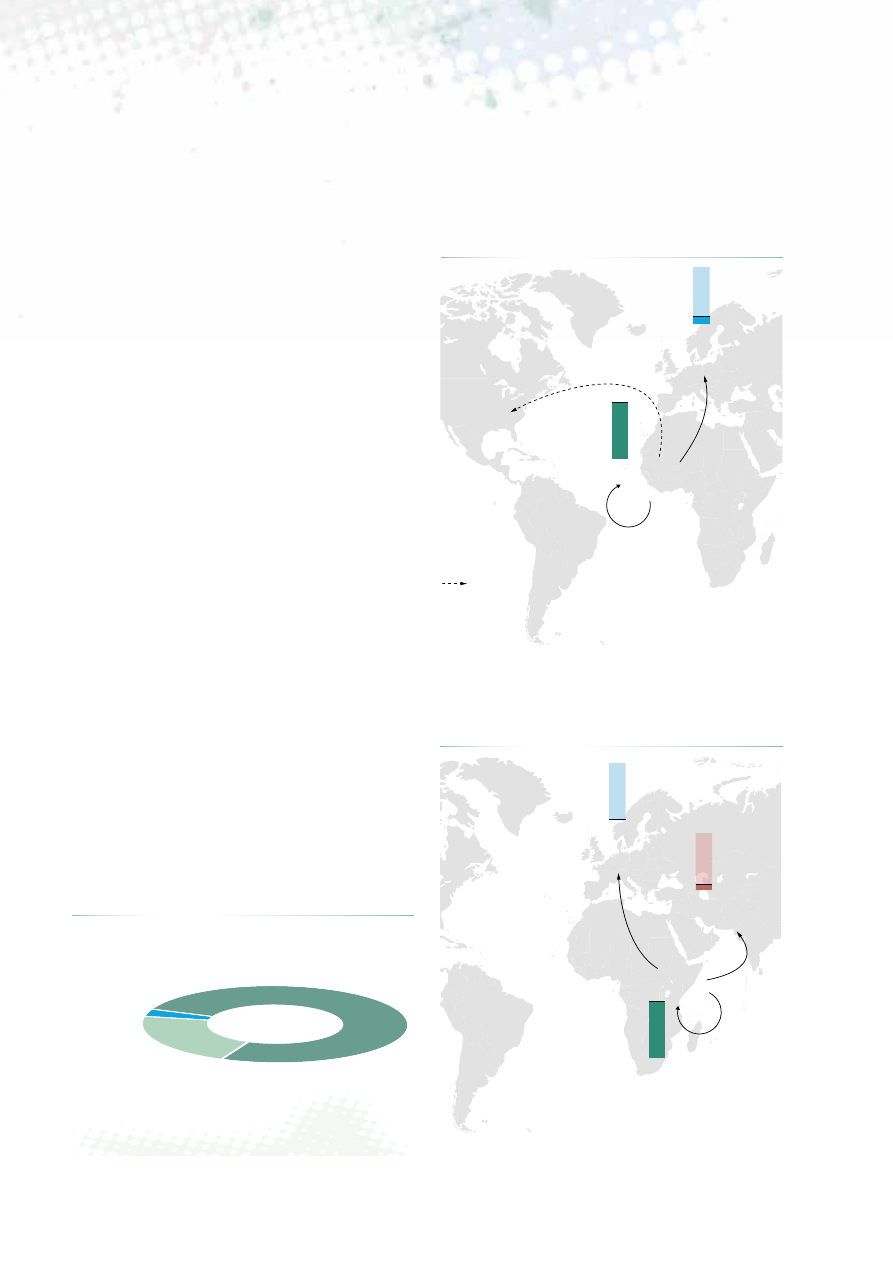
As an origin area for trafficking out of the subregion, there
are two significant outbound flows from Sub-Saharan
Africa. One is bound for Western and Central Europe,
and one for North Africa and the Middle East. These flows
are largely comprised of West Africans trafficked to West-
ern Europe, and East and West African victims detected
in North Africa and the Middle East (most prominently
in the Middle East).
West African victims have been detected in almost all
Western European countries. The share of West African
victims detected in Western Europe has remained constant
for the last few years, and the flows are largely comprised
of women and girls trafficked for sexual exploitation. Vic-
tims from East Africa are frequently detected in countries
FIG. 64:
Origin of victims detected in
Sub-Saharan Africa,
shares of the
total number of victims detected
in the subregion,
2010-2012
Source: UNODC elaboration on national data.
DOMESTIC
TRAFFICKING
76%
SUB-SAHARAN AFRICA
- CROSS-BORDER
21%
SOUTH ASIA,
EAST ASIA AND
THE PACIFIC
3%
MAP 19:
Destinations of trafficking victims
originating in West Africa, propor-
tion of the total number of detected
victims at destinations,
2010-2012
Source: UNODC.
MAP 20:
Destinations of trafficking victims
originating in East Africa,
proportion
of the total number of detected
victims at destinations,
2010-2012
Source: UNODC elaboration on national data.
GLOBAL REPOR
T ON
TRAFFICKING IN PERSONS
2014
84
33%
6%
1%
31%
18%
10%
Americas
Domestic (within countries)
2%
and within the subregion
(cross-border)
29%
Eastern Europe
and Central Asia
Sub-Saharan
Africa
East Asia
and the Pacific
South
Asia
The
Middle
East
100% is equivalent to
825 detected victims
Sciences Po - Atelier de cartographie, 2014
in the Middle East. During the reporting period, they
accounted for some 10 per cent of total number of victims
detected in that area.
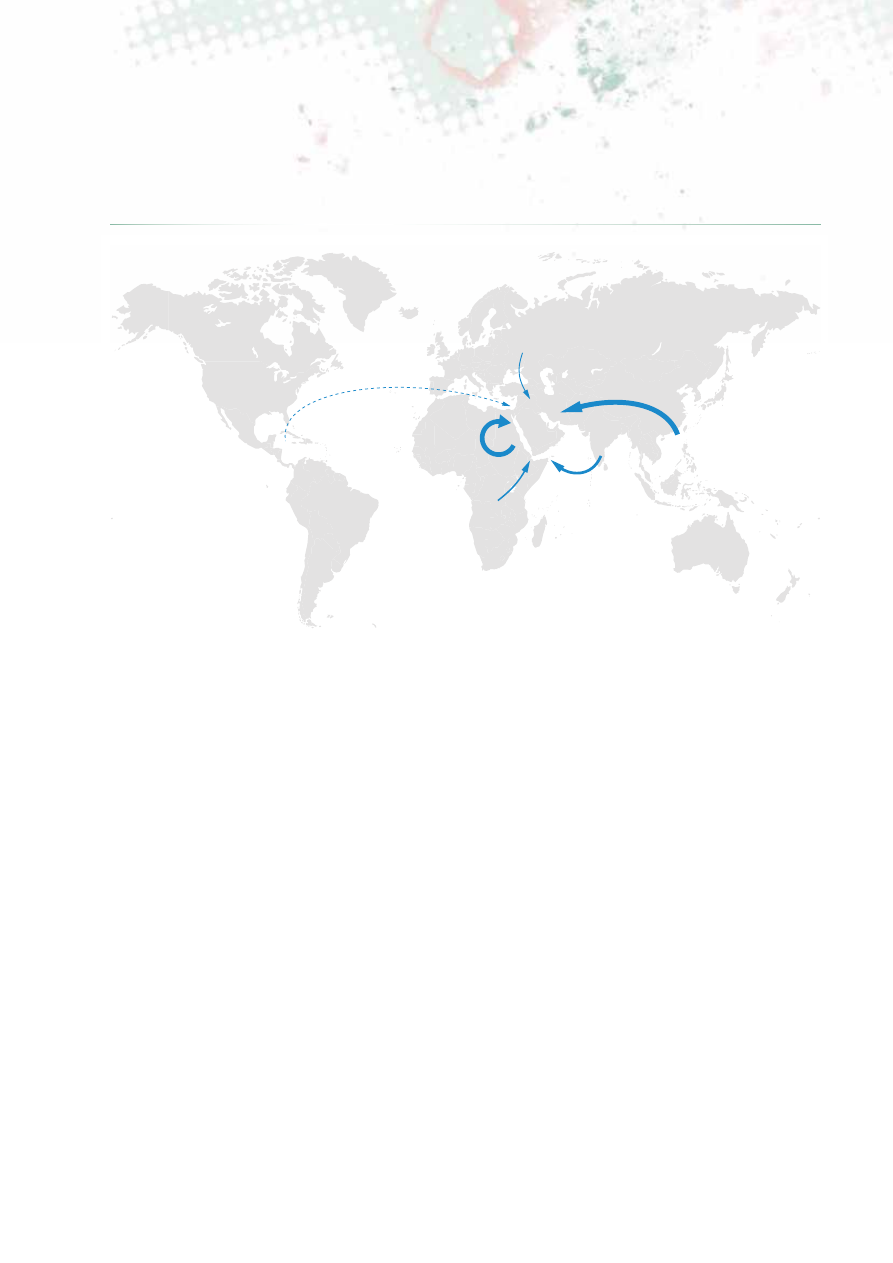
The Middle East is not only a destination for Sub-Saharan
(mainly East) Africans. The region also experiences
inbound trafficking from distant regions, especially from
the region of South Asia, East Asia and the Pacific. It is
not possible to single out one major area of origin; victims
from a variety of countries in South-East Asia and the
Indian sub-continent are trafficked mainly to the Gulf
and other Middle Eastern countries.
Another significant inbound trafficking flow to the
Middle East originates in Eastern Europe and Central
Asia; a flow that comprises some 6 per cent of the victims
detected in this subregion. This flow appears to be decreas-
ing relatively rapidly. During the 2007-2010 period, these
victims made up some 10 per cent of the total number of
detected victims in North Africa and the Middle East,
which is significantly higher than the 6 per cent share seen
during the current reporting period.
Trafficking within the subregion accounts for some 30
per cent of the total number of victims, which is relatively
low when compared to patterns recorded in other parts
of the world, and lower than the number of victims from
relatively distant East Asia and the Pacific. The share
appears to be increasing, however, as the number of
detected North African victims has grown in several coun-
tries in the Middle East. Domestic trafficking appears to
be extremely limited in the Middle Eastern countries,
while it is more relevant for the countries in North Africa.
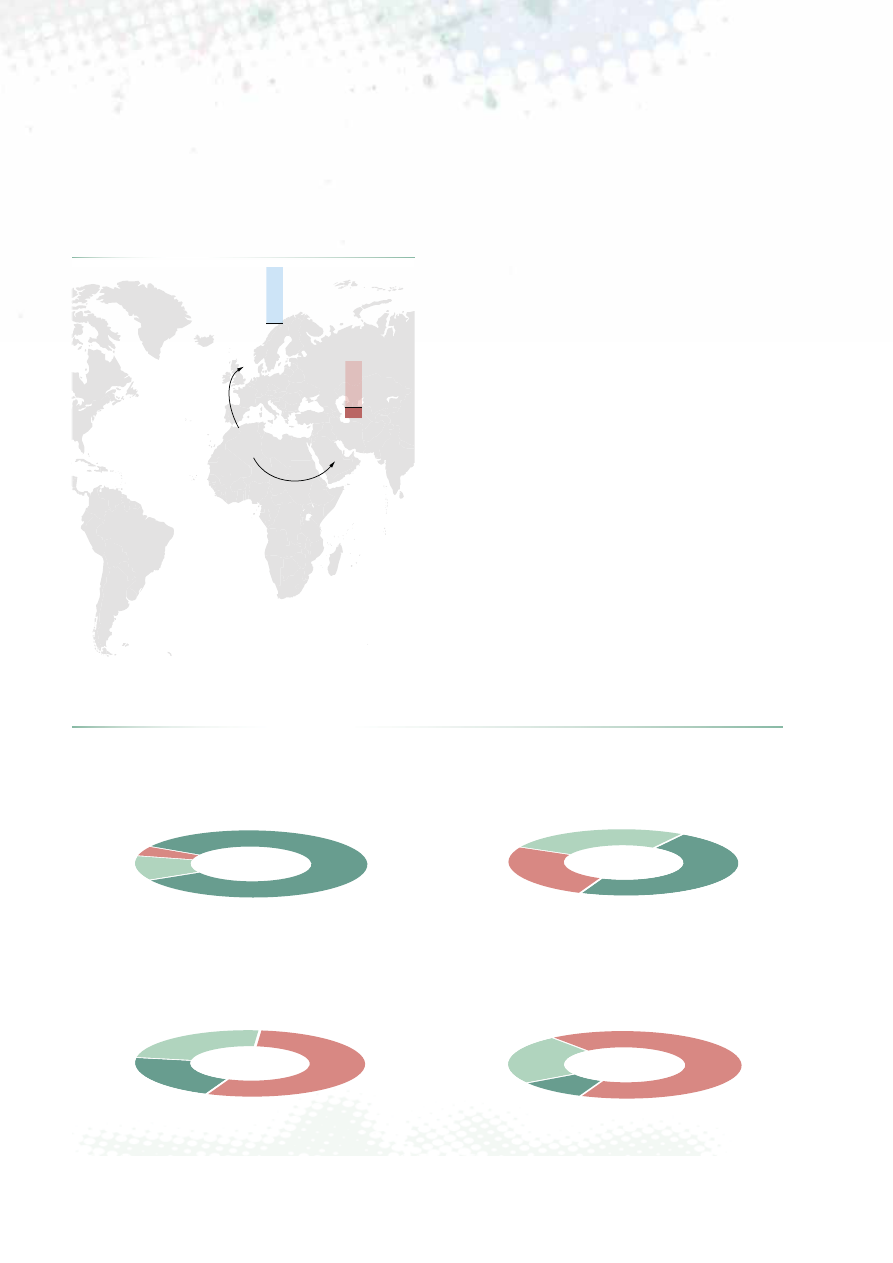
This subregion is not a significant origin region for cross-
border trafficking. Only Western and Central European
countries report detecting small but significant numbers
of victims from North Africa and the Middle East, about
2 per cent of the total number of victims detected there.
Most of these victims are from North Africa.
Response to trafficking in persons
As reported in the global overview, the subregion of Sub-
Saharan Africa is a part of the world where the lack of
legislation is a key concern. Several countries still need to
adopt legislation in line with the Trafficking in Persons
Protocol more than ten years after its entry into force.
Nonetheless, significant improvements have been made
in this subregion over the past decade. In 2003, 85 per
MAP 21:
Origins of victims trafficked to the Middle East,
proportions of the total number
of victims detected there,
2010-2012
Source: UNODC.
Regional overviews
II
85
North Africa
2%
Western and Central
Europe
20%
The Middle
East
Sciences Po - Atelier de cartographie, 2014
cent of the countries in Sub-Saharan Africa lacked legisla-
tion on trafficking. Just two West African countries had
comprehensive laws on trafficking in persons, and four
had partial legislation that criminalized child trafficking
only. After five years, in 2008, more than half of the
countries still lacked a trafficking in persons crime in their
legislation, while some more countries had introduced a
child trafficking offence. Most of the efforts were concen-
trated between 2008 and 2012, and nowadays, 28 coun-
tries have legislation that is in line with the Trafficking in
Persons Protocol. Still, more than 30 per cent of countries
either have partial legislation or no specific offence at all.
As a result of the late introduction of proper legislation,
most of the countries in this part of the world report very
low numbers of convictions, and the number of countries
where this information is not available or accessible is very
high compared to the rest of the world. Only two coun-
tries, Togo and Nigeria, reported convictions of some 50
persons in at least one of the reporting years. The other
countries either reported no convictions at all, or less than
ten per year.
For North Africa and the Middle East, the situation in
2003 was similar to or worse than that of Sub-Saharan
Africa. No country in North Africa and the Middle East
MAP 22:
Destinations of trafficking victims
originating in North Africa,
propor-
tion of the total number of detected
victims at destinations,
2010-2012
Source: UNODC.
FIG. 65:
Historical evolution of the legislation in Sub Saharan Africa,
2003-2014
Source: UNODC elaboration on national data.
2003
NO OFFENCE
35
MOST / ALL
FORMS
2
PARTIAL
OFFENCE
5
NO OFFENCE
20
MOST / ALL
FORMS
11
PARTIAL
OFFENCE
11
2008
NO OFFENCE
9
MOST / ALL
FORMS
23
PARTIAL
OFFENCE
10
2012
NO OFFENCE
4
MOST / ALL
FORMS
28
PARTIAL
OFFENCE
10
2014
TOTAL NUMBER OF COUNTRIES CONSIDERED, N:42

GLOBAL REPOR
T ON
TRAFFICKING IN PERSONS
2014
86
had an offence that criminalized trafficking in persons as
such. Only two countries had partial legislation (that
focused on trafficking in children). Some improvements
were reported in the first five years after the entry into
force of the Trafficking in Persons Protocol, however, and
by the year 2012 the majority of the countries in this sub-
region had legislation that was in line with international
standards.
Information on the criminal justice response is limited.
Very few countries can provide data on the number of
convictions, and when such figures are available, they are
generally very low, with a couple of exceptions. About 40
per cent of the persons investigated for trafficking in per-
sons in the United Arab Emirates are convicted in the first
instance, and Israel reports a similar ratio. The lack of
information for other countries does not permit similar
analyses elsewhere.
FIG. 66:
Historical evolution of the legislation in North Africa and the Middle East,
2003-2014
Source: UNODC elaboration on national data.
2003
NO OFFENCE
12
PARTIAL
OFFENCE
2
NO OFFENCE
8
MOST / ALL
FORMS
4
PARTIAL
OFFENCE
2
2008
TOTAL NUMBER OF COUNTRIES CONSIDERED, N:14
NO OFFENCE
3
MOST / ALL
FORMS
10
PARTIAL
OFFENCE
1
2012
NO OFFENCE
3
MOST / ALL
FORMS
11
2014