ВУЗ: Не указан
Категория: Не указан
Дисциплина: Не указана
Добавлен: 13.10.2020
Просмотров: 1643
Скачиваний: 1
GLOBAL REPOR
T ON
TRAFFICKING IN PERSONS
2014
72
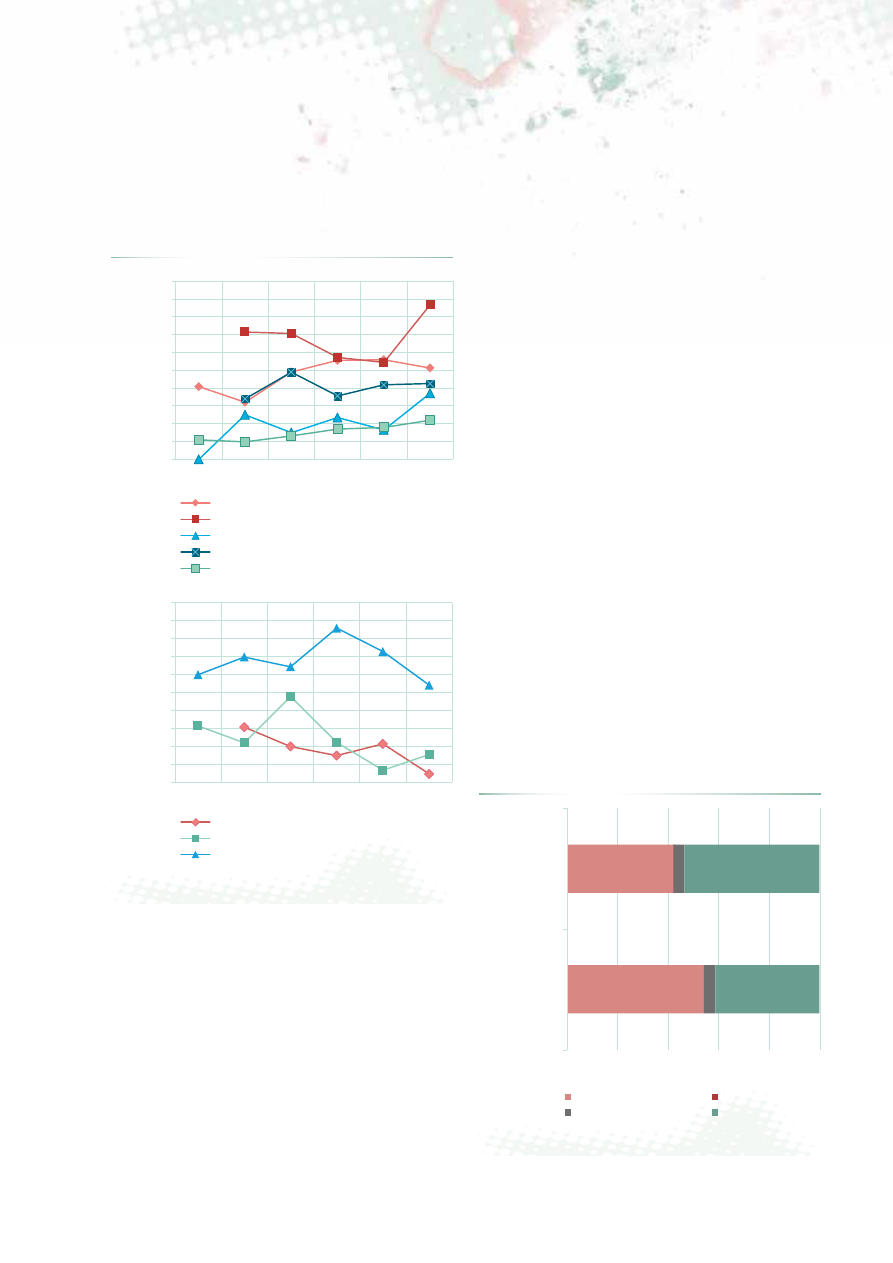
In the Americas, trafficking for forced labour is promi-
nently detected. In North and Central America and the
Caribbean, this form of trafficking accounts for more than
half of the detected victims, whereas in South America,
the share is above 40 per cent. It is very likely that traf-
ficking for forced labour is underreported to an unknown
extent in some South American countries. Some countries
have legislation that only covers trafficking for sexual
exploitation, and some register situations that may be cases
of trafficking for forced labour under offences such as
‘slavery’ or similar practices.
Assuming that all countries in South America had legisla-
tion consistent with the Trafficking in Persons Protocol
and used the Protocol framework for defining trafficking
in persons in their responses to this crime, it is likely that
forced labour would emerge as the main form of traffick-
ing detected in South America.
Two of the cases that involved large numbers of victims
among the court cases submitted by Member States were
cases of trafficking for forced labour. One was a case from
North America (Canada), and the other, from South
America (Argentina). The sectors involved were construc-
tion and manufacturing, and in both cases, the victims
were trafficked from relatively poorer to relatively richer
countries by extended family members or family friends.
In the Canadian case, it was clearly an organized crime
group, as approximately 10 people were convicted. In the
Argentine case, there were two convicted offenders –
father and son.
The detection of trafficking for sexual exploitation in this
region is broadly inverse to the shares of forced labour. In
South America, such trafficking accounts for some 55 per
cent of the detected victims, whereas in North and Cen-
tral America and the Caribbean, some 40 per cent. In both
subregions, some 5 per cent of victims are subjected to
‘other’ forms of trafficking, including mixed exploitation
(sexual and labour) and trafficking for begging.
FIG. 52:
Share of children among the total
number of detected trafficking
victims,
selected countries in the
Americas,
2007-2012
Source: UNODC elaboration on national data.
0%
10%
20%
30%
40%
50%
60%
70%
80%
90%
100%
2007
2008
2009
2010
2011
2012
El Salvador
Guatemala
Canada
Mexico
United States of America
0%
10%
20%
30%
40%
50%
60%
70%
80%
90%
100%
2007
2008
2009
2010
2011
2012
Argentina
Paraguay
Peru
FIG. 53:
Forms of exploitation detected
in the Americas,
by subregion
,
2010-2012 (or more recent)
Source: UNODC elaboration on national data.
0%
20%
40%
60%
80%
100%
South
America
North America,
Central America
and Caribbean
Sexual exploitation
Organ removal
Others
Forced labour
42% 4%
54%
54% 5%
41%
Regional overviews
II
73
59%
25%
7%
3%
5%
East Asia
and the Pacific
South
Asia
Domestic (within countries)
14%
and within the subregion (cross-border)
45%
Central Europe
and the Balkans
North America,
Central America
and the Caribbean
South
America
100% is equivalent to
2,204 detected victims
Sciences Po - Atelier de cartographie, 2014
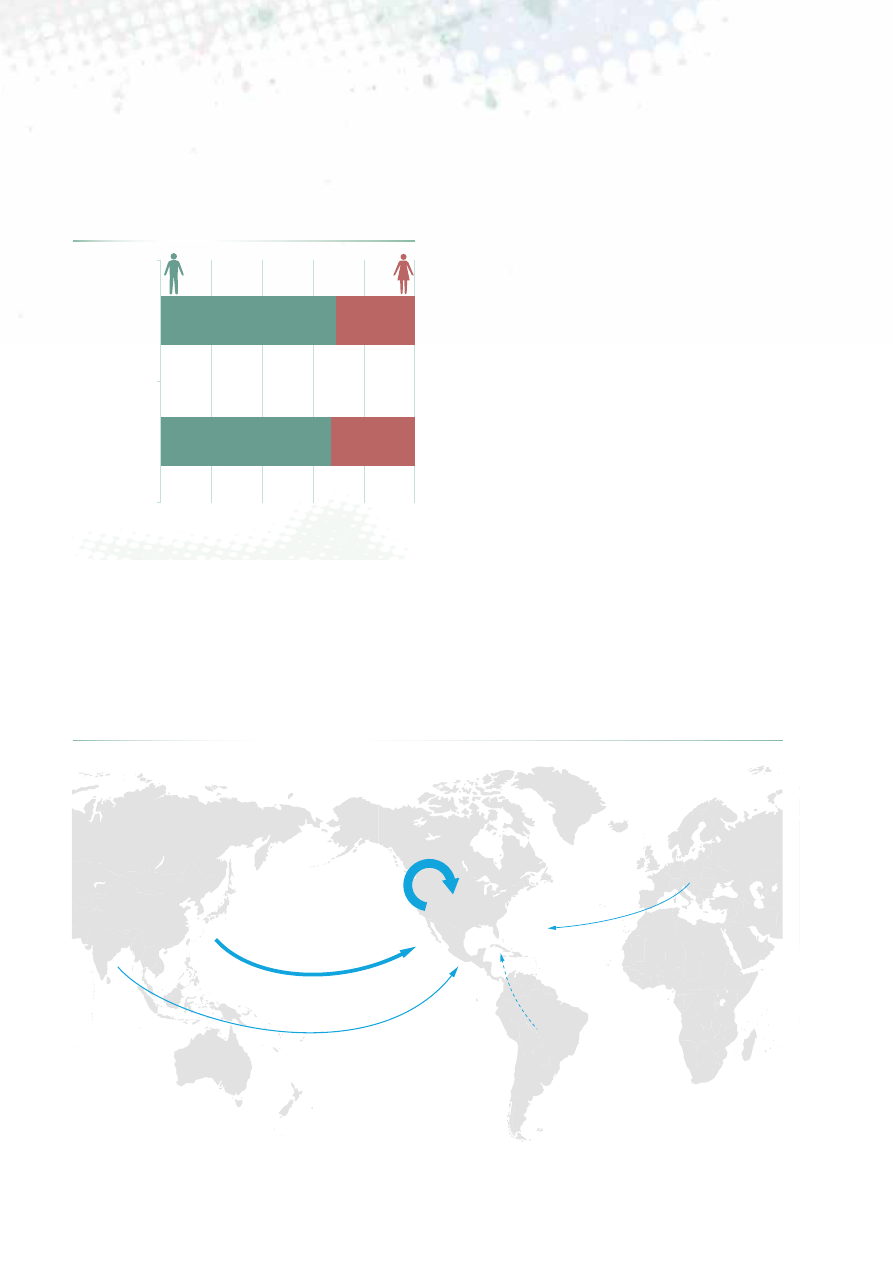
A closer look at the victims for forced labour shows that
the gender profile of these victims in the Americas is very
similar to that found in Europe and Central Asia. Some
30 per cent of the victims who were trafficked for forced
labour are females, and 70 per cent are males. Less than
FIG. 54:
Gender breakdown of victims
trafficked for forced labour in the
Americas, by subregion,
2010-2012
Source: UNODC elaboration on national data.
0%
20%
40%
60%
80%
100%
North
America,
Central
America and
Caribbean
South
America
70%
30%
67%
33%
MAP 13:
Origins of victims trafficked into North and Central America and the Caribbean,
shares
of the total number of victims detected,
2010-2012 (or more recent)
Source: UNODC.
5 per cent of the victims who were trafficked for sexual
exploitation are males.
Trafficking flows
Turning now to trafficking flows in the subregion of
North and Central America and the Caribbean, 58 per
cent of the relevant flows are either domestic or subre-
gional. This is consistent with past Reports as well as
results from other parts of the world. Looking at detec-
tions in some detail, victims from Central America have
been trafficked across the borders into neighboring coun-
tries in Central America, and victims from the Caribbean
have been detected in the Caribbean. Central American
and Caribbean victims have also been detected in North
America. In addition, domestic trafficking is also com-
monly detected. Overall, the detections show a clear pat-
tern of trafficking of persons from relatively poorer origin
countries towards comparatively richer destinations within
the same subregion.
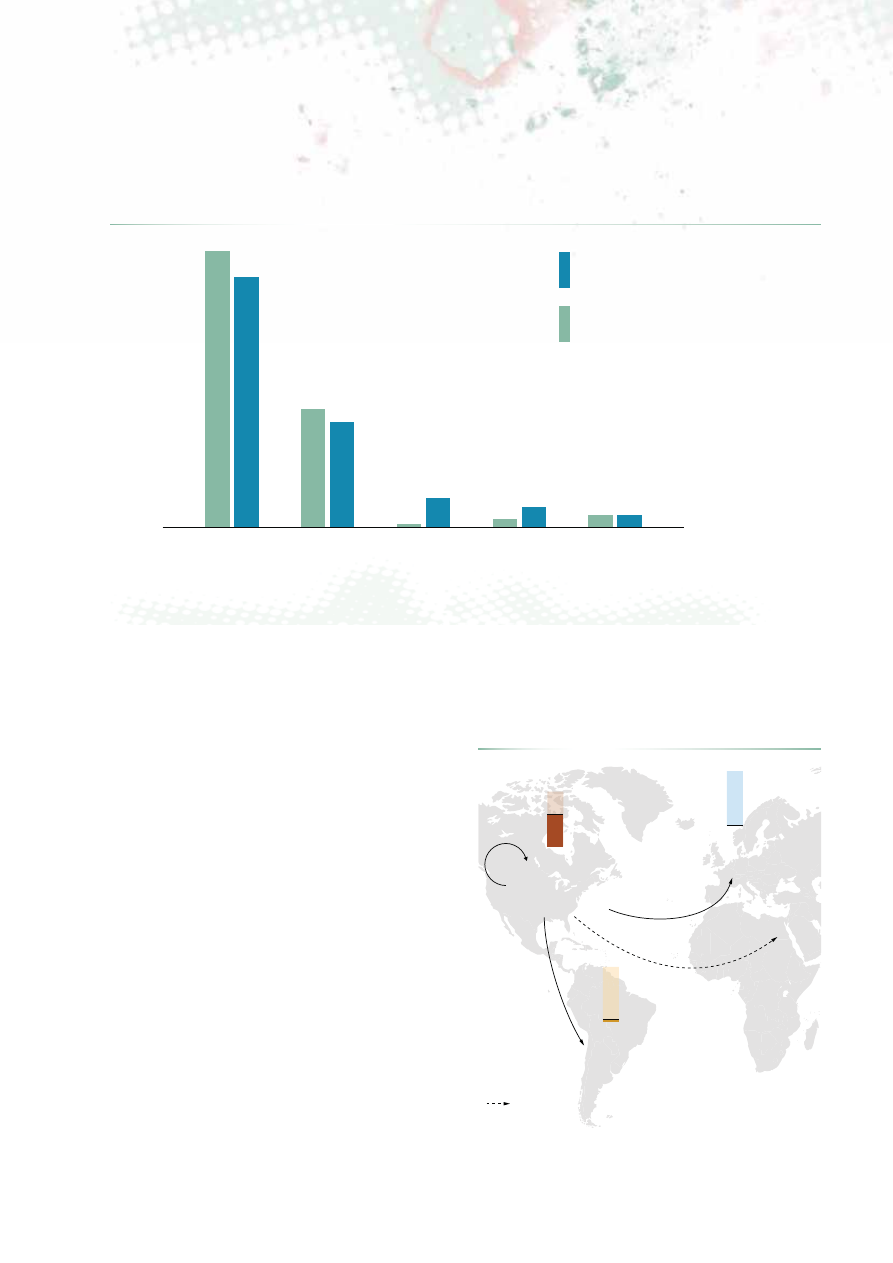
Transregional flows comprise more than 40 per cent of
the detected trafficking to North and Central America and
the Caribbean. This means that this subregion is a signifi-
cant destination for such flows. The origins of flows des-
tined for North America are much less diverse than those
of European countries, however. The main origin of
GLOBAL REPOR
T ON
TRAFFICKING IN PERSONS
2014
74
North America,
Central America
and the Caribbean
2%
Western and Central
Europe
The
Middle
East
59%
4%
South
America
Flows of less than 1% of detected victims at destination
Sciences Po - Atelier de cartographie, 2014
inbound long-distance trafficking is Asia, and particularly
East Asia. More than one in four of the victims detected
in North and Central America and the Caribbean are from
East Asian countries and these victims were mainly
detected in the United States and Canada. Additionally,
victims from South Asia were detected in significant num-
bers in the United States during the reporting period.
This subregion also reported an increasing share of victims
from Western and Central Europe – mainly Central Euro-
pean countries – and these victims now account for about
5 per cent of the total number of detected victims there.
This is larger than the share of detected victims from the
neighbouring subregion of South America as these victims
comprise some 3 per cent of the total number.
Looking at this subregion as origin of trafficking victims,
as mentioned previously, most of the trafficking is intrare-
gional. As a result, most victims from this part of the world
are trafficked to a richer country nearby, or to a richer area
within the same country.
However, there are also some transregional trafficking
flows originating from the subregion, particularly coun-
tries in the Caribbean.
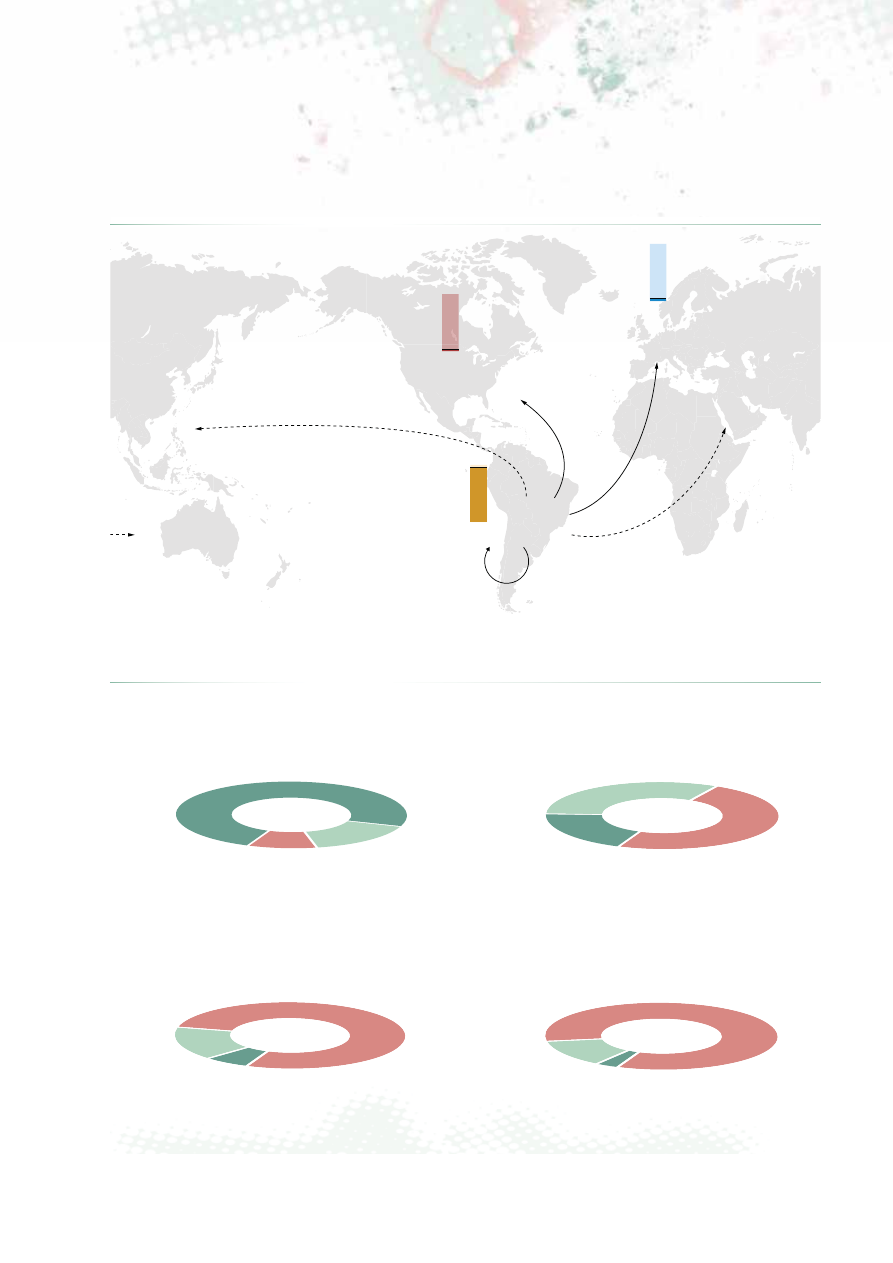
Turning now to South America, this is by and large a sub-
region of destination for domestic or intraregional traf-
FIG. 55:
Evolution of the origins of trafficking into North and Central America and the
Caribbean,
2007/2010-2010/2012
Source: UNODC elaboration on national data.
2007-2010
100% is equivalent to
1,592 detected victims
2010-2012
100% is equivalent to
2,204 detected victims
within North,
Central America
and the Caribbean
South
America
South Asia
Central Europe
and the Balkans
East Asia
65%
59%
3% 3%
1%
7%
2%
5%
28%
25%
Sciences Po - Atelier de cartographie, 2014
MAP 14:
Destinations of trafficking victims
originating in North and Central
America and the Caribbean,
propor-
tion of the total number of detected
victims at destinations,
2010-2012 (or
more recent)
Source: UNODC.
Regional overviews
II
75
94%
1%
4%
South Asia, East Asia
and the Pacific
Domestic (within countries)
51%
and within the subregion (cross-border)
43%
South
America
Central America
and the Caribbean
100% is equivalent to
1,810 detected victims
Sciences Po - Atelier de cartographie, 2014
ficking. Almost all the victims detected in South American
countries are either citizens of the detecting country or
have been trafficked across the border from neighbouring
countries. The same broad pattern of trafficking from
relatively poorer towards comparatively richer areas can
be discerned. For example, Bolivians are trafficked to
Argentina, Brazil, Chile and Paraguay; Paraguayans and
Peruvians are trafficked to Argentina and Chile; and
Colombians are trafficked to Chile and to some Central
American countries, to mention some of the flows.
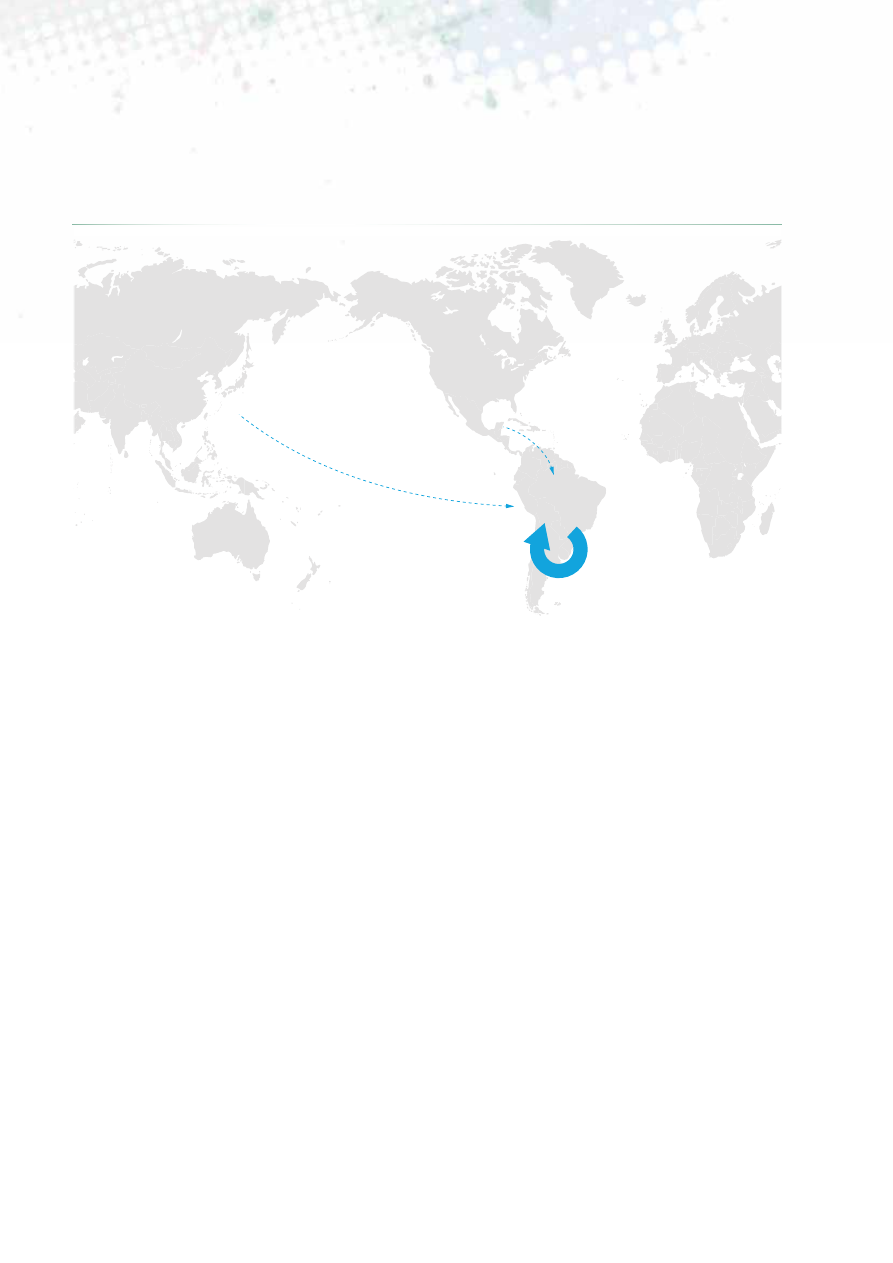
In terms of inbound trafficking from outside the subre-
gion, this only accounts for some 6 per cent of the total
number of detected victims. This share mainly comprises
East Asian victims, as well as a limited number of victims
from Central America and the Caribbean.
As an origin area for trafficking in persons out of the sub-
region, South American victims have been detected in a
variety of countries. The most pertinent flows are those
directed towards Western and Central Europe (some 6
per cent of the victims detected there), and North and
Central America and the Caribbean (some 3 per cent,
mainly detected in Central American and Caribbean
countries). A limited number of South American victims
have also been detected in East Asia and the Pacific, and
in North Africa and the Middle East.
Response to trafficking in persons
In terms of the regional response to trafficking in persons,
most of the countries have specific legislation today,
although for some of the countries, the legislative cover-
age is partial. All North and Central American countries
have a specific offence in line with the UN Trafficking in
Persons Protocol. Among those considered, one country
in the Caribbean lacks a specific offence on trafficking in
persons, while four countries in South America and the
Caribbean criminalize only some aspects of trafficking in
persons.
Most of the countries in this part of the world did not
include trafficking in persons in their criminal code before
the entry into force of the Trafficking in Persons Protocol
in 2003. In fact, only three countries had a specific offence
in line with international standards at that time, while
five had partial legislation. A few years later, the situation
improved. In 2008, almost half of the countries in the
Western Hemisphere had legislation on trafficking in per-
sons in compliance with the international standards. Now-
adays, the situation has further improved as a vast majority
of the countries have full-fledged legislation.
The criminal justice response in the Western Hemisphere
shows that among the countries considered, only the
MAP 15:
Origin of victims detected in South America,
as a proportion of the total number of
victims detected in the subregion,
2010-2012 (or more recent)
Source: UNODC.
GLOBAL REPOR
T ON
TRAFFICKING IN PERSONS
2014
76
South
America
6%
Western and Central
Europe
The Middle East
and North Africa
East
Asia
3%
North America, Central America
and the Caribbean
94%
Flows of less than 1%
of detected victims
at destination
Sciences Po - Atelier de cartographie, 2014
MAP 16:
Destinations of trafficking victims originating in South America,
proportion of the
total number of detected victims at destinations,
2010-2012 (or more recent)
Source: UNODC elaboration on national data.
FIG. 56:
Historical evolution of the legislation in the Americas,
2003-2014
Source: UNODC elaboration on national data.
2003
NO OFFENCE
23
MOST / ALL
FORMS
3
PARTIAL
OFFENCE
5
NO OFFENCE
6
MOST / ALL
FORMS
15
PARTIAL
OFFENCE
10
2008
TOTAL NUMBER OF COUNTRIES CONSIDERED, N:31
NO OFFENCE
2
MOST / ALL
FORMS
24
PARTIAL
OFFENCE
5
2012
NO OFFENCE
1
MOST / ALL
FORMS
26
PARTIAL
OFFENCE
4
2014