ВУЗ: Не указан
Категория: Не указан
Дисциплина: Не указана
Добавлен: 13.10.2020
Просмотров: 1659
Скачиваний: 1

Regional overviews
II
67
In Western and Central Europe, eight countries recorded
more than 50 convictions in at least one year during the
2010-2012 period.
On average, 30 per cent of trafficking in persons suspects
in Western and Central Europe received a conviction in
the first instance. About half of those prosecuted got a
first-instance conviction.
Eastern Europe and Central Asia
•
Most of the detected trafficking is intraregional; few
victims trafficked from other regions.
•
Many female traffickers and victims.
•
Mainly sexual exploitation, but more forced labour
than in Western and Central Europe.
•
All countries have Protocol-compliant legislation.
One of the key characteristics of trafficking in persons in
Eastern Europe and Central Asia is the strong involvement
of women, both as traffickers and victims.
Profile of the offenders
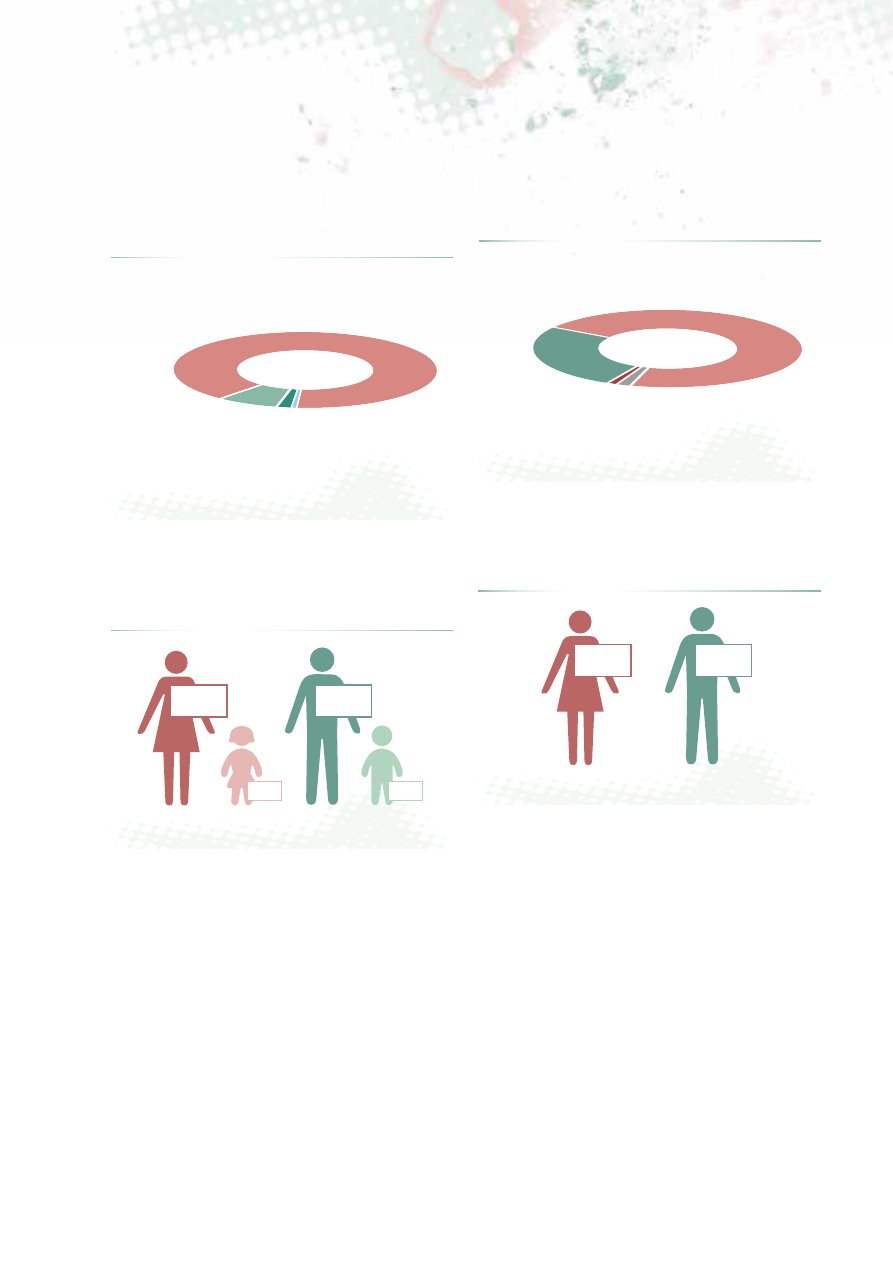
Considering both prosecutions and convictions, almost
half of the traffickers in Eastern Europe and Central Asia
are women. While women are more involved in traffick-
ing in persons than most other crimes, a female offending
rate of some 50 per cent is exceptional as the global aver-
age for trafficking in persons is around 30 per cent.
The vast majority of the traffickers convicted in this sub-
region – more than 90 per cent - are local citizens con-
victed in their own countries. About 8 per cent are
foreigners from countries within Eastern Europe and Cen-
tral Asia. This is an expected citizenship profile breakdown
for a subregion which mainly experiences intraregional
and domestic trafficking in persons and which is mainly
an origin area for trafficking victims.
Some 3 per cent of the convicted traffickers in Eastern
Europe and Central Asia come from other (sub)regions;
most of them from Western and Central Europe, but also
some from the Middle East. Both are areas of destination
for victims who are citizens of countries in Eastern Europe
and Central Asia. For example, in the court cases submit-
ted to UNODC by Member States, a case from Belarus
saw a man from a country in Western and Central Europe
convicted in Belarus for his involvement in trafficking
local women via his own country to another Western
European destination for sexual exploitation. He was
living in Belarus and targeted poor women looking for
work opportunities abroad. Through promises of well-
paid work, he deceived the victims to travel abroad. Their
first stop was the offender’s home country where the
women were met by his accomplices. While this man was
the only offender sentenced in the case (he received a
prison sentence of seven years), the case brief made it clear
that several others were also involved.
Profile of the victims
While the prominent detections of women victims in the
entire region has already been mentioned, in Eastern
Europe and Central Asia it is particularly high, at 77 per
cent. This is the highest share of women victims of any
(sub)region.
Some 15 per cent of the detected victims are men, which
brings the share of adult trafficking victims in this subre-
gion well above 90 per cent. This is a very large share in
FIG. 40:
Prosecutions for trafficking in per-
sons in Eastern Europe and Central
Asia,
by gender,
2010-2012 (or more
recent)
Source: UNODC elaboration on national data.
FIG. 41:
Convictions for trafficking in persons
in Eastern Europe and Central Asia,
by gender,
2010-2012 (or more recent)
Source: UNODC elaboration on national data.
46
%
54
%
56
%
44
%
GLOBAL REPOR
T ON
TRAFFICKING IN PERSONS
2014
68
a global perspective. Detected child trafficking is marginal
compared to adult trafficking in Eastern Europe and Cen-
tral Asia, as only about 8 per cent of the detected victims
are children. As in Western and Central Europe, child
trafficking mainly concerns girls.
In terms of the forms of exploitation, sexual exploitation
is by far the most commonly detected form, accounting
for more than 70 per cent of the victims.
About 26 per cent of the victims detected here are traf-
ficked for forced labour. A relatively large share of forced
labour victims detected in Eastern Europe and Central
Asia are women; some 30 per cent.
About 50 victims of trafficking in persons for the purpose
of organ removal were detected during the period consid-
ered in Europe and Central Asia; 38 of them in Eastern
Europe and Central Asia. About 80 per cent of these vic-
tims were males.
Trafficking flows
Most of the victims who are detected in countries in East-
ern Europe and Central Asia originate from that subre-
gion, regardless of whether they are victims of domestic
trafficking or cross-border trafficking within the subre-
gion. In other words, there are very few foreigners from
outside Eastern Europe and Central Asia trafficked into
the subregion for exploitation there.
Moreover, nearly all - 99 per cent - of the victims detected
in this subregion are either domestically trafficked or traf-
ficked from neighboring countries within the subregion.
FIG. 42:
Citizenships of convicted traffickers
in Eastern Europe and Central Asia
(by region/subregion),
2010-2012 (or
more recent)
Source: UNODC elaboration on national data.
FOREIGNERS -
EASTERN EUROPE
AND CENTRAL ASIA
8%
NATIONAL
OFFENDERS
90%
WESTERN AND
CENTRAL EUROPE
2%
AFRICA AND
MIDDLE EAST
0.5%
FIG. 43:
Gender and age profiles of victims
detected in Eastern Europe and
Central Asia,
2010-2012 (or more
recent)
Source: UNODC elaboration on national data.
FIG. 44:
Forms of exploitation detected in
Eastern Europe and Central Asia,
2010-2012 (or more recent)
Source: UNODC elaboration on national data.
77
%
15
%
6
%
2
%
ORGAN
REMOVAL
1%
SEXUAL
EXPLOITATION
71%
OTHERS
2%
FORCED
LABOUR
26%
FIG. 45:
Gender breakdown of victims traf-
ficked for forced labour in Eastern
Europe and Central Asia,
2010-2012
(or more recent)
Source: UNODC elaboration on national data.
30
%
70
%
Regional overviews
II
69
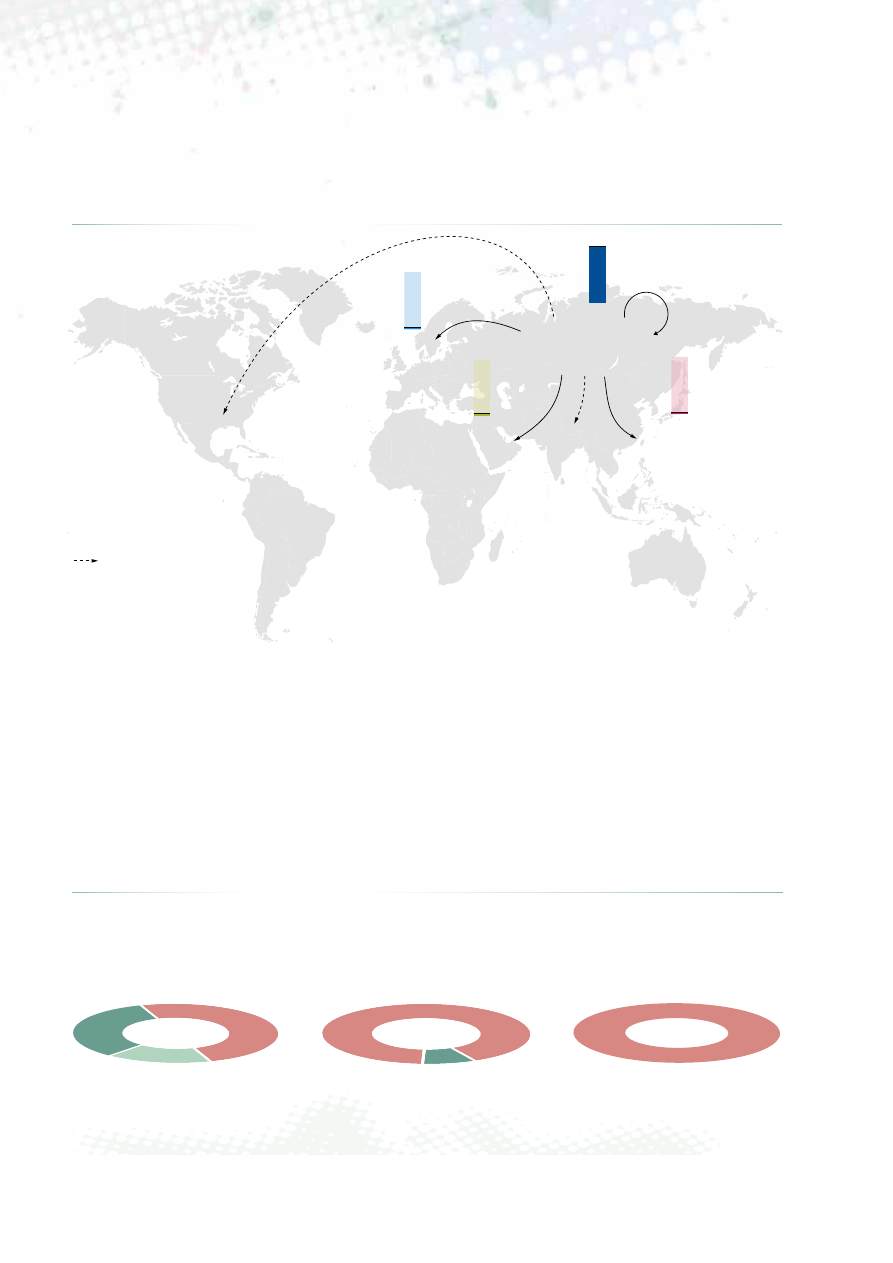
From an origin perspective, victims from Eastern Europe
and Central Asia have been detected in or repatriated from
a large number of countries, especially in Western and
Central Europe. Victims from this subregion have also
been significantly detected in the Middle East and in East
Asia. While detections of these citizens are decreasing, at
least in Western and Central Europe, North America and
the Middle East, displacement of these trafficking flows
to other regions or intra-regionally cannot be excluded.
Response to trafficking in persons
All countries in Eastern Europe and Central Asia now
have legislation in line with the UN Trafficking in Persons
Protocol. Similar to Western and Central Europe, the year
2003 marked the moment when a wave of new legislation
started to be introduced.
Among these countries, the Central Asian ones needed
most time to have legislation fully in line with the inter-
MAP 12:
Destinations of trafficking victims from Eastern Europe and Central Asia,
as a propor-
tion of the total number of victims detected at destination,
2010-2012
Source: UNODC.
North America,
Central America
and the Caribbean
4%
Western
and Central
Europe
Eastern Europe
and Central Asia
99.3%
South
Asia
6%
North
Africa and
the Middle
East
2.5%
East Asia
and the Pacific
Flows of less than 1%
of detected victims
at destination
Sciences Po - Atelier de cartographie, 2014
FIG. 46:
Historical evolution of the legislation in Eastern Europe and Central Asia,
2003-2012
Source: UNODC elaboration on national data.
2003
NO OFFENCE
4
MOST / ALL
FORMS
6
PARTIAL
OFFENCE
2
NO OFFENCE
1
MOST / ALL
FORMS
11
2008
MOST / ALL
FORMS
12
2012
TOTAL NUMBER OF COUNTRIES CONSIDERED, N:12

GLOBAL REPOR
T ON
TRAFFICKING IN PERSONS
2014
70
national standards of the Trafficking in Persons
Protocol.
The number of persons convicted per 100,000 population
in Europe and Central Asia is high in comparison to the
rest of the world, and the average rates in Eastern Europe
are somewhat higher than in Western Europe. However,
the highest rates of convictions per population in Europe,
and in the world, are registered in the Balkans, with a peak
of 2 convictions per 100,000 population.
Most of the countries in Eastern Europe and Central Asia
reported having between 10 and 50 convictions for traf-
ficking in persons per year. For two countries in this sub-
region, however, this information was not available.
TRAFFICKING IN PERSONS IN THE
AMERICAS
•
Forced labour prominent.
•
Many foreign traffickers convicted in origin countries.
•
Large share of women traffickers.
The region of the Americas encompasses the subregions
of North and Central America and the Caribbean, and
South America. While the two subregions are different in
some respects, particularly regarding trafficking flows,
they display many similarities in terms of the patterns.
For this reason, they will be considered together in this
section, with a subregion-specific brief analysis of traffick-
ing flows at the end.
Profile of the offenders
With regard to the citizenships of the offenders, as a result
of lack of data from key countries, only a partial analysis
can be presented. As in other parts of the world, most of
the offenders in the Americas are people convicted of traf-
ficking in persons in their own country of citizenship
(about 80 per cent of the total number of convicted
offenders). About 17 per cent of the offenders are citizens
of other countries in the region, whereas some 3 per cent
are traffickers from countries in other regions. Some of
the traffickers in this group are citizens of typical destina-
tion countries for South American victims.
Keeping in mind the global finding that most foreign traf-
fickers are convicted in destination countries, the Americas
region is somewhat anomalous. The participation of for-
eign traffickers in countries of origin in this region seems
to be higher than in most other parts of the world. Some
13 per cent of the foreign traffickers were convicted in
typical origin countries of cross-border trafficking, and
this may be a low figure as data from some key countries
is missing.
Traffickers from countries in the Americas are not only
convicted there, however. Western European countries
have convicted a significant number of citizens of coun-
tries in South America and the Caribbean during the
reporting period. Citizens of countries in the Americas
account for about 4 per cent of the total number of con-
victed persons in the subregion of Western and Central
Europe.
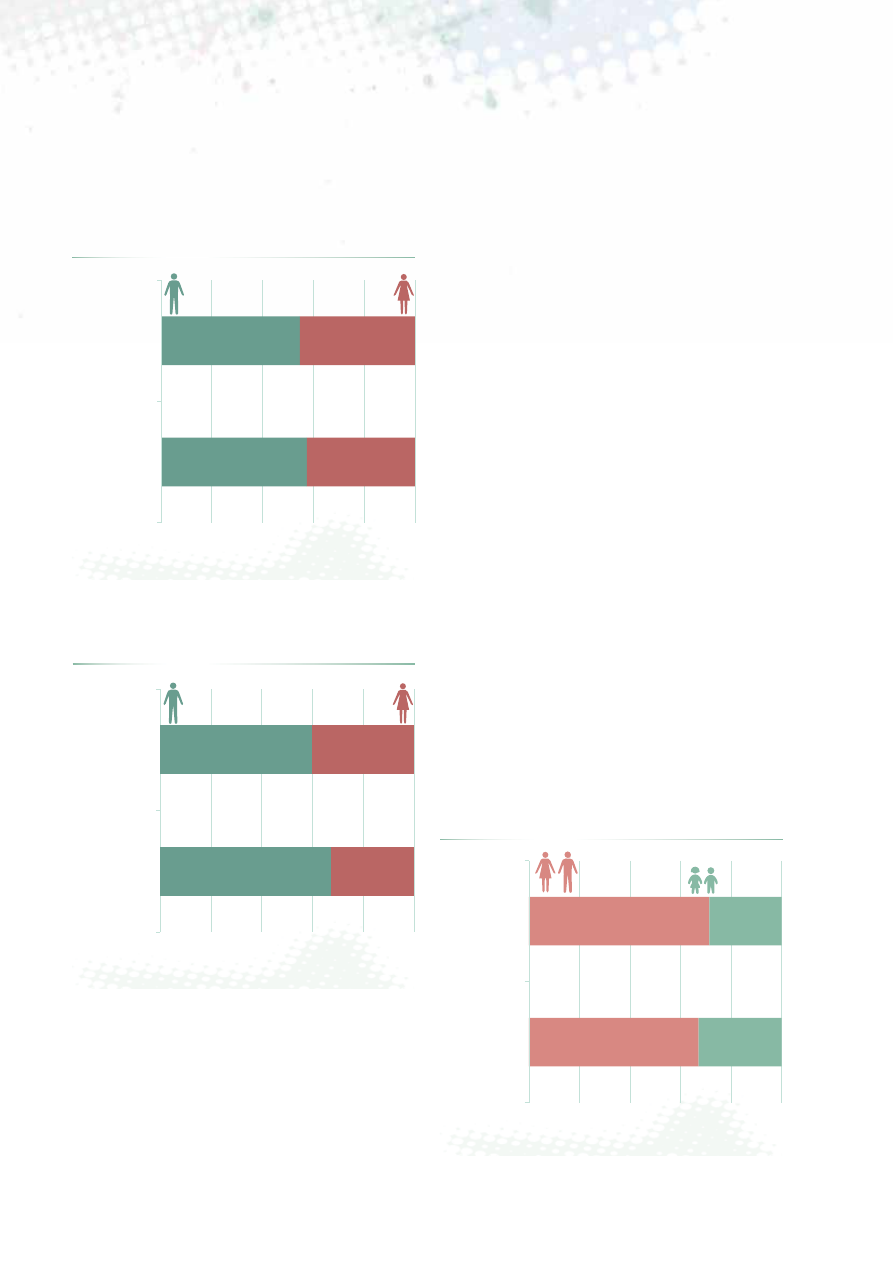
Overall, the share of women among the total number of
FIG. 47:
Citizenships of offenders convicted
in the Americas (by (sub)region),
2010-2012 (or more recent)
Source: UNODC elaboration on national data.
NATIONAL
OFFENDERS
80%
FOREIGNERS -
AMERICAS
17%
SOUTH ASIA,
EAST ASIA AND
THE PACIFIC
1%
WESTERN AND
CENTRAL EUROPE
2%
FIG. 48:
Convictions of foreign offenders
(relative to the convicting country)
by countries of origin and destina-
tion of cross-border trafficking in
the Americas,
2010-2012
Source: UNODC elaboration on national data.
COUNTRIES OF
DESTINATION
88%
COUNTRIES
OF ORIGIN
12%
Regional overviews
II
71
traffickers in the Americas is also relatively high, ranging
around 40 per cent for prosecutions as well as convictions.
These shares are similar in both subregions, even if some-
what higher in South America. A closer look reveals that
Central American countries record higher shares of female
involvement in the trafficking process (which may be
related to the profile of the victims detected there),
whereas Canada in North America reported a much lower
female conviction rate.
Profile of the victims
The profiles of the victims detected across the two subre-
gions of the Americas are similar. Child trafficking
accounts for almost 30 per cent of the total number of
detected victims, with adults making up the other 70 per
cent. These shares are similar to those found for the 2007-
2010 period.
A closer look at the two subregions brings to light some
differences in terms of the profiles of detected victims.
While in North America and in the South Cone of South
America, adult trafficking accounts for a larger share of
victims than the regional average, the share of detected
child trafficking is relatively high in Central America and
in the northern part of South America.
Most of the detected child victims are girls. Out of every
three children detected as victims, two are girls and one
is a boy. This breakdown applies to the whole region. The
females also dominate among the adults. Adult women
account for approximately half of all detected victims in
the Americas, whereas some 20 per cent are men.
There is a clearly increasing detection rate of children in
North and Central America and the Caribbean. In South
America, however, the country-level trends are more
mixed.
FIG. 49:
Prosecutions for trafficking in
persons in the Americas,
by sub-
region and gender,
2010-2012
(or more recent)
Source: UNODC elaboration on national data.
FIG. 50:
Convictions for trafficking in persons
in the Americas,
by subregion and
gender,
2010-2012 (or more recent)
Source: UNODC elaboration on national data.
0%
20%
40%
60%
80%
100%
South
America
North America,
Central America
and Caribbean
55%
45%
43%
57%
0%
20%
40%
60%
80%
100%
North America,
Central America
and Caribbean
South
America
60%
40%
33%
67%
FIG. 51:
Age profiles of detected victims
in the Americas, by subregion,
2010-2012 (or more recent)
Source: UNODC elaboration on national data.
0%
20%
40%
60%
80%
100%
South America
North America,
Central America
and Caribbean
CHILDREN
ADULTS
71%
29%
67%
33%