ВУЗ: Не указан
Категория: Не указан
Дисциплина: Не указана
Добавлен: 13.10.2020
Просмотров: 1645
Скачиваний: 1

Global overview
I
57
Gl
l
l
l
ob
o
al o
o
verview
I
in the Middle East and in Western Europe. The
local confraternity cells are involved in different
criminal activities wherever they operate. This
includes trafficking in persons for the purpose of
sexual exploitation, drug trafficking, counterfeiting,
documents falsification and money-laundering.
They maintain a rigid hierarchical structure headed
by a directorate and each
forum
is independent. The
members have a specific functional and hierarchical
role; they are connected by familiar or other rela-
tional ties. They have defined rules, initiation ritu-
als and hundreds of members operating in Africa
and on or in other continents. They use a combina-
tion of money collectors, cash mules and corrup-
tion to launder and transfer illegal profits from
Europe to West Africa.
v
As far as these confraternities’ involvement in the
human trafficking activity is concerned, it appears
that the role may change according to the different
organizational capabilities of the local
forum.
In
some cases the local
forum
does not directly engage
in the recruitment, transportation and exploitation
of victims, but rather ‘taxed’ and supervised the
madam-driven networks that operate independently
but within the territory under the confraternity’s
control. In some other cases, the confraternities are
directly managing the recruitment, transfer and
exploitation of the victims. They also applied a
‘taxation’ to free prostitutes who want to operate in
the areas under their control.
v
Whether or not they do operate the human traffick-
ing directly, the confraternities may facilitate it
when they have some leverage to exert. For instance,
investigative evidence shows that the confraternities
are able to bribe officers in some European airports
to facilitate the transit of victims into the European
Union free movement area. These groups access
institutions in Africa and Europe in order to secure
travel documents and impunity. They use system-
atic corruption and violence to protect and expand
their profits from the trafficking.
v
On the basis of the evidence collected by the inves-
tigators, it is clear that the confraternities play an
important role in interfacing with other criminal
organizations that operate in the same territory,
either peacefully or violently. For instance, in Italy,
the members of the
Eiye
arrested were in business
with a group from the Balkans for the distribution
of marijuana in the area under confraternity con-
trol.
v
The Spanish investigators define the trafficking in
persons originating from Nigeria as having a serious
incidence in Spain (in 2013, 13 per cent of the
victims detected and 8 per cent of the suspects
arrested in Spain were Nigerian citizens). Some
investigators suspect most of the Nigerian groups
operating this trafficking operate under the control
of the confraternities.
v
The endurance of this trafficking flow in almost all
Western European countries indicate this maybe
the case also in other countries of the continent,
although further investigative work would be
needed to verify this.
I
The primary information for this text box was collected from
law enforcement officers specialized on trafficking in persons
and organized crime in Italy and Spain. The information con-
cerning Spain was gathered from intelligence reports received
from the national authorities of the Centro de Inteligencia
Contra el Crimen Organizado (CICO), the Fuerzas y Cuerpos
de Seguridad del Estado (Guardia Civil y el Cuerpo Nacional
de Policia), and from the Mossos d’Esquadra for what con-
cerns specifically the Autonomous Community of Catalonia in
Spain. In Italy, the information was extrapolated from investi-
gative files provided by the Procura Distrettuale Anti Mafia on
the operation CULTS, completed in March 2014.
II
Primary information collected for this study as indicated in
note I. See also Carling, J.,
Migration, Human Smuggling and
Trafficking from Nigeria to Europe
, International Organization
for Migration (IOM), 2005; Carchedi, F. and Orfano, I.,
La
Tratta di Persone in Italia; Evoluzione del Fenomeno ed Ambiti
di Sfruttamento
, Osservatorio Tratta, FrancoAngeli, Milano,
2007; UNICRI,
Trafficking of Nigerian Girls to Italy - the data,
the stories, the social services
, 2010.
III
Juju is a traditional religious belief of the Yoruba people of
Southwest Nigeria on the spirit world affecting the everyday
life and it is predominantly practiced is in the Edo state and
the River Niger Delta region. Juju was originally created by
the early Europeans and it has its origins in the French word
joujou, meaning toy or plaything. Juju refers to a small object
that is believed to contain energy that brings luck and protec-
tion. The early Europeans mistakenly understood these objects
to be the focus of worship and named the religious belief as
juju. (Anti-trafficking Consultants: http://www.antitrafficking-
consultants.co.uk/tactics/)
IV
See Lo Iacono, E., ‘Victims, Sex Workers and Perpetrators:
Grey Areas in the Trafficking of Nigerian Women’,
Trends in
Organized Crime,
2014.
V
Primary information collected for this study as indicated in
footnote I.
VI
Research Directorate, Immigration and Refugee Board,
Nige-
ria: The Black Axe Confraternity, also known as the Neo-Black
Movement of Africa
, 2005 (Response to Information Request,
available at: http://www.irb-cisr.gc.ca/Eng/ResRec/RirRdi/
Pages/index.aspx?doc=433931).



59
CHAPTER II
REGIONAL OVERVIEWS
Following the global overview, the regional overviews will
go into more detail about the trafficking situation in the
four regions considered in this Report. The regions are
presented in separate sections which first discuss the pro-
files of offenders, then victims, then trafficking flows and
finally the regional responses to the trafficking crime.
TRAFFICKING IN PERSONS IN
EUROPE AND CENTRAL ASIA
•
Victims are often adult women.
•
Sexual exploitation is prominently detected.
•
Traffickers from this region are mainly prosecuted
there.
•
Diversity of trafficking flows, particularly in Western
and Central Europe.
In this Report, Europe and Central Asia is divided into
two subregions, namely Western and Central Europe, as
well as Eastern Europe and Central Asia. The two subre-
gions display some similarities in terms of the patterns
and flows of trafficking in persons, summarized above.
Other aspects are quite different, particularly in relation
to trafficking flows. Since the data from this region is
solid, particularly for Western and Central Europe, the
two subregions will be presented in separate sections.
Western and Central Europe
37
•
Diversity of trafficking flows.
•
Many foreign offenders; mostly from within the
subregion.
•
Mostly adult women victims.
•
Sexual exploitation very prevalent.
•
All countries have Protocol-compliant legislation.
37 As the data coverage in this region is solid, it is possible to present
more detailed analyses of the trafficking patterns and flows. In order
to do so, the following geographical aggregations will be used in this
section when appropriate: ‘Western Europe’ - Austria, Denmark, Fin-
land, France, Germany, Ireland, the Netherlands, Norway, Sweden,
Switzerland and the United Kingdom; ‘Southern Europe’ - Cyprus,
Greece, Italy, Malta, Portugal, Spain and Turkey; ‘Central Europe’
- Czech Republic, Estonia, Hungary, Latvia, Lithuania, Poland, Slo-
vakia and Slovenia; and ‘the Balkans’ - Albania, Bosnia and Herze-
govina, Bulgaria, Croatia, Montenegro, Romania, Serbia and the
Former Yugoslav Republic of Macedonia.
Western and Central Europe is a region that is both an
origin and a destination for trafficking in persons. Coun-
tries in Central Europe and the Balkans are mainly origin
areas for cross-border trafficking into the rest of Europe.
These countries also detect significant levels of domestic
trafficking. The richer countries in Western and Southern
Europe are generally destinations for victims trafficked
from other regions (Asia, Africa and the Americas) and
for European victims trafficked from Central Europe and
the Balkans. Most of these countries also report consider-
able levels of domestic trafficking.
Profile of the offenders
The profiles of traffickers convicted in this subregion
broadly reflect the different roles of countries in the traf-
ficking process. Western and Central European countries
convict citizens of their own country and foreigners in
near equal proportions. As shown in map 7 (p. 60), some-
what more than half of the offenders convicted during the
2010-2012 period were citizens of the country of convic-
tion. About 30 per cent of the traffickers were foreigners
from countries within the same subregion. Compared to
the global average, countries in Western and Central
Europe convict fewer own citizens (even though they do
make up a majority of offenders) but more foreigners from
within the subregion.
Considering origins from outside Western and Central
Europe, the largest share is made up of traffickers from
Africa and the Middle East. This group accounts for some
10 per cent of the total number of people convicted. Most
of these offenders are citizens of countries in West and
North Africa. However, the relevance of West African traf-
fickers (some 6 per cent of the convicted offenders) is
limited in comparison to the large share of victims from
this region that are detected in Western and Central
Europe.
Other significant groups of foreign traffickers from out-
side the subregion are Asians and citizens of countries in
the Americas. These groups each account for some 5 per
cent of the offenders in this region. Offenders from East-
ern Europe and Central Asia comprise a small, but sig-
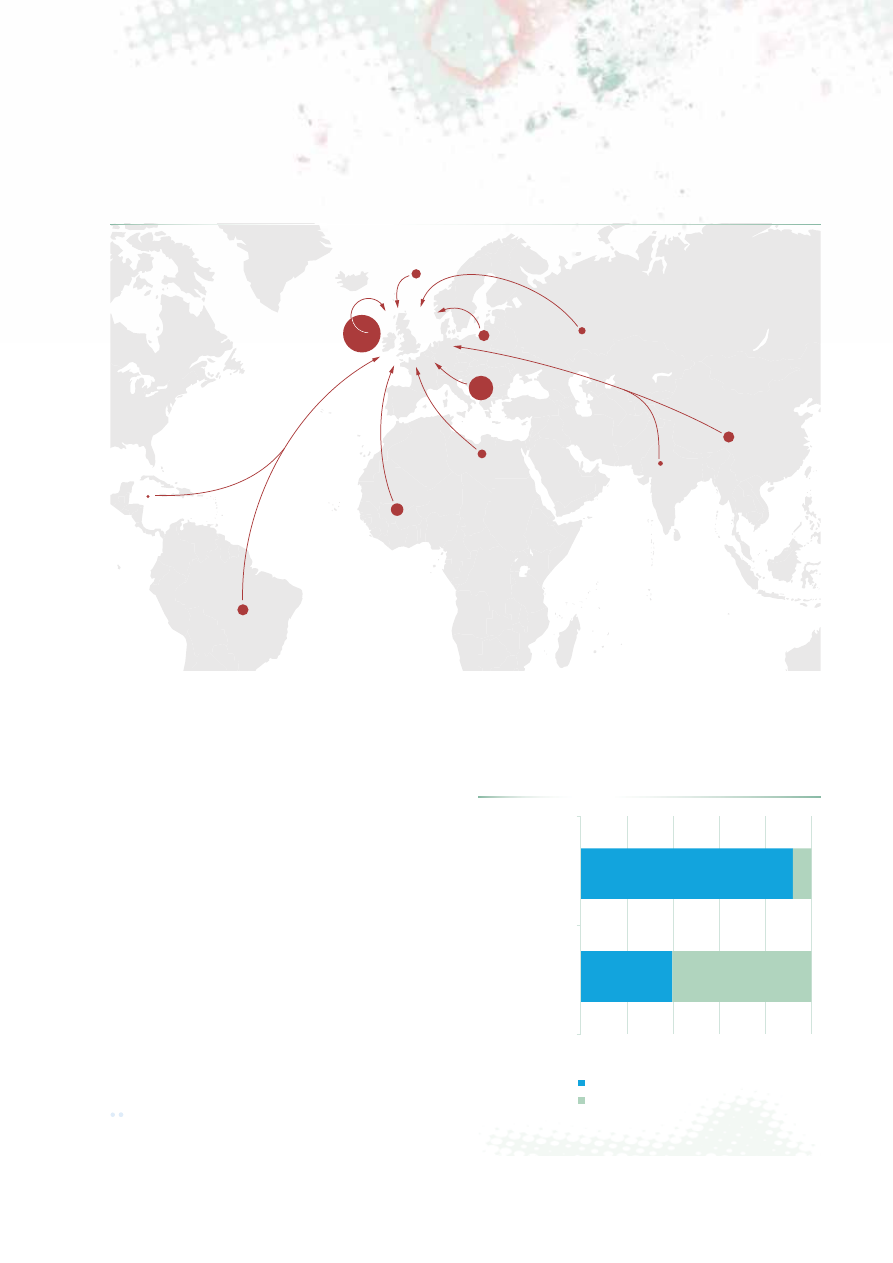
GLOBAL REPOR
T ON
TRAFFICKING IN PERSONS
2014
60
nificant share, with 2 per cent of the total. The citizenship
profiles of the foreign offenders broadly mirror the profiles
of the detected foreign trafficking victims, at least by
major regional aggregations. A statistical analysis presented
in the section
Traffickers, organized crime and the business
of exploitation
indicated that there is a quantitative rela-
tion between the citizenships of offenders and victims
detected in Western and Central Europe, when foreigners
are considered in both categories. The same result was
found in other destinations of trafficking in persons and
confirmed by a qualitative analysis of the court cases sub-
mitted by Member States.
38
The global findings show that areas that are more typical
origins for cross-border trafficking in persons tend to have
vastly different offender profiles than areas that are more
typical destinations. As Western and Central Europe is a
subregion that encompasses countries of origin as well as
destination of cross-border trafficking, this is true also
38 For more information on the court cases, please refer to the section
on Methodology.
5%
4%
1%
4%
0.5%
1.5%
The Balkans
(cross-border)
Central Europe
(cross-border)
Others Europe
(cross-border)
Eastern Europe
and Central Asia
East Asia
South
America
Central America
and the Caribbean
Western
and Central
Europe
West Africa
6%
Local nationals
51%
South Asia
North Africa
and the Middle East
3%
3%
4%
22%
100% is equivalent to
3,539 persons convicted
Sciences Po - Atelier de cartographie, 2014
FIG. 31:
Distribution of national and
foreign offenders among countries
of origin and destination of cross-
border trafficking in Western and
Central Europe,
2010-2012
Source: UNODC elaboration on national data.
MAP 7:
Citizenships of convicted traffickers in Western and Central Europe, by subregion,
shares of the total,
2010-2012 (or more recent)
Source: UNODC.
0%
20%
40%
60%
80%
100%
Western and
Southern Europe
Central Europe
and the Balkans
National offenders
Foreign offenders
92%
40%
60%
8
%
Regional overviews
II
61
there. Countries in the Balkans and Central Europe
39
are
mainly origin areas (with most victims trafficked to West-
ern Europe) and thus convict largely local citizens. More
than 9 in 10 convicted traffickers in these areas are own
citizens. Countries in Western and Southern Europe -
mainly countries of destination - convict large shares of
foreigners, approximately 60 per cent. Almost all - about
97 per cent - of the foreigners who were convicted of traf-
ficking in persons in Western and Central Europe were
detected in the more typical destination countries of cross-
border trafficking.
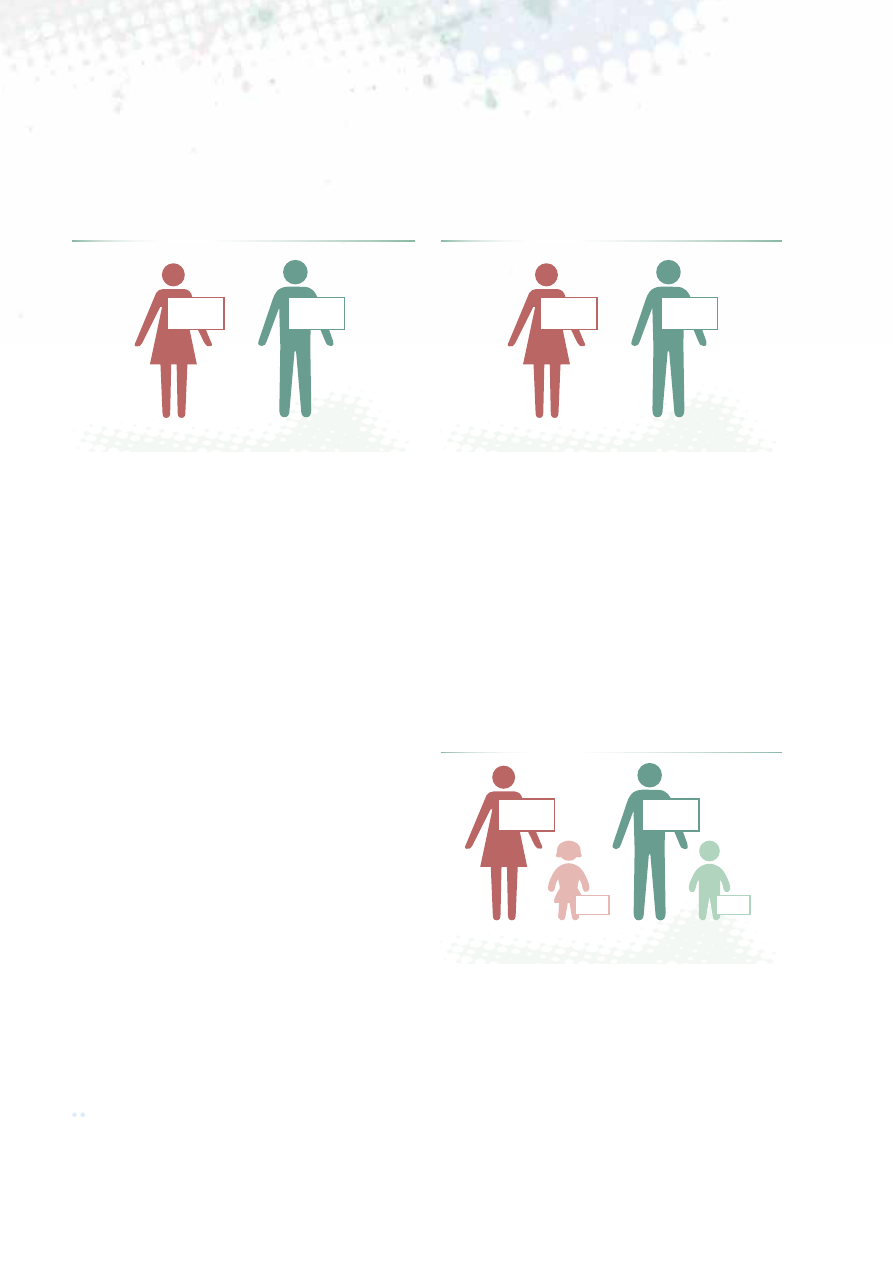
In terms of the gender of the offenders, countries in West-
ern and Central Europe prosecute and convict somewhat
fewer women than the global average. Some 23 per cent
of those prosecuted and/or convicted of trafficking in per-
sons in this subregion are women, compared to some 28
per cent at the global level.
Countries within the subregion report significant differ-
ences in the shares of women who are prosecuted and
convicted. Some countries, for example in the Balkans,
have very low shares of convictions of women. In other
countries, including in the Baltic area, women comprise
nearly one third of the convicted trafficking offenders.
Profile of the victims
On average, countries in Western and Central Europe
detect more adult victims and more women victims than
other (sub)regions. A majority of the detected victims of
trafficking in persons in Western and Central Europe –
some 63 per cent - are adult women, whereas the second
largest group is adult men, who account for 19 per cent
39 For this analysis, 15 countries that are more typical origin than desti-
nation countries for cross-border trafficking have been considered.
of the total number or victims. Adult victims thus com-
prise more than 80 per cent of all detected victims in this
subregion.
The detection of child trafficking in Western and Central
Europe is not as common as in other regions. Children
account for almost 20 per cent of the detected victims,
whereas globally, this group makes up nearly one third of
victims. Girls are much more frequently detected than
boys. Out of every five children trafficked in Western and
Central Europe, four are girls and one is a boy.
Most of the detected victims in this subregion – approxi-
mately 65 per cent - were subjected to sexual exploitation.
This seems to be connected to the high share of females
among the total number of detected victims since traf-
ficking for sexual exploitation largely affects women. Traf-
ficking for sexual exploitation does not only affect females,
however. Some 4 per cent of the victims of this type of
trafficking were males in Western and Central Europe
during the 2010 – 2012 period.
FIG. 32:
Prosecutions for trafficking in per-
sons in Western and Central Europe,
by gender,
2010-2012 (or more recent)
Source: UNODC elaboration on national data.
FIG. 33:
Convictions for trafficking in persons
in Western and Central Europe,
by
gender,
2010-2012 (or more recent)
Source: UNODC elaboration on national data.
23
%
77
%
22
%
78
%
FIG. 34:
Gender and age profiles of victims
detected in Western and Central
Europe,
2010-2012 (or more recent)
Source: UNODC elaboration on national data.
62
%
19
%
16
%
3
%