ВУЗ: Не указан
Категория: Не указан
Дисциплина: Не указана
Добавлен: 13.10.2020
Просмотров: 1650
Скачиваний: 1
GLOBAL REPOR
T ON
TRAFFICKING IN PERSONS
2014
52
over, the sanctions for the traffickers may not be com-
mensurate to the gravity of the crimes committed.
Looking in more detail at the legislative coverage, the
Africa and Middle East region appears to be the part of
the world that more than others needs to fill the legisla-
tive gap. Eight countries in this region lack a specific traf-
ficking in persons offence. In addition, when considering
countries with offences that criminalize only some aspects
of trafficking, ten are in this region. On the other hand,
it is also very important to consider the population size
of countries without adequate legislation in place. When
this is taken into consideration, regions other than Africa
also emerge as problematic.
Large and densely populated countries in Asia and South
America still have partial legislation. As a result, in these
countries, there are persons living in trafficking situations
constituting an offence according to the international
standards, but who may not be considered as trafficking
victims by the national authorities as these are using legal
definitions not in line with the UN Trafficking in Persons
Protocol.
Combining the population size of the country with the
status - lack or partiality - of the legislation shows that
about one third of the world’s population - some 2 billion
people - live in a situation where trafficking is not crimi-
nalized as required by the UN Trafficking in Persons Pro-
tocol. This situation combined with a very low number
of convictions makes trafficking in persons a crime of vast
impunity.
Legislation which is not in compliance with the UN Traf-
ficking in Persons Protocol may also leave vast segments
of the world’s population without the protection and sup-
port which victims of human trafficking have the right to
obtain. There is also the risk that the traffickers who are
exploiting these victims may face light or no criminal
charges even when they are detected by law enforcement
authorities. In addition, cooperation with national author-
ities of other countries is often very difficult, as country-
level legislation may be incompatible.
Criminal justice response:
impunity is
rife
The data on investigations, prosecutions and convictions
collected for the 2010-2012 period shows that the number
of convictions for the crime of trafficking in persons
remains very low.
About 15 per cent of the 128 countries covered by the
data collection for this Report did not record a single con-
viction during the reporting period. Another large share
of the countries covered, about one fourth, recorded a
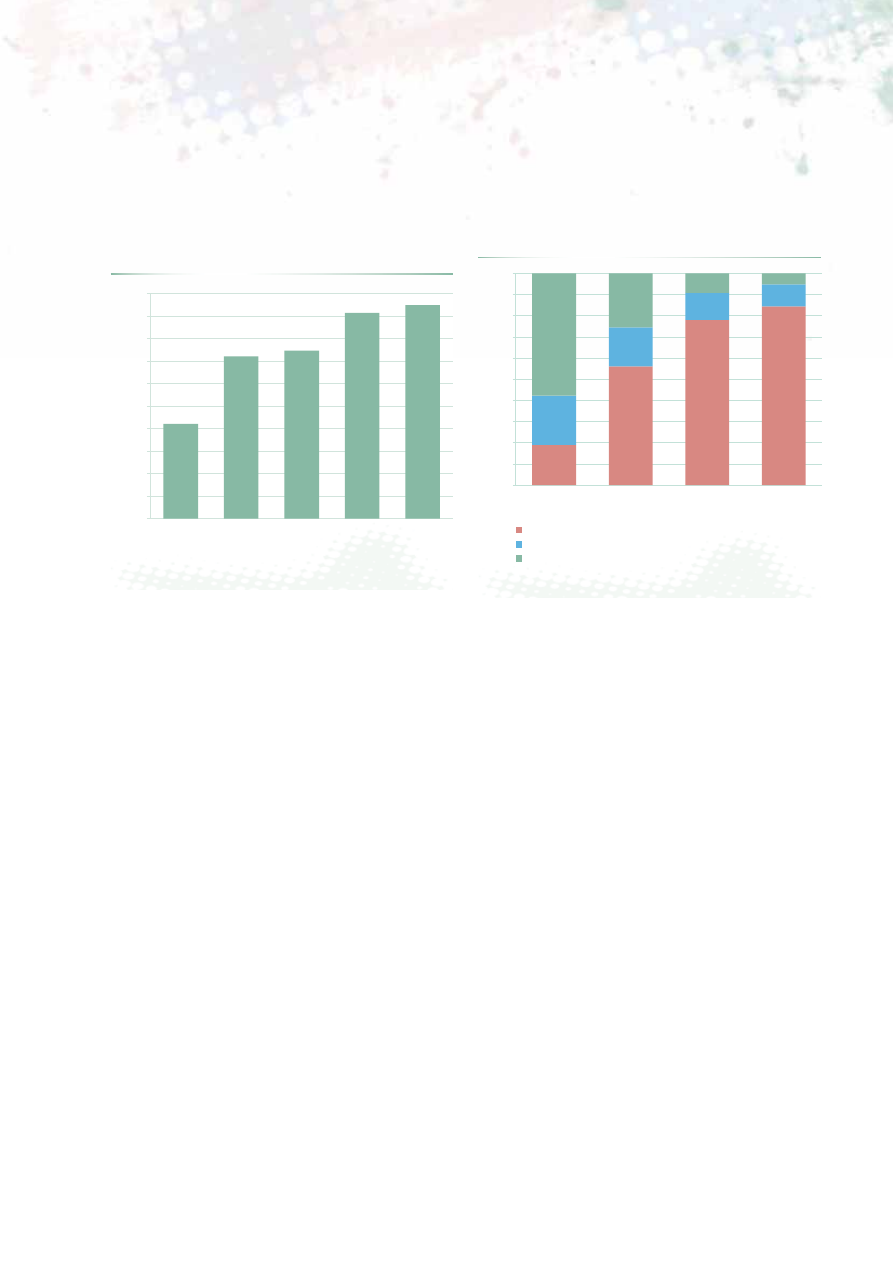
FIG. 26:
Share of countries around the world
criminalizing trafficking in persons,
partially or in full compliance with
the UN Trafficking in Persons Proto-
col,
2003-2014
Source: UNODC elaboration on national data.
FIG. 27:
Criminalization of trafficking in
persons with a specific offence,
number and share of countries,
2003-2014
Source: UNODC elaboration on national data.
42%
72%
75%
91%
95%
0%
10%
20%
30%
40%
50%
60%
70%
80%
90%
100%
November
2003
December
2006
November
2008
August
2012
August
2014
33
(19%)
97
(56%)
135
(78%)
146
(84.5%)
40
(23%)
32
(18.5%)
22
(13%)
18
(10.5%)
100
(58%)
44
(25.5%)
16
(9%)
9
(5%)
0%
10%
20%
30%
40%
50%
60%
70%
80%
90%
100%
November
2003
November
2008
August
2012
August
2014
Most/all forms
Partial
No specific offence

Global overview
I
53
Gl
G
obal overview
I
Confiscated assets and compensation of human trafficking victims
It is generally believed that confiscating the pro-
ceeds of crime is both an appropriate punishment
and an effective prevention tool. Confiscation is a
deterrent for criminals who try to maximize their
profits, and it also prevents illicitly acquired assets
from being reinvested into the legitimate economy.
Confiscation can also serve as a mechanism to dis-
rupt criminal activities, help create an image that
crime does not pay and increase public confidence
in the criminal justice system.
I
In addition, confis-
cated assets can be used to compensate the damage
suffered by trafficking victims.
Many countries face significant challenges related
to the confiscation of assets in trafficking in persons
cases.
II
Traffickers do their best to hide the illicit
profits or place the detected assets beyond the reach
of the criminal justice system. Also, the lack of
funding often undermines the effectiveness of
financial investigation and confiscation efforts.
Given these challenges, are there any successful
confiscations in trafficking in persons cases, and are
these funds substantial enough to be used as com-
pensation for victims of trafficking?
Very little information exists on funds that have
been confiscated in relation to trafficking in per-
sons convictions. The data that UNODC has
received from some 10 Member States in Europe,
Asia and the Pacific, and Central and South Amer-
ica indicates that some countries have been success-
ful in confiscating assets related to trafficking in
persons cases between 2010 and 2013. However,
the yearly amounts vary greatly from a few thou-
sands to 6 million US dollars. When the confiscated
funds are compared to the number of detected vic-
tims the funds remain below 9,000 dollars per
victim; in most cases below 2,000 dollars per victim.
Both the United Nations Convention against Trans-
national Organized Crime
III
and the Trafficking in
Persons Protocol
IV
make specific references to com-
pensation of trafficking victims and the possibility
of using confiscated proceeds for the purpose of
compensation. Many countries have laws that
enable victims of crime to claim compensation for
the damages they have suffered.
V
Despite this legal
framework, compensation remains one of the weak-
est rights of trafficked people.
VI
Although confis-
cated assets seem to provide a logical and
appropriate source for such compensation, very few
countries seem to have sufficient resources to imple-
ment the idea. Low numbers of convictions com-
bined with limited use of financial investigations
hinder efficient confiscation of assets in human
trafficking cases. In order to have efficient and
functional compensation schemes based on confis-
cated assets, countries need to improve their crimi-
nal justice responses, particularly by focusing more
on financial investigations.
I
See, for example, UNODC,
Digest of Organized Crime Cases,
2012; RAND Europe,
Study for an impact assessment on a pro-
posal for a new legal framework on the confiscation and recovery of
criminal assets,
report prepared for the European Commission
Directorate General Home Affairs, 2012.
II
COMP.ACT - European Action for Compensation for Traf-
ficked Persons,
Toolkit on Compensation for Trafficked Persons:
Findings and Results of the European Action for Compensation for
Trafficked Persons,
2012
(www.compactproject.org)
.
III
Articles 14 and 25 (2).
IV
Article 6 (6).
V
See, for example, Organization for Security and Co-operation
in Europe (OSCE), Office for Democratic Institutions and
Human Rights,
Compensation for Trafficked and Exploited Per-
sons in the OSCE Region
, 2008; European Union, Europa –
Summaries of EU Legislation, ‘The rights of crime victims’,
2014, available at: http://europa.eu/legislation_summaries/
justice_freedom_security/judicial_cooperation_in_criminal_
matters/l33091_en.htm; Buchanan, C. (editor),
Gun Vio-
lence, Disability and Recovery,
Surviving Gun Violence Project,
Sydney, 2014, pp. 37-40.
VI
COMP.ACT - European Action for Compensation for Traf-
ficked Persons,
Toolkit on Compensation for Trafficked Per-
sons: Guidance on representing trafficked persons in compensation
claims,
2012
(www.compactproject.org)
.
limited number of convictions, between 1 and 10, in at
least one of the years between 2010 and 2012.
About 40 per cent of the countries covered reported more
than 10 convictions, out of which, some 16 per cent had
more than 50 convictions in at least one of the years here
considered.
The number of convictions and their distribution around
the world remained stable compared to the 2007-2010
period. During that period, the number of countries that
reported no convictions was about 16 per cent of the total
sample, whereas 23 per cent of the countries reported less
than ten convictions in one year.
Data limitations prevent a comprehensive comparison
between the number of convictions and the number of


GLOBAL REPOR
T ON
TRAFFICKING IN PERSONS
2014
54
detected victims. Among the countries that reported on
both indicators, most of the countries with few or no
convictions also identified or assisted a very limited
number of victims. About one third of the countries with
few or no recorded convictions, however, detected a sig-
nificant number of victims. While this suggests that local
institutions are responding to the trafficking occurring in
their countries by identifying and possibly assisting vic-
tims, this does raise the question of why this response does
not turn into a final sentence for the traffickers. For some
of the countries that record few convictions and a signif-
icant number of victims, the use of other offences to con-
vict the traffickers could explain why there is no correlation
between the detection of victims and a proper criminal
justice response. In other cases, it appears that the iden-
tification of a victim does not lead to the prosecution of
a trafficker.
Overall, the global picture of the criminal justice response
shows few signs of change in recent years. An assessment
of how many countries reported increases or decreases in
the absolute number of convictions per year during the
period 2010-2012 confirms this. The vast majority of the
countries reported a relatively stable number of convic-
tions over the 2010-2012 period, while just 13 per cent
saw a noticeable increase. However, another 10 per cent
of countries recorded decreasing trends over the same
period. This means that from a global, aggregated perspec-
tive, the situation remained unchanged. Moreover, the
share of countries reporting stable conviction trends has
not changed significantly since 2003. Between 2003 and
2007, the share of countries with stable or unclear trends
was 71 per cent,
35
between 2007 and 2010 it was 60 per
cent
36
but between 2010 and 2012, the share was 77 per
cent. Similarly, the share of countries with increasing
number of convictions decreased from 21 to 13 per cent.
The data above shows that the number of countries that
successfully manage to punish at least some of the traf-
fickers that operate in their territories is very limited. It
also shows that the situation has not changed in the short
to medium term.
As more countries introduced adequate legislation over
the last ten years, a gradual increase of convictions world-
wide was expected in those countries where trafficking in
persons was known to be a problem. Moreover, over the
35 UNODC/UN.GIFT,
Global Report on Trafficking in Persons
, 2009, p.
37.
36 UNODC,
Global Report on Trafficking in Persons 2012,
p. 85.
last few years, there has been a perception that proper
criminal justice responses would lead to a rising number
of convictions some years after the entry into force of the
UN Trafficking in Persons Protocol. This has not hap-
pened, or perhaps only to a very limited extent. While
more countries in the world now have solid legislation in
place, the number of convictions is stable at a very low
level more or less everywhere.
While it is true that some countries reported large num-
bers of convictions per year, these were often very popu-
lous countries. Their population size alone could explain
the large absolute numbers of convictions. When the ratio
of convictions per population is considered, Europe and
Central Asia reports more convictions per 100,000 popu-
lation (around 0.3). South Asia, East Asia and the Pacific
reports a rate above 0.1, while the Americas and Africa
and the Middle East register rates well below 0.1. Glob-
ally, the number of convictions per 100,000 population
remained basically unchanged in comparison to the 2007-
2010 period (0.1 per 100,000 population).
The wide regional differences obscure different levels of
the overall criminal justice response at the national level
and at different stages of the criminal justice process.
From investigation to conviction; a brief
analysis of the criminal justice response
Where does the criminal justice response start and how
does it develop? There are considerable procedural differ-
ences between countries. However, it is reasonable to argue
that in most legal traditions, the processing of cases
through the criminal justice system proceeds according
FIG. 28:
Number of convictions recorded per
year, share of countries,
2010-2012
Source: UNODC elaboration on national data.
INFORMATION
NOT AVAILABLE
17%
NO CONVICTIONS
15%
MORE THAN 50
CONVICTIONS
16%
LESS THAN TEN
CONVICTIONS
26%
BETWEEN 10 AND
50 CONVICTIONS
26%

Global overview
I
55
to a similar flow. One may consider three main steps
within the process that will ultimately lead to either a
conviction or an acquittal. Step one is the formal act of
initiating a criminal procedure. This is normally done
when the crime is reported and recorded by the authori-
ties. The investigation of the case could lead to the iden-
tification and arrest of crime suspects when the crime is
often regarded as cleared. The second step starts when the
case is turned over to the prosecution service and the sus-
pects are formally charged, on the basis of the evidence
collected during the investigation phase. The third step is
the trial and its outcome, where the suspect is either found
guilty or acquitted. Not all suspects end up being con-
victed; some may have been wrongly accused, or the evi-
dence may not have been strong enough for a conviction.
Moreover, it can be assumed that not all traffickers are
identified by the police forces.
It is very challenging to assess the risk of arrest for a traf-
ficker as the number of active traffickers in a certain area
is difficult to estimate. However, it is possible to estimate
the risks of facing a first-instance conviction for a poten-
tial trafficker who has been identified by the police. At
the global level, an average of some 24 per cent of those
persons who are suspected or investigated by the police
for conducting human trafficking activities are convicted
(in the first instance). In detail, it appears that about 45
per cent of those suspected by the police are prosecuted.
Of the persons prosecuted, 55 per cent are convicted.
From the analysis above, it appears that less than one in
four suspects face conviction. This reflects the relatively
low conviction ratio, which measures the efficiency of
criminal justice systems to deal with trafficking in person
cases. This, in turn, might be a result of the limited capac-
ity of the police, prosecution and judges to respond to
human trafficking crimes. However, considering global
and regional averages always risks obscuring different per-
formances. In Western and Central Europe, about 30 per-
sons among those suspected and 50 of those prosecuted
are convicted in the first instance. These values are high
in comparison to the other regions of the world, which
explains the higher number of convictions per 100,000
population discussed above. South Asia, East Asia and the
Pacific, as well as the Americas present lower ratios of
persons suspected per conviction compared to Europe.
However, also within the regions, significant differences
can be found at the country-level. In these regions, it is
also possible to identify countries where a larger number
of those suspected or prosecuted for trafficking in persons
proceed to receive convictions.
FIG. 29:
Trends in the number of recorded
convictions between 2010 and 2012,
share of countries
Source: UNODC elaboration on national data.
STABLE OR
UNCLEAR TRENDS
77%
INCREASING
TRENDS
13%
DECREASING
TRENDS
10%
FIG. 30:
Probability of first-instance
conviction for persons investigated
for trafficking in persons
Source: UNODC elaboration on national data.
100
persons investigated by the police
45
persons prosecuted
24
persons convicted in first instance
?
Operating traffickers and trafficking networks
Sciences Po - Atelier de cartographie, 2014

GLOBAL REPOR
T ON
TRAFFICKING IN PERSONS
2014
56
G
LO
B
AA
L
RE
P
O
RT
O
N
TR
A
56
Do confraternities control the trafficking of Nigerian victims in
Europe?
ı
Trafficking of young women from Nigeria to
Europe for the purpose of sexual exploitation is one
of the most persistent trafficking flows. During the
2007-2012 period, Nigerian victims constantly
accounted for more than 10 per cent of the total
number of detected victims in Western and Central
Europe, making this the most prominent transre-
gional flow in this subregion. Present in different
European countries since the late 1990s,
ıı
one of the
reasons of its endurance may be the structured orga-
nization of the trafficking rings.
Typically, during the recruitment phase, the victims
are convinced to migrate by means of deception or
by peer pressure. In order to finance their migration
from Africa to Europe, the women sign a ‘contract’
with a member of the organization that sponsors
the trip. A local ‘priest’ blesses the contract with a
ritual called
juju.
ııı
The trafficking route follows the
main smuggling migration paths by land, sea or air.
Victims trafficked to Spain, for instance, may fly to
the main airports of the country or of neighbouring
countries. In the case of the land route, they will
travel through the Sahel, the Sahara to North Africa
and cross the border into Ceuta or Melilla in Spain.
Similarly, on the route to Italy, they will attempt
the sea passage from North Africa to Lampedusa or
Sicily.
v
Once at destination, the victims are already under
the control of the criminal organizations, and sexu-
ally exploited by being forced into prostitution in
order to pay back the debt contracted with the
sponsor. The belief in the power of the
juju
ritual as
well as threats to family members back home nor-
mally secure the loyalty of the victims. In Europe,
the victims are controlled by
madams
; older Nige-
rian women who manage the exploitation phase.
The Spanish authorities reported one mean of con-
trol used by the madams is guarding the victims’
children while the former are in the streets.
ıı
The victims’ debt could amount to some 40,000-
70,000 euros that would cover just the travel and
the protection. The debt will raise for additional
expenses. Investigators estimate just 10,000 euros is
spent by the organization to transfer the victim into
Europe. Once the debt is paid back, the victims are
in theory free.
ıı
However, some of them may feel
that they have few alternatives to continuing pros-
titution or to becoming
madams
themselves. While
being exploited, some victims may decide to coop-
erate with the
madams
in order to have their debt
reduced. In that case, they may move up the hierar-
chy to become
controllers.
Some victims can also
become trafficker so to emancipate from their
exploiters by exploiting other girls. Victims in full
exploitative situation may still accept such status, as
they believe that one day, this system will work in
their favour, and they will run their own trafficking
ring. In this way, victims are also legal accomplices
in the trafficking crime, thus they won’t report the
traffickers to the authorities.
ıv
In March 2014, the Italian authorities concluded an
investigation named ‘CULTS’. As a result of the
investigation 34 persons were arrested. These were
members of two groups, called the
Eiye
and
Aye
confraternities, operative in some parts of Italy
since at least 2008. The investigation brought to
light a level of organization, violence and intimida-
tion similar to other, better known
mafias.
The
presence of these groups have been detected in
some parts of Spain since at least the year 2007.
v
In the area of Rome (Italy), the
Eiye
and the
Aye
have been fighting for over six years for control of
the territories and streets where the victims were
sexually exploited. The investigators report that
these groups were directly involved in managing the
trafficking of young women from the rural areas of
Benin City to Italy via Lome’ (Togo), and that they
had connections in other countries in Europe and
in different parts of Italy.
v
The
Eiye
and the
Aye
confraternities are two of
about a dozen criminal groups that started as uni-
versity campus confraternities in Nigeria. The vio-
lent conflicts between these confraternities since the
late 1970s is well documented, and there have been
hundreds of deaths over the last few decades
vi
. Their
presence in Europe is more recent, however.
Investigators describe these groups to function
through a system of cells (called
forum
) operating
locally but connected to other cells established in
different countries in West African, in North Africa,