ВУЗ: Не указан
Категория: Не указан
Дисциплина: Не указана
Добавлен: 13.10.2020
Просмотров: 1639
Скачиваний: 1

22
GLOBAL REPOR
T ON
TRAFFICKING IN PERSONS
2014
AFRICA AND THE MIDDLE EAST
38 states out of the 66 UN Member States
in the region
AMERICAS
29 states out of the 35 UN Member States
in the region
EUROPE AND CENTRAL ASIA
43 states out of the 53 UN Member States
in the region
SOUTH ASIA, EAST ASIA AND
THE P
ACIFIC
18 states out of the 39 UN Member States
in the region
North Africa and
the Middle East
(11 countries)
Sub-Saharan Africa
(total: 27)
North and Central
America and the
Caribbean
(total: 18)
South America
(total: 11)
W
estern and
Central Europe
(total: 34)
Eastern Europe
and Central Asia
(total: 9)
East Asia and
the Pacific
(total: 12)
South Asia
(6 countries)
Rwanda
United States of
America
Lithuania
Senegal
Malta
Seychelles
Montenegr
o
Sierra Leone
Netherlands
South Africa
Norway
Swaziland
Poland
Togo
Portugal
Uganda
Romania
United Republic of
Tanzania
Serbia
Zimbabwe
Slovakia
Slovenia
Spain
Sweden
Switzerland
The former Y
ugo-
slav Republic of
Macedonia
Turkey
United Kingdom of
Gr
eat Britain and
Norther
n Ir
eland

23
CHAPTER I
GLOBAL OVERVIEW
In the United Nations Global Plan of Action to Combat
Trafficking in Persons,
1
Member States requested for the
present report to focus on the patterns and flows of traf-
ficking in persons. ‘Patterns’ refer to the profiles of traf-
fickers and victims; that is, their citizenship, age and
gender as well as the forms of exploitation. ‘Flows’ refer
to the geographic dimension of trafficking, with a ‘flow’
defined as one origin country and one destination country
with at least five detected victims during the 2010-2012
reporting period.
2
A snapshot of the data shows that most of the offenders
are men, while most of the detected victims are female
(mainly women, but also a significant number of under-
age girls). Trafficking is a transnational crime that is often
carried out domestically or within a given subregion, and
most offenders are convicted in their countries of citizen-
ship. Victims, on the other hand, are often foreigners in
the country where their exploitation was detected. Traf-
ficking flows are usually confined to a geographically lim-
ited area, either within a country or between neighbouring
or relatively close countries.
That said, a greater proportion of women are convicted
of trafficking in persons than of nearly any other crime,
and the detection of male victims is increasing. Many
countries convict a significant number of foreigners of
trafficking in persons, and many victims are not trafficked
abroad but exploited in their own countries. Although
transregional trafficking is less common than the domestic
or intraregional types, it still accounts for nearly a quarter
of all trafficking flows.
This chapter seeks to untangle some of this complexity.
It will first present a global overview of patterns and flows,
and then, a discussion on markets and organized crime as
they relate to trafficking in persons. The chapter closes
with an overview of the legislative and criminal justice
responses to this crime across the world.
1 A/RES/64/293.
2
This also includes flows where the country of origin and destination
is the same, thus the case of domestic trafficking.
TRAFFICKERS
In order to understand the crime of trafficking in persons,
it is crucial to know who the offenders are. Analysing the
citizenship and gender of traffickers can help generate a
broader understanding of the profiles of traffickers and
their networks, as well as on how they operate. As traf-
ficking in persons is a crime that is often transnational,
the question of traffickers’ citizenship is highly relevant,
particularly when it comes to cross-border trafficking as
there is often a citizenship link between traffickers and
victims. Moreover, the issue of female involvement in traf-
ficking in persons is also pertinent.
Information on the citizenship of persons convicted
3
of
trafficking in persons was provided by 64 countries, cov-
ering a total of 5,747 offenders. Information on the gender
of suspected, prosecuted and/or convicted offenders was
provided by 43, 59 and 64 countries respectively, cover-
ing 29,568 persons suspected, 4,915 persons convicted of
and 10,024 persons prosecuted for trafficking in persons.
The data covers the 2010-2012 period (or more recent).
Citizenship profiles of traffickers
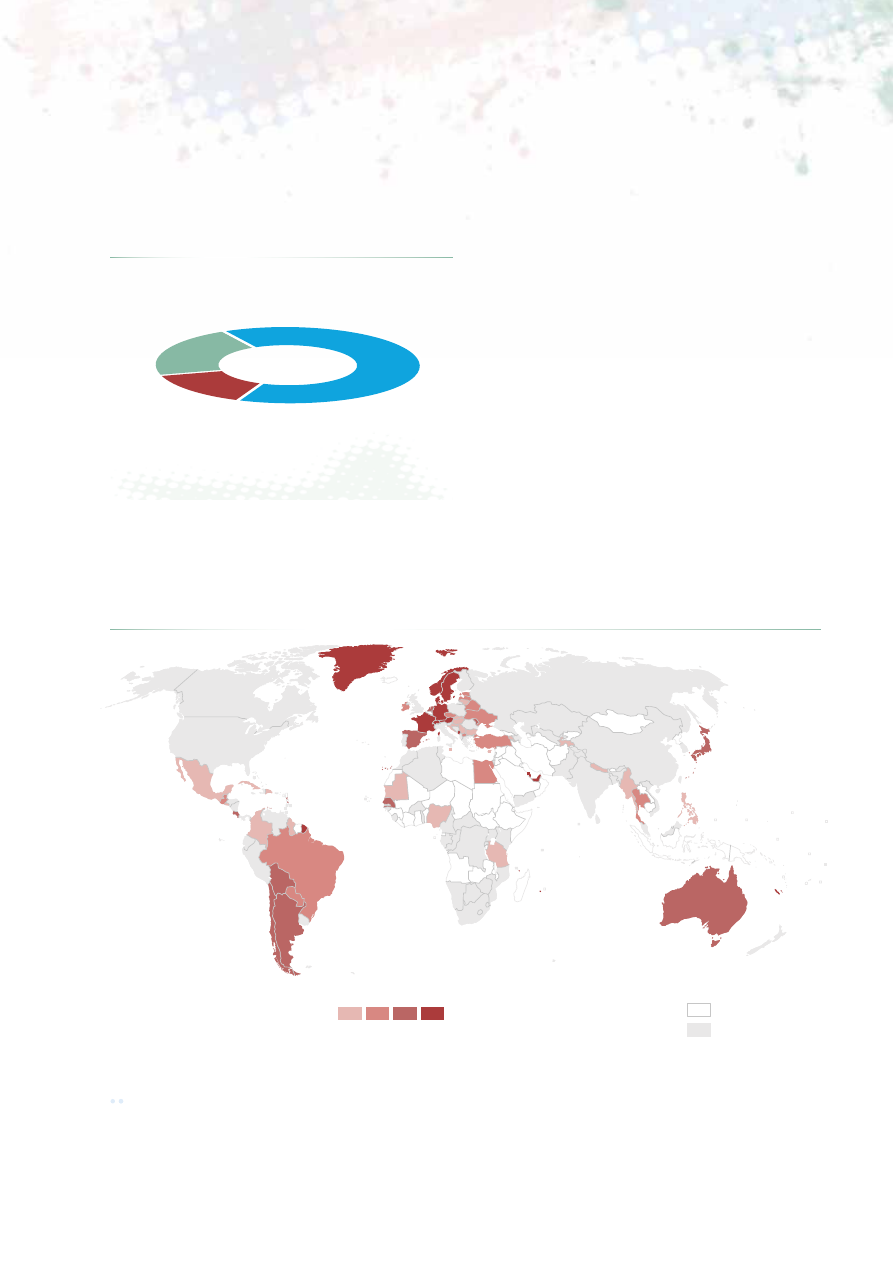
The aggregated citizenship profiles of the people convicted
of trafficking in persons show that most offenders are
citizens of the country where they were convicted. This is
true for more than 6 in 10 convicted traffickers globally.
It is reasonable to expect that the majority of people con-
victed of nearly any crime would be citizens of the pros-
ecuting country. Even though international mobility is
high, most people still live and operate mainly within their
own countries.
While the majority of offenders are citizens of the country
where they were convicted, about 35 per cent of convicted
traffickers are foreigners in those countries. This is a larger
3 Including profile information on persons investigated for traffick-
ing, or on the citizenships of those prosecuted for trafficking (as is
done for the gender profile) would have yielded more data. However,
using citizenship information only on offenders convicted in the first
instance is more solid and limits possible biases related to the poten-
tial targeting of particular citizenships within some criminal justice
systems.

GLOBAL REPOR
T ON
TRAFFICKING IN PERSONS
2014
24
Sciences Po - Atelier de cartographie, 2014
countries not covered
Share of foreign offenders
data not available
0
5
25
60
100
FIG. 1:
Citizenship of convicted traffickers
globally,
2010-2012 (or more recent);
shares of local and foreign nationals
(relative to the country of conviction)
Source: UNODC elaboration on national data.
share of convicted foreigners than what is typically seen
for most other crimes, for which foreign citizens generally
comprise approximately 10 per cent of those convicted.
4
4 United Nations Surveys on Crime Trends and the Operations of
Criminal Justice Systems (CTS), available at: http://www.unodc.org/
unodc/en/data-and-analysis/statistics/data.html.
The high share of foreign involvement should not be sur-
prising considering the often transnational nature of this
crime. As will be presented later in the Report, about two
thirds of the human trafficking victims reported to
UNODC over the 2010 – 2012 period were exploited in
cases that involved at least one border crossing.
When foreign offenders are involved, they tend to come
from countries that are relatively close, geographically, to
the prosecuting country. Some 22 per cent of those con-
victed of trafficking in persons are foreigners from coun-
tries within the region where they were prosecuted, while
14 per cent are citizens of countries in other regions. This
means that in a given country in Asia, for example, it is
reasonable to expect that most of the people convicted of
trafficking in persons will be citizens of that country. The
second largest group will be other Asians, and a relatively
small share will be non-Asian foreigners.
This distribution largely follows the breakdown of global
trafficking flows, as long-distance (transregional) traffick-
NATIONALS
64%
FOREIGNERS FROM
OTHER REGIONS
14%
FOREIGNERS FROM COUNTRIES
IN THE SAME REGION
22%
MAP 1:
Share of foreign offenders among the total number of persons convicted of trafficking
in persons,
by country,
2010-2012
Source: UNODC.
Note: The boundaries shown on this map do not imply official endorsement or acceptance by the United Nations. Dashed lines represent undetermined
boundaries. The dotted line represents approximately the Line of Control in Jammu and Kashmir agreed upon by India and Pakistan. The final status of
Jammu and Kashmir has not yet been agreed upon by the parties. The final boundary between the Sudan and South Sudan has not yet been determined.

Global overview
I
25
Global overview
I
Origin or destination country?
In the context of discussing trafficking flows, the
question of whether a given country is more of an
origin or destination country is very relevant.
Understanding whether a country ‘sends’ or ‘receives’
more trafficking victims is helpful for discerning
transnational trafficking dynamics. It is not possi-
ble, however, to make a rigid distinction between
origin and destination countries. As with any aggre-
gation, such a broad categorization runs the risk of
obscuring important details and highlighting obser-
vations that may not be accurate at the micro level.
Moreover, domestic trafficking, which is detected in
most countries across the world, makes countries
origins and destinations simultaneously.
Even if only cross-border trafficking is considered,
countries may belong to both categories. Indeed,
most countries do, as they detect both outbound
trafficking of own citizens and inbound trafficking
of foreigners. Only a very few are exclusively origin
or destination countries. For this reason, countries
may be thought of as being more typical origin or
more typical destination countries. While countries
play both roles, the majority of the trafficking flows
are either outbound (in the case of a more typical
origin country) or inbound (more typical destina-
tion).
A more typical country of origin of cross-border
trafficking may detect some foreign victims who are
being exploited within its territory, but the out-
bound flow of that country’s citizens for exploita-
tion in other countries will be far larger.
Out of the 78 countries that provided information
concerning the citizenship of the convicted offend-
ers, 37 were considered to be more typical origin
countries of cross-border trafficking, whereas 41
were considered more typical destination countries.
While it should be kept in mind that the diverse
national situations cannot be fully captured by such
a broad categorization, when looking at the global
level, classifying countries as more typical origin or
destination countries of trafficking in persons is
nonetheless very useful for trying to understand
and describe typical cross-border trafficking flows.
their destination country by promising a reasonable salary
and reassuring them that they would not be involved in
prostitution, and then transported the victims across the
borders to accomplices. Once in the destination country,
the victims were exploited in prostitution against very
little pay. In this scheme, the offenders received money
from their partners to cover their costs. From the available
information, it seems that the convicted men were ‘sub-
contracted’ to recruit and transport victims for a larger,
foreign-based operation. This shows how convicted per-
sons reported as ‘local offenders’ may actually be involved
in cross-border operations.
Though there are some differences, the overall pattern of
offender citizenships in the case of cross-border traffick-
ing holds true globally. But if a distinction is made
between origin and destination countries for cross-border
trafficking, the picture changes dramatically.
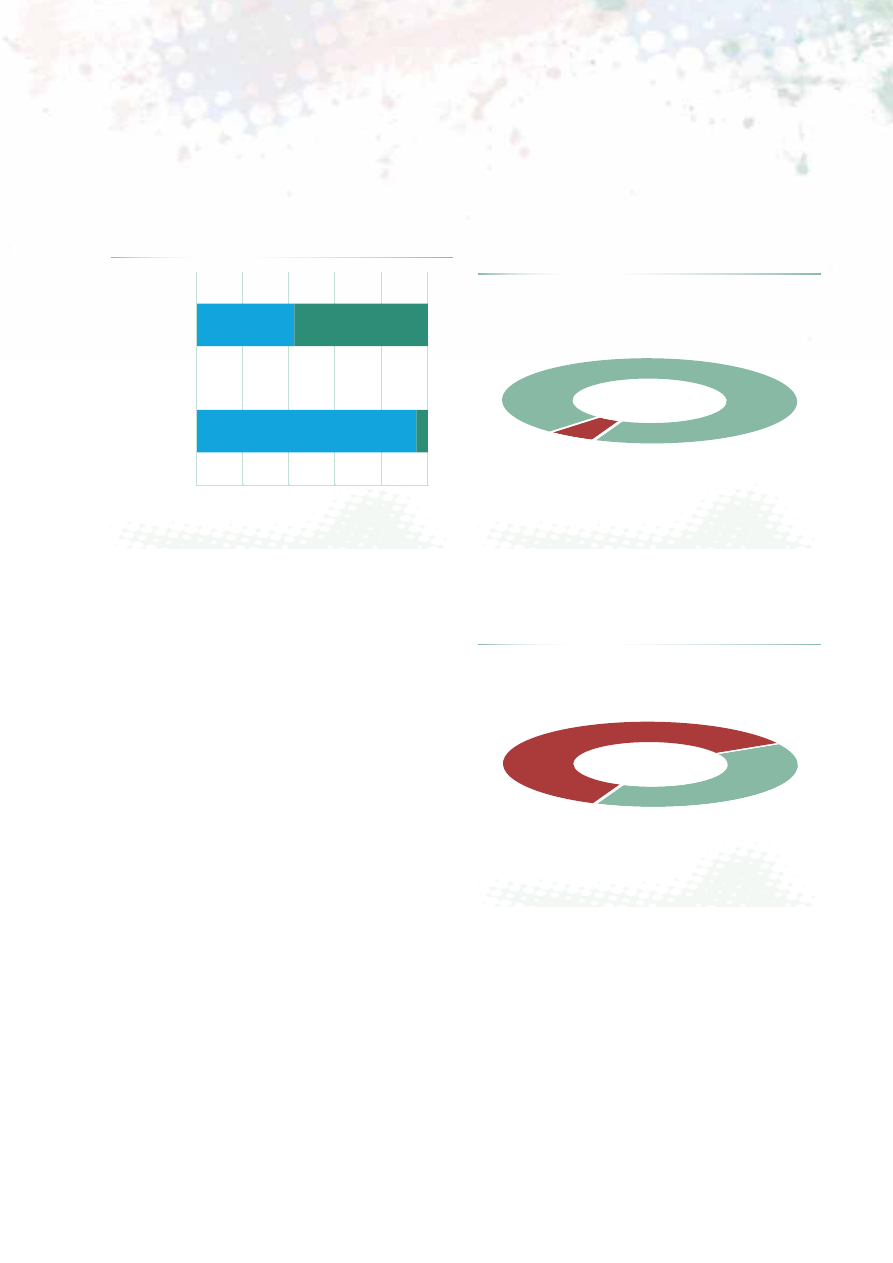
While countries that are more typically origin countries
for cross-border trafficking convict mainly local citizens
(about 95 per cent of all convictions), more typical des-
tination countries convict fewer own citizens than foreign-
ers of trafficking in persons (58 per cent foreigners, 42
per cent locals). Foreign participation is therefore a key
ing is much less frequently detected than domestic or
subregional trafficking. However, it should be noted that
the share of convicted own citizens among the total
number of trafficking offenders is generally much higher
than the share of domestic trafficking detected in a given
country. This could imply that domestic trafficking -
which happens within the borders of one country - is
mainly organized by citizens of that country.
But even so, local citizens are not only engaged in domes-
tic trafficking. Many of those who were convicted in their
own countries during 2010 – 2012 were taking part in
cross-border trafficking, be it subregional or transregional.
Convicted local citizens could be involved in both domes-
tic and cross-border trafficking in some way, for example,
as recruiters, transporters, guards or exploiters.
The court cases submitted to UNODC by Member States
5
include an illustrative case from Latvia, where two Latvian
men were convicted of trafficking Latvian women to a
different country in Western Europe for sexual exploita-
tion. The offenders recruited the victims, deceived them
regarding the working conditions they could expect in
5 For more information on the court cases, please refer to the section
on Methodology.
GLOBAL REPOR
T ON
TRAFFICKING IN PERSONS
2014
26
FIG. 3:
Convictions of foreign citizens
(relative to the convicting country)
by countries of origin and destina-
tion of cross-border trafficking,
2010-2012
Source: UNODC elaboration on national data.
characteristic of cross-border trafficking in persons in des-
tination countries, but not in origin countries.
A qualitative analysis of the cross-border trafficking cases
within the set of court cases shows that, while victims are
normally recruited by local citizens in the victims’ own
country (origin country), the traffickers who carry out the
exploitation in the destination country may be either local
citizens of these destination countries or foreigners. More-
over, as shown in the chart above, 58 per cent of traffickers
in destination countries are not citizens of the country
where they were convicted. Only 5 per cent of all the traf-
fickers convicted in origin countries are foreigners in these
countries. While there is insufficient evidence to draw
authoritative conclusions, on the base of the official data
collected, it can be hypothesized that traffickers in desti-
nation countries are often able to recruit or maneuver local
traffickers in origin countries.
A closer look at only the foreign citizens convicted of traf-
ficking in persons shows that 95 per cent are convicted in
destination countries. For local offenders, on the other
hand, the distribution between origin countries and des-
tinations is relatively equal. In other words, national
offenders convicted of trafficking in persons may be found
in origin and destination countries in similar
proportions.
These findings seem to indicate that while recruitments
in origin countries are largely carried out by citizens of
those countries, the exploitation schemes in destination
countries are likely to involve more transnational
operators.
Many foreign traffickers also seem to frequently traffic
victims from their own country of citizenship. This is
confirmed by a clear statistical correlation between the
citizenships of victims and offenders in selected destina-
tions of cross-border trafficking. Moreover, in the court
cases, many of the case briefs indicated that the citizen-
ships of both trafficker(s) and victim(s) matched. This was
particularly apparent when the offender was prosecuted
in the destination country for the act of recruitment
FIG. 2:
Distribution of national and foreign
offenders among countries of origin
and destination of cross-border traf-
ficking,
2010-2012
Source: UNODC elaboration on national data.
FIG. 4:
Convictions of local citizens (relative
to the convicting country) by coun-
tries of origin and destination of
cross-border trafficking,
2010-2012
Source: UNODC elaboration on national data.
95%
42%
5
%
58%
0%
20%
40%
60%
80%
100%
Countries of
origin
Countries of
destination
NATIONAL OFFENDERS
FOREIGN OFFENDERS
COUNTRIES OF
DESTINATION
95%
COUNTRIES OF
ORIGIN
5%
COUNTRIES OF
ORIGIN
60%
COUNTRIES OF
DESTINATION
40%