ВУЗ: Не указан
Категория: Не указан
Дисциплина: Не указана
Добавлен: 13.10.2020
Просмотров: 1642
Скачиваний: 1
Global overview
I
27
(sometimes also other acts). This indicates that ethno-
linguistic affinities and specific local knowledge may be
very useful for traffickers in recruiting their victims.
Gender profiles of traffickers
An analysis of potential offenders’ first contact with the
criminal justice system – the time of suspicion and/or
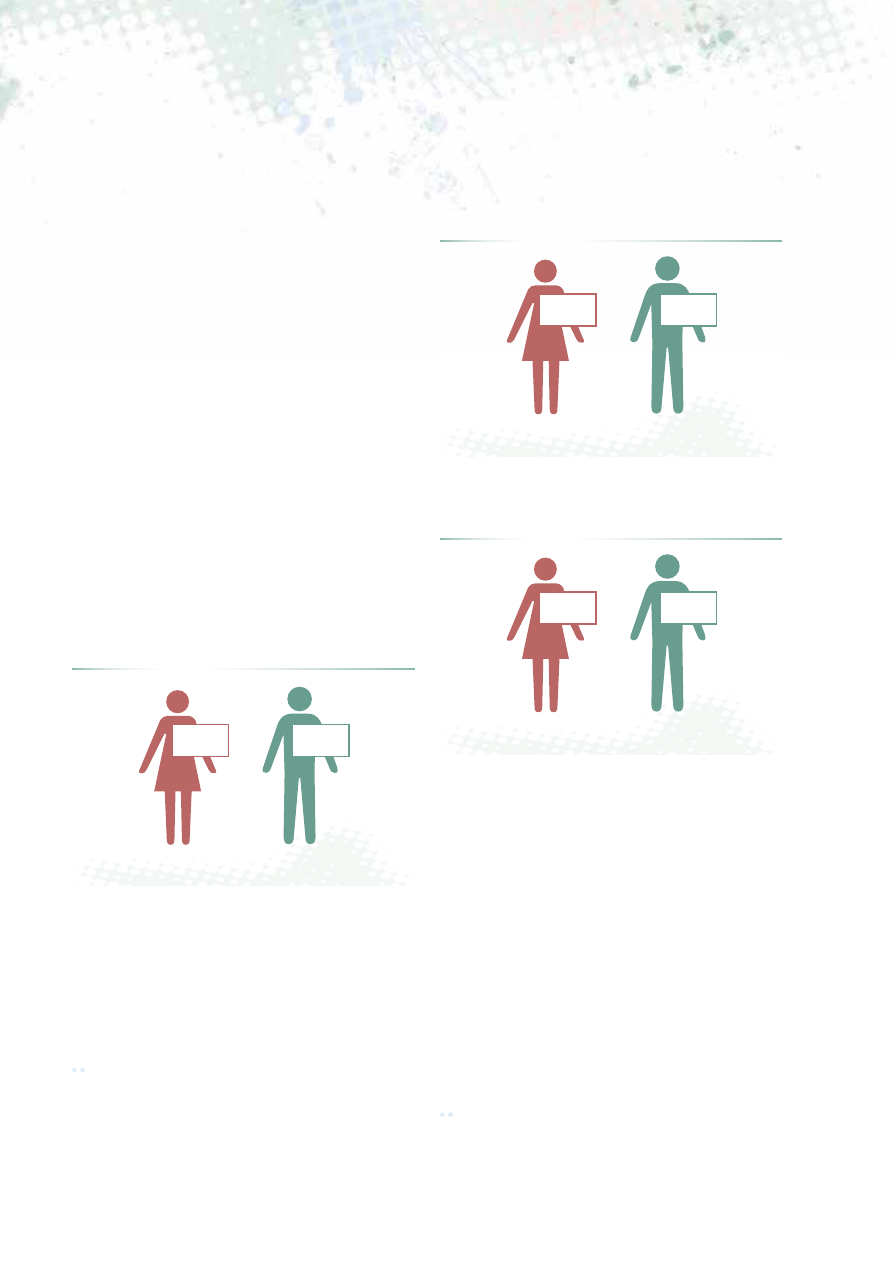
investigation but before prosecution – shows that 38 per
cent of suspected offenders were women during 2010-
2012. This is another anomaly in comparison to other
types of crime. While the majority, some 62 per cent, of
suspected traffickers are male, the female share is large.
These shares are similar, though somewhat smaller, at
other stages of the criminal justice process as well: 32 per
cent of prosecuted and 28 per cent of convicted traffickers
are women. For most other crimes, the share of females
among the total number of convicted persons is in the
range of 10-15 per cent.
6
Relatively high female involve-
ment appears to be another characteristic of the crime of
trafficking in persons.
When looking at the gender and age of offenders and vic-
tims, for the period 2007-2010, countries with high rates
of female offending were generally countries where many
underage female (girl) victims were detected. This could
indicate that female traffickers are more frequently
involved in the trafficking of girls.
7
One possible explanation for the high female involvement
in this crime is that women might play different roles in
6 United Nations Surveys on Crime Trends and the Operations of
Criminal Justice Systems (CTS), available at: http://www.unodc.org/
unodc/en/data-and-analysis/statistics/data.html .
7 UNODC,
Global Report on Trafficking in Persons 2012
(United
Nations publication, Sales No. E.13.V.1).
the trafficking process; roles that may be more visible and
therefore more easily detected by law enforcement. Per-
haps women are more frequently used as recruiters, par-
ticularly in cases of trafficking for sexual exploitation, as
they may be more easily trusted by other females. Women
may also be more likely to be assigned roles as guards,
money collectors and/or receptionists in places where
exploitation takes place. These ‘low-ranking’ activities are
often more exposed to the risks of detection and prosecu-
tion.
8
In addition, the roles of women in the human traf-
ficking process often seem to be those that require frequent
interaction with victims. This can increase the risk of
detection for female offenders since many investigations
of trafficking in persons cases rely heavily on victims’
testimonies.
Another factor may be that a relatively high proportion
8
For more details, see UNODC,
Global Report on Trafficking in Persons
2012
, pp 30-31.
FIG. 5:
Suspected trafficking offenders
coming into first contact with the
criminal justice system,
by gender,
2010-2012 (or more recent)
Source: UNODC elaboration on national data.
38
%
62
%
FIG. 6:
Persons prosecuted for trafficking
in persons,
by gender,
2010-2012
(or more recent)
Source: UNODC elaboration on national data.
32
%
68
%
FIG. 7:
Persons convicted of trafficking
in persons, by gender,
2010-2012
(or more recent)
Source: UNODC elaboration on national data.
28
%
72
%

GLOBAL REPOR
T ON
TRAFFICKING IN PERSONS
2014
28
G
LO
B
AA
L
RE
P
OR
T
ON
TR
AF
FI
CK
IN
G
IN
P
ER
SO
N
28
Intimate and/or close family relationships and trafficking in
persons offending
One of the characteristics of the crime of trafficking
in persons is the large extent of female involvement.
Not only do women and girls comprise the vast
majority of detected victims worldwide, but women
are also prosecuted and convicted of the trafficking
crime far more often than for most other types of
crime. Some 30 per cent of convicted traffickers
worldwide between 2010 and 2012 were women,
whereas the average female conviction rate for other
crimes is usually in the region of 10-15 per cent.
Offending linked to intimate relationships, as well
as close family relationships (parent-child or sib-
lings), may be a factor in explaining why female
offending is higher for trafficking in persons than
for other crimes. In the court cases submitted to
UNODC by Member States (some 115 cases sub-
mitted by nearly 30 different countries), there were
many cases that saw convictions of couples, and
some that involved mother-daughter pairs or sib-
lings. While there were more men than women
among the total number of convicted traffickers,
the proportion of women offenders who were con-
victed alongside an intimate partner or close family
member was larger than for men.
Several of the court cases that involved couples were
transnational and involved trafficking of women for
sexual exploitation. In these cases, the couples often
lived in a destination country, and either one or
both of the spouses were citizens of an origin coun-
try. Victims were usually recruited from the origin
country, by the person with background from that
country, and then transported for exploitation in
the couple’s adopted country. The offenders gener-
ally collaborated in the exploitation; the person who
carried out the recruitment did not limit his/her
participation to that phase of the crime. Such cases
were reported from several destination countries.
For example, in one court case reported by Den-
mark, a couple with background from an East Asian
country was convicted of trafficking four women
from their origin country for sexual exploitation in
Denmark. The female partner travelled to her
origin country to carry out the recruitment; a task
made easier by her prior experience working in the
sex industry in her new country. The case notes
confirm that the partners took equal part in the
offence, and they received the same sentence, which
included a permanent entry ban from their adopted
country.
Similar cases have been registered in many coun-
tries around the world. These cases could be either
domestic or transnational. One of the transnational
court cases, submitted by Belarus, saw the convic-
tion of a couple for trafficking six women from that
country into sexual exploitation in a country in
Western and Central Europe. Both perpetrators
received 5-year prison sentences. One of the offend-
ers was a citizen of Belarus, and the other, of the
country where the exploitation took place. There
were also other accomplices who were charged in
separate cases. The victims were recruited through
deception and subsequently ‘sold’ to owners of
nightclubs in the receiving country.
While there were more cases of sexual exploitation
in the court cases, couples and close family members
also carry out trafficking for forced labour, as in a
case from Mexico that saw the conviction of two
women who were related. Together, they trafficked
eight children from their native country to a neigh-
bouring country for exploitation in forced labour.
The children were made to clean car windshields
and sell flowers, with the traffickers taking away the
profits of their work. Moreover, an Israeli case saw
an elderly couple convicted of trafficking for forced
labour. They exploited their foreign housekeeper by
making her work excessive hours, controlling her
movements and not permitting breaks or holidays.
The two perpetrators both received 4-month prison
sentences. Although women offenders seem to be
more frequently involved in trafficking for sexual
exploitation, they also partake in trafficking for
forced labour. The cases suggest that female offend-
ing is often linked to close personal relationships.
Global overview
I
29
of trafficking cases seems to involve intimate partner and/
or family relations. This was seen in the court cases, where
convictions of intimate partners or two or more people
in close family relationships were reported from several
countries.
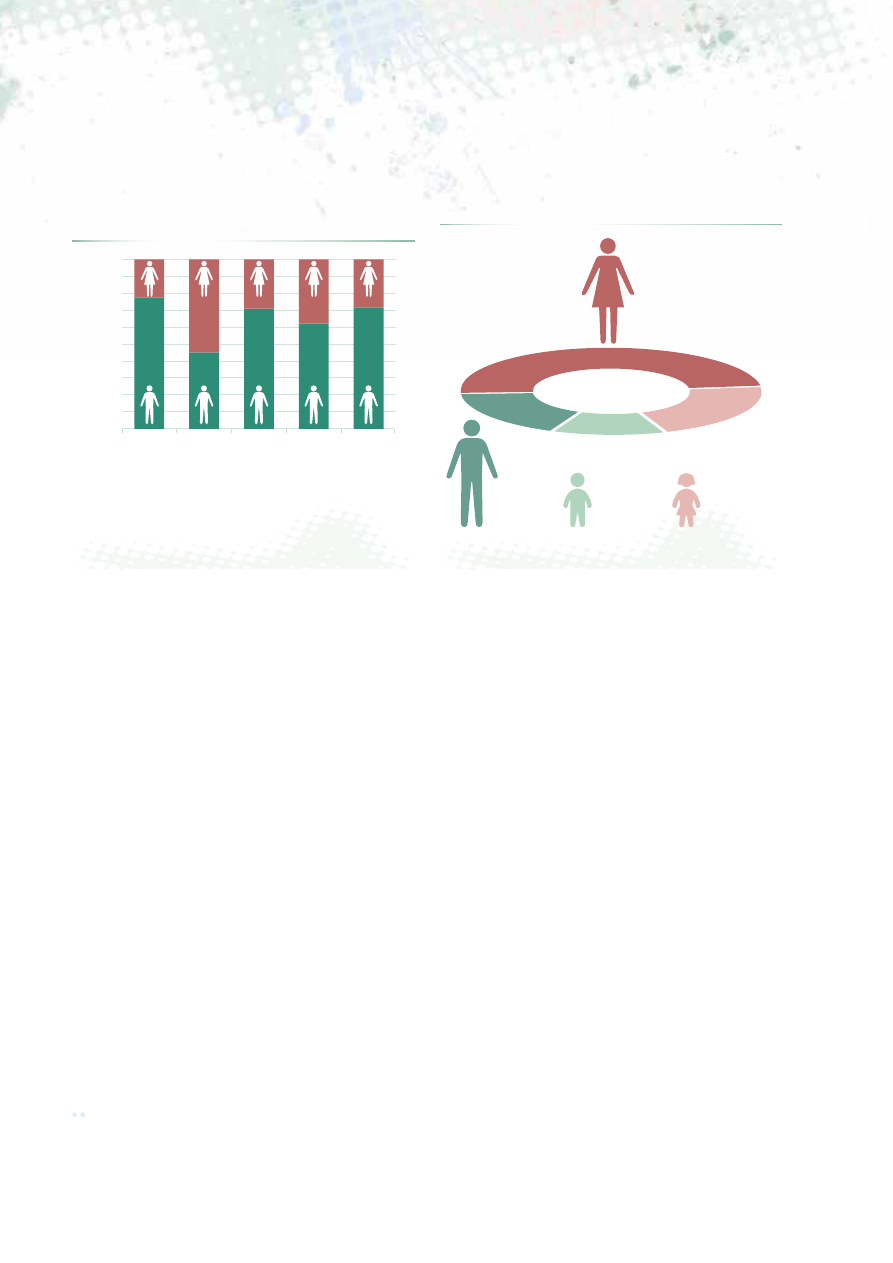
There are some regional differences in terms of the gender
breakdown of persons prosecuted for and convicted of
trafficking in persons. Female offending rates in Eastern
Europe and Central Asia are higher than the global aver-
age. Africa and the Middle East, as well as the subregion
of Western and Central Europe, report relatively low
shares of convicted female offenders.
TRAFFICKING VICTIMS
An analysis of the profiles of detected trafficking victims
over the 2010-2012 period confirms the broad pattern
reported previously by UNODC
9
covering the 2003-2010
period. The vast majority of the victims detected globally
are females; either adult women or underage girls.
The
overall profile of trafficking victims may be slowly chang-
ing, however, as relatively fewer women, but more girls,
men and boys are detected globally.
Information on the age and gender of trafficking victims
was provided by 80 countries. It covers a total of 31,766
9 See
UNODC,
Global Report on Trafficking in Persons 2012
and
UNODC/UN.GIFT,
Global Report on Trafficking in Persons,
2009.
victims detected between 2010 and 2012 whose age and
gender were reported.
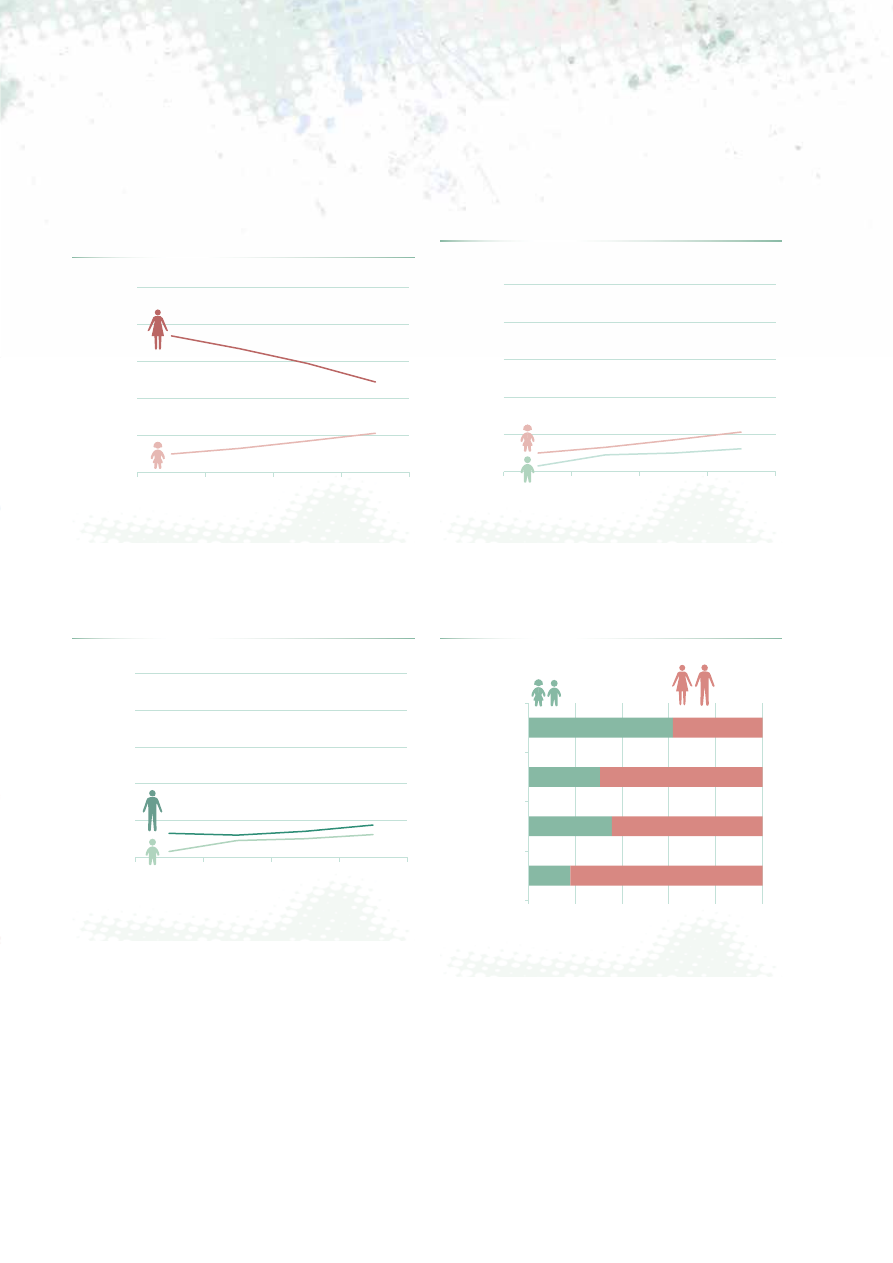
Adult women continue to comprise the largest group of
detected victims, as approximately half of the total number
are women. Although this is a large proportion, it has
decreased markedly, which is in line with the trend
reported in previous editions of this Report. This reduc-
tion in the number of women is partially offset by the
increasing detection of girls, who now comprise around
one fifth of the total number of detected victims world-
wide. As a result, while the proportion of detected female
victims is clearly decreasing, it is not decreasing as steeply
as the trend for adult women.
During the 2010-2012 period, the share of males among
the total number of victims detected globally ranged
between 25 and 30 per cent. This is an increase compared
to the years 2006 and 2009. The trend of underage boy
victims has increased since 2004. While increases can be
seen for both men and boys, it is more pronounced for
men. The key reason seems to be the greater number of
detected cases of trafficking for forced labour in many
countries, as this type of trafficking involves more male
than female victims.
The previously reported trend of an overall lowering of
the average age of detected victims has been confirmed by
the data collected for this Report. Child trafficking, in
which victims are below 18 years of age, accounts for more
FIG. 8:
Persons convicted of trafficking in
persons,
by gender and (sub)region,
2010-2012
Source: UNODC elaboration on national data.
0%
10%
20%
30%
40%
50%
60%
70%
80%
90%
100%
We
st
ern
and
Ce
ntr
a
l Europe
Eas
te
rn
Eur
o
p
e
a
n
d Central Asia
So
uth Asia,
East Asia
and Pacific
Amer
ic
as
Af
ri
ca
a
n
d
Mid
d
le
East
FIG. 9:
Detected victims of trafficking in
persons,
by age and gender,
2011
Source: UNODC elaboration on national data.
WOMEN
49%
MEN
18%
BOYS
12%
GIRLS
21%

GLOBAL REPOR
T ON
TRAFFICKING IN PERSONS
2014
30
0
Towards a global victim
estimate?
The question of the magnitude of the trafficking
problem – that is, how many victims there are – is
hotly debated as there is no methodologically sound
available estimate. In December 2013, UNODC
hosted a meeting with academics and researchers
with experience in uncovering various ‘hidden pop-
ulations’. The objective of the meeting was to
obtain an overview of successful methodologies in
enumerating hidden populations
I
and to discuss
research methods on trafficking in persons, with
particular emphasis on the potential development
of a global victim estimate.
The experts encouraged UNODC to avoid generic
global or regional extrapolations based on weak
methodologies. The data currently available to
UNODC and the complexity of the phenomenon
do not support the development of a reliable global
victim estimate based upon a sound methodology.
In order to start filling the data gaps, which are
particularly acute in developing countries, the
experts concluded that:
1.
UNODC could initiate a series of small field
studies to be conducted at local levels in differ-
ent parts of the world. Such studies may only
be considered as representative of the specific
geographical realities and for the specific forms of
trafficking considered.
2.
Such studies should be based on a multiple steps
approach:
•
Conduct preliminary assessment and lit-
erature review of the forms of trafficking in
persons and exploitation (sexual, labour, beg-
ging, domestic servitude, et cetera) occurring
in the region concerned, and thus focus the
field work on the most relevant.
•
Define strict geographical boundaries.
•
Carefully define tight indicators for
trafficking in persons that are appropriate for
the local realities and the forms of trafficking
under consideration.
•
Design modular questionnaires for different
sub-populations.
•
Identify the best sampling designs for the
population considered and endeavour to use
multiple validating approaches (respondent-
driven sampling, geo-mapping, network
scale-up, capture-recapture).
•
Participate in the field studies.
Once a critical mass of small studies has been com-
pleted, a more comprehensive assessment of the
severity of trafficking in persons may be carried out.
Additionally the experts encouraged UNODC to
try to take advantage of existing data collection
vehicles by making efforts to have relevant traffick-
ing in persons-related questions included. This is
particularly relevant for industrialized countries as
these often carry out various national surveys with
some regularity. There are also some United
Nations-led surveys that could be used similarly.
Generating a methodologically sound estimate of
the global number of trafficking victims is a com-
mendable objective. Achieving it, however, would
require significant resources and a long-term per-
spective.
I
Further information on the research methodologies and
approaches discussed at the expert meeting can be found in
the next edition of the UNODC journal
Forum on Crime
and Society
(forthcoming 2015). The meeting participants
were: Kelle Barrick (RTI – Research Triangle Institute, United
States), Jan van Dijk (Tilburg University, the Netherlands),
Peter van der Heijden (Utrecht University, the Netherlands/
University of Southampton, United Kingdom), John Picarelli
(United States Department of Justice), Michael ‘Trey’ Spiller
(Centers for Disease Control and Prevention, United States),
Thomas M. Steinfatt (Miami University, United States), Ieke
de Vries (National Rapporteur on Trafficking in Human Beings
and Sexual Violence against Children, the Netherlands) and
Sheldon X. Zhang (San Diego State University, United States).
than 30 per cent of the total number of victims detected
during the 2010-2012 period. The proportion of detected
child victims has increased significantly in recent years.
However, increasing shares of children among the detected
victims were not witnessed across all regions or areas.
While Africa and the Middle East, North and Central
America, as well as some countries in South America did
register clear increases during the 2010-2012 period, in
other regions of the world, such as Europe and Central
Asia as well as South Asia, East Asia and the Pacific, child
trafficking remained relatively stable compared to the
2007-2010 period.
The patterns of trafficking in persons continue to show
pronounced regional differences. Children comprise the
Global overview
I
31
majority of victims detected in Africa and the Middle East,
accounting for more than 60 per cent of the victims in
this region. In Europe and Central Asia, trafficking in
persons mainly concerns adult victims, as they comprise
83 per cent of the victims detected there. South Asia, East
Asia and the Pacific and the Americas report similar age
profile breakdowns, with adults comprising about two
thirds of the detected victims, with children making up
the remaining one third.
FIG. 10:
Trends in the shares of females
(women and girls) among the
total number of detected victims,
2004-2011
Source: UNODC elaboration on national data.
FIG. 11:
Trends in the shares of males (men
and boys) among the total number
of detected victims,
2004-2011
Source: UNODC elaboration on national data.
10%
13%
17%
21%
74%
67%
59%
49%
0%
20%
40%
60%
80%
100%
2004
2006
2009
2011
13%
12%
14%
18%
3%
9%
10%
12%
0%
20%
40%
60%
80%
100%
2004
2006
2009
2011
FIG. 12:
Trends in the shares of children (girls
and boys) among the total number
of detected victims,
2004-2011
Source: UNODC elaboration on national data.
10%
13%
17%
21%
3%
9%
10%
12%
0%
20%
40%
60%
80%
100%
2004
2006
2009
2011
FIG. 13:
Shares of children and adults among
the detected victims of trafficking in
persons,
by region,
2010-2012
Source: UNODC elaboration on national data.
18%
36%
31%
62%
82%
64%
69%
38%
0%
20%
40%
60%
80%
100%
Europe and
Central Asia
South Asia,
East Asia and
the Pacific
Americas
Africa and
Middle East
ADULTS
CHILDREN